
Artec Leo Handheld Color 3D Scanner
| Brand | Artec |
|---|---|
| Origin | Imported (Non-China) |
| Manufacturer Type | Authorized Distributor |
| Model | LEO |
| 3D Resolution | 0.25 mm |
| 3D Point Accuracy | ≤ 0.1 mm |
| Accuracy Drift | ≤ 0.03% per 100 cm |
| Light Source | Dual-source — White-light LED array (12 LEDs) + VCSEL-based structured light |
| Near-range FOV | 246 × 153 mm |
| Far-range FOV | 843 × 527 mm |
| Working Distance | 0.35–1.2 m |
| Texture Capture | Yes |
| Video Frame Rate | Up to 80 FPS |
| Data Acquisition Time | 0.0002 s per frame |
| Capture Speed | Up to 4 million points/sec |
| Weight | 1.8 kg |
| Power | Integrated swappable battery or external 12 V DC supply |
| Dimensions (H×D×W) | 227 × 163 × 228 mm |
| Connectivity | Wi-Fi, Gigabit Ethernet, SD card slot |
| Onboard Processing | Yes — real-time reconstruction, no external PC required |
| Calibration | Self-calibrating |
| System Requirements | None — fully autonomous operation |
Overview
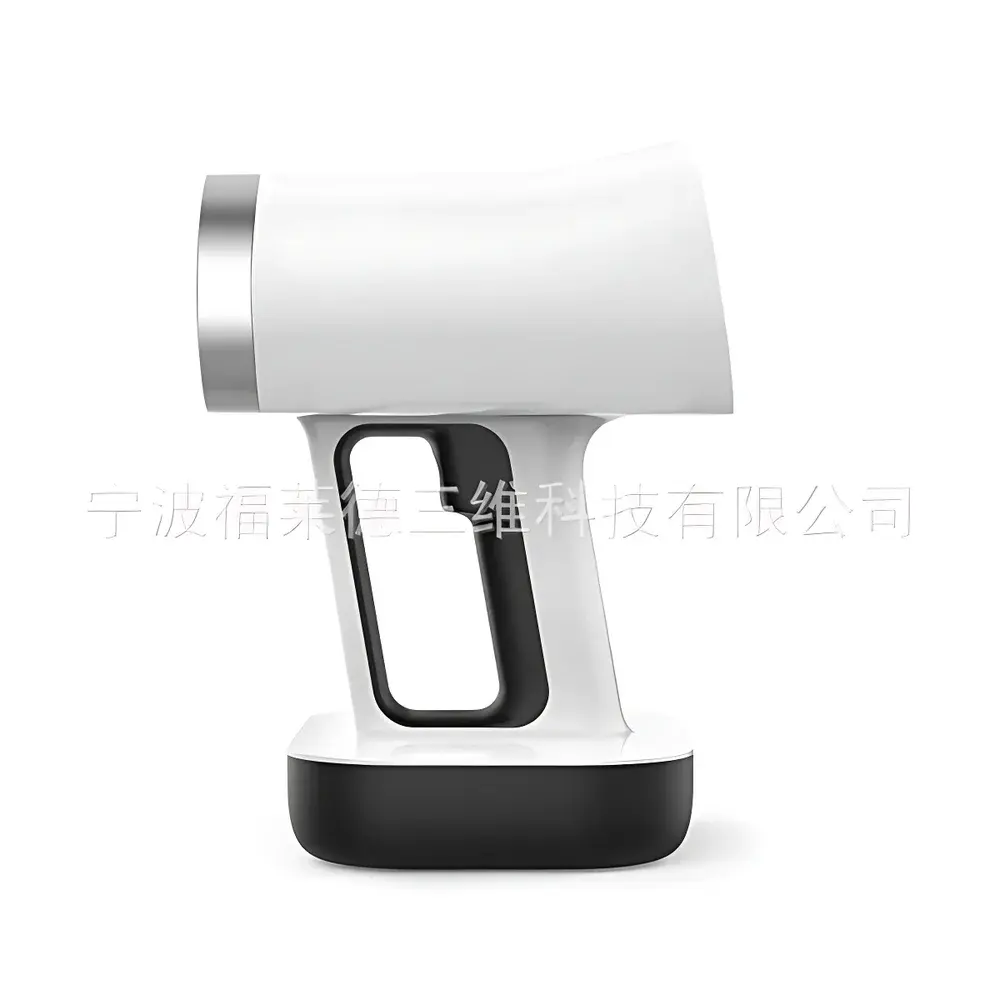
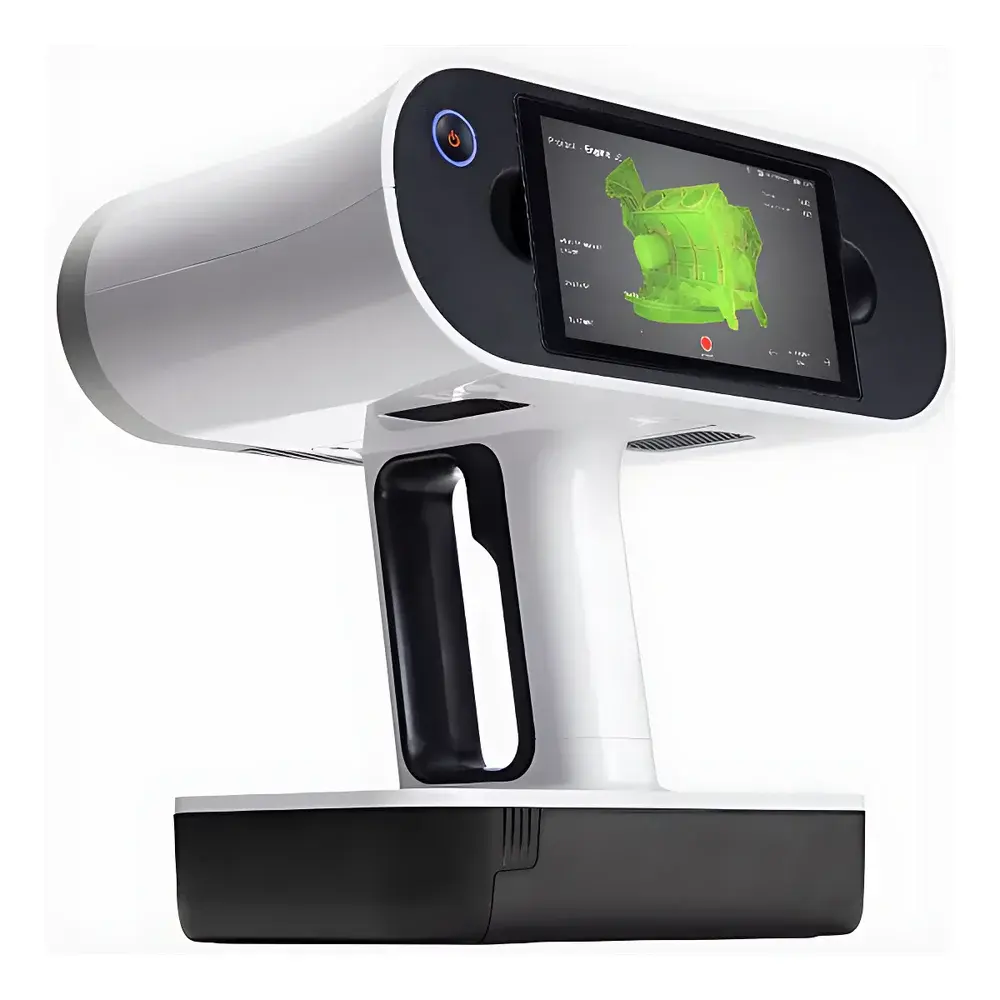
The Artec Leo is a professional-grade, handheld color 3D scanner engineered for high-fidelity, real-time surface digitization in industrial metrology, reverse engineering, heritage documentation, and medical modeling applications. Unlike traditional contact or tripod-mounted optical scanners, the Leo employs a dual-light-source architecture—combining high-luminance white-light LED projection with a precision VCSEL (Vertical-Cavity Surface-Emitting Laser) pattern generator—to deliver robust, geometry- and texture-synchronized capture under variable ambient lighting conditions. Its onboard NVIDIA Jetson TX2 processor enables full 3D reconstruction—including alignment, fusion, hole-filling, and texturing—directly on-device, eliminating dependency on external computing hardware. The integrated 5.5-inch HD touchscreen provides immediate visual feedback: users observe live mesh generation, rotate the evolving model in real time, and identify occluded or undersampled regions during acquisition—effectively transforming complex 3D scanning into an intuitive, photogrammetric-like workflow.
Key Features
- Fully Autonomous Operation: No laptop, driver installation, or external power source required—scan, process, and export directly from the device.
- Real-Time Onboard Reconstruction: GPU-accelerated algorithms perform iterative closest point (ICP) alignment, multi-view fusion, and adaptive mesh simplification without latency.
- Dual-Spectrum Illumination System: White-light LEDs ensure accurate color texture mapping; VCSEL-based structured light guarantees sub-millimeter geometric fidelity across reflective, dark, or low-contrast surfaces.
- Ergonomic Industrial Design: Balanced weight distribution (1.8 kg), thermal management optimized for extended field use, and IP52-rated enclosure for dust and splash resistance.
- Multi-Protocol Connectivity: Simultaneous Wi-Fi (802.11ac), Gigabit Ethernet, and high-speed SD UHS-I support for local storage, remote monitoring, and networked fleet deployment.
- Self-Calibrating Architecture: Automatic recalibration upon startup and temperature stabilization—no user intervention or third-party calibration artifacts required.
Sample Compatibility & Compliance
The Artec Leo accommodates a broad spectrum of physical specimens—from small mechanical components (≥50 mm) to full-body human scans—within its 0.35–1.2 m working envelope. It delivers consistent performance on non-reflective organic materials (skin, clay, textiles), moderately reflective metals (anodized aluminum, brushed stainless), and matte plastics. For highly specular or transparent objects, optional matte spray application remains compatible with ISO 10360-8 and ASTM E2924-18 guidelines for optical coordinate measuring system validation. While the device itself does not carry CE/UKCA marking as a standalone measurement instrument, its output data meets traceability requirements when used within validated workflows compliant with ISO/IEC 17025, ASME B89.4.22, and NIST SP 500-256 frameworks. All firmware updates are digitally signed and version-locked to ensure audit trail integrity per GLP/GMP documentation standards.
Software & Data Management
Scanned data is stored natively in Artec’s binary .E57-compatible format on removable SD cards, preserving raw point cloud metadata (timestamp, pose estimate, confidence map, illumination settings). The optional Artec Studio 19+ desktop software—deployable on Windows 10/11 x64 systems—provides advanced post-processing capabilities including automated CAD-to-scan deviation analysis, GD&T-compliant reporting (per ISO 1101), and direct export to STEP, IGES, STL, OBJ, and PLY formats. Software licensing supports concurrent network deployment with centralized license server management and role-based access control. All processing logs, parameter histories, and user annotations are embedded in project files, satisfying FDA 21 CFR Part 11 requirements for electronic records and signatures when configured with audit-trail-enabling policies.
Applications
- Reverse engineering of legacy parts where CAD data is unavailable or outdated
- Quality assurance of molded plastic components against nominal geometry
- Forensic documentation of crime scenes and evidence items with photorealistic texture fidelity
- Digital preservation of cultural artifacts and museum collections
- Custom orthotic and prosthetic device design with anatomical accuracy
- Pre- and post-surgical patient monitoring in maxillofacial and reconstructive disciplines
- Automotive interior prototyping and ergonomic assessment
FAQ
Does the Artec Leo require a computer to operate?
No—the scanner performs all data acquisition, registration, meshing, and texturing onboard. A computer is only needed for advanced post-processing or archival export using Artec Studio.
Can it scan shiny or black surfaces without preprocessing?
It achieves reliable capture on many low-gloss metallic and dark surfaces using adaptive exposure control and VCSEL modulation. Highly reflective or transparent objects may require standard matte coating per ISO 10360-8 Annex C recommendations.
What is the maximum recommended scan volume for metrological repeatability?
For sub-0.1 mm point accuracy, optimal results are achieved within a 1 m³ volume at working distances between 0.5–1.0 m. Larger volumes require overlapping passes and global registration via reference targets.
Is firmware update logging auditable for regulated environments?
Yes—each firmware revision includes SHA-256 checksums, timestamped installation logs, and rollback capability, supporting compliance with FDA 21 CFR Part 11 and EU Annex 11 validation protocols.




