
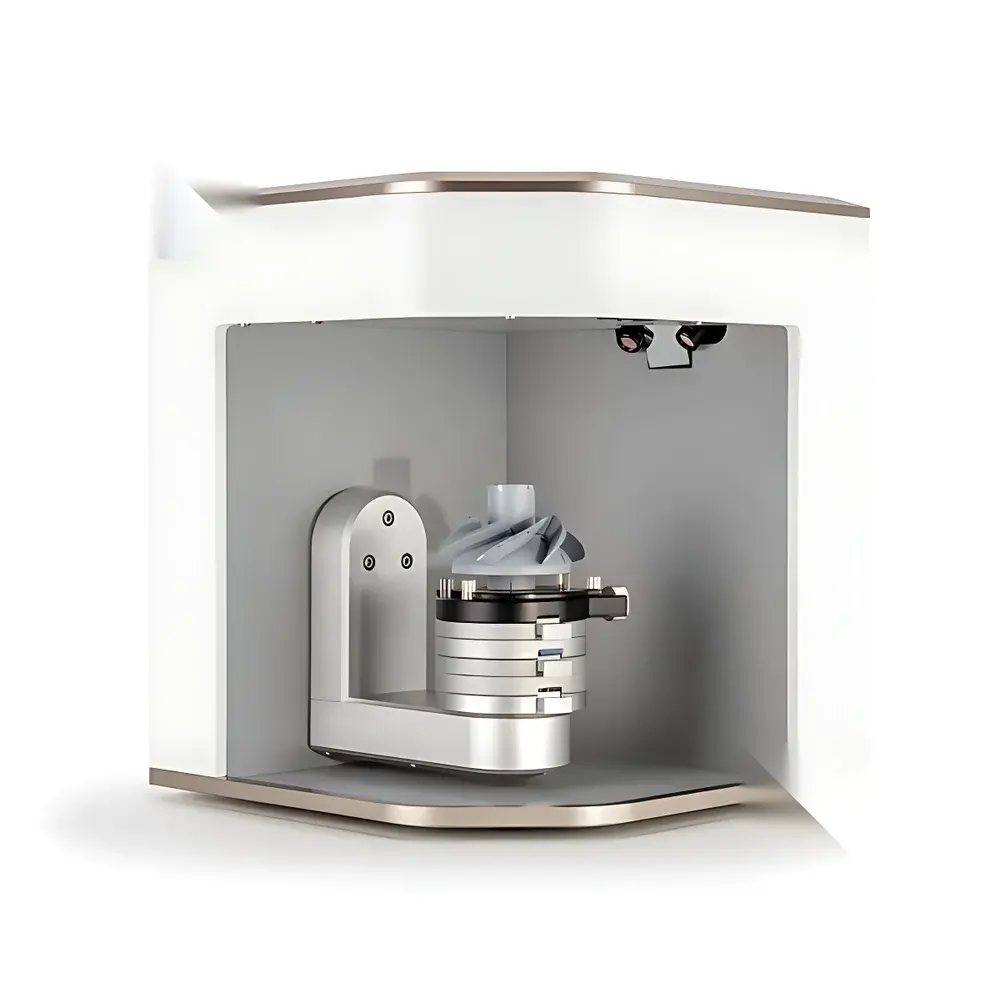
Artec Micro Blue-Light Desktop 3D Scanner
| Brand | Artec |
|---|---|
| Origin | Imported |
| Manufacturer Type | Authorized Distributor |
| Pricing | Upon Request |
| Point Accuracy | Up to 10 µm |
| Automation Level | Fully Automatic Desktop Operation |
| Target Object Size | Small Industrial Components (Typical Scan Volume: Ø70 × 65 mm) |
| Light Source | Structured Blue LED Light |
| Primary Applications | Metrology-grade QC, Reverse Engineering, Dental CAD/CAM, Jewelry Digitization |
Overview
The Artec Micro is a fully automated, metrology-grade blue-light desktop 3D scanner engineered for high-precision digitization of small-scale industrial components. Utilizing structured blue LED light projection and dual high-resolution CMOS sensors, the system captures surface geometry via triangulation-based photogrammetric reconstruction—delivering sub-10 µm point accuracy without external tracking or manual alignment. Unlike laser-based or white-light systems, blue-light illumination offers superior signal-to-noise ratio on reflective, dark, or translucent surfaces common in dental prostheses, precision-machined gears, watch components, and fine jewelry. The scanner operates within a fixed, temperature-stable optical enclosure, minimizing thermal drift and ensuring repeatability compliant with ISO 10360-2 and VDI/VDE 2634 Part 2 standards for coordinate measuring instruments.
Key Features
- Fully automated scanning sequence: Load specimen, close lid, press one button—no user intervention required during acquisition or alignment.
- Metrology-grade accuracy: Certified point accuracy up to 10 µm, with volumetric deviation < 15 µm across full scan volume (Ø70 × 65 mm).
- Blue-light structured illumination: Optimized wavelength (450–495 nm) enhances contrast on challenging materials—including polished metals, ceramic restorations, and resin-printed dental models—without speckle noise or saturation.
- Integrated turntable with 0.001° angular resolution: Enables full 360° + top-bottom coverage with automatic multi-position registration.
- Self-calibrating optical path: Onboard reference targets and real-time sensor diagnostics maintain traceability between calibration cycles.
- Robust mechanical architecture: Aluminum alloy frame with passive vibration damping, rated for continuous operation in Class 10,000 cleanroom environments.
Sample Compatibility & Compliance
The Artec Micro accommodates specimens ranging from 10 mm to 70 mm in diameter and up to 65 mm in height—including turbine blades, orthodontic brackets, ring settings, microfluidic chips, and Class I/II medical devices. Surface finish requirements align with ASTM E2924-22 (Standard Guide for Digital Imaging in Metrology), supporting both matte-sprayed and bare-finish inspection. Data outputs comply with ASME Y14.41-2019 for digital product definition and are compatible with GD&T evaluation workflows in PolyWorks Inspector and Geomagic Control X. The system meets CE marking requirements under EU Machinery Directive 2006/42/EC and EMC Directive 2014/30/EU. For regulated environments, audit trails, electronic signatures, and raw data retention protocols support FDA 21 CFR Part 11 and ISO 13485:2016 quality management system validation.
Software & Data Management
Acquisition and processing are managed through Artec Studio 19, a modular software platform validated for GxP environments. The software provides automated mesh generation, outlier rejection, curvature-based smoothing, and NURBS surface fitting for CAD-ready output. Raw scan data (including per-pixel intensity, confidence maps, and sensor metadata) is stored in vendor-neutral HDF5 format, enabling long-term archival and third-party algorithm integration. Version-controlled project files include full parameter logs, calibration timestamps, and operator IDs—satisfying GLP/GMP documentation requirements. API access (C++/Python SDK) supports integration into automated QA pipelines and MES/ERP systems via RESTful webhooks.
Applications
- Quality control & first-article inspection of micro-machined parts, including thread profiles, gear tooth geometry, and bearing raceways.
- Reverse engineering of legacy components lacking CAD documentation—generating watertight STEP or IGES files for CNC re-manufacturing.
- Dental laboratory digitization: Full-arch scans of stone models, implant analogs, and wax-ups; direct export to exocad, 3Shape, and DentalCAD platforms.
- Jewelry prototyping: High-fidelity capture of filigree, gemstone settings, and engraving details for rapid iteration and casting pattern generation.
- Research & development: Surface deformation analysis under thermal or mechanical load (when paired with time-lapse scanning protocols).
FAQ
What is the maximum object weight the Artec Micro turntable supports?
The integrated precision turntable supports loads up to 500 g with maintained angular accuracy.
Does the system require periodic recalibration by a certified technician?
Yes—recommended annually or after 500 operational hours, using Artec-certified calibration kits traceable to NIST standards.
Can scan data be exported in formats compatible with GD&T evaluation software?
Yes—exports include .STL (with color/texture), .OBJ, .PLY, .STEP AP242, and .IGES, all retaining dimensional integrity for downstream metrology analysis.
Is the Artec Micro suitable for scanning human teeth intraorally?
No—it is a benchtop device designed for ex vivo scanning of impressions, models, or prostheses; not intended for clinical intraoral use.
How does blue-light illumination improve measurement stability compared to white-light systems?
Blue-light’s shorter wavelength reduces diffraction effects on fine surface features and provides higher chromatic contrast against common industrial materials—resulting in lower standard deviation in repeated measurements (typical repeatability: ±2 µm at 95% confidence).





