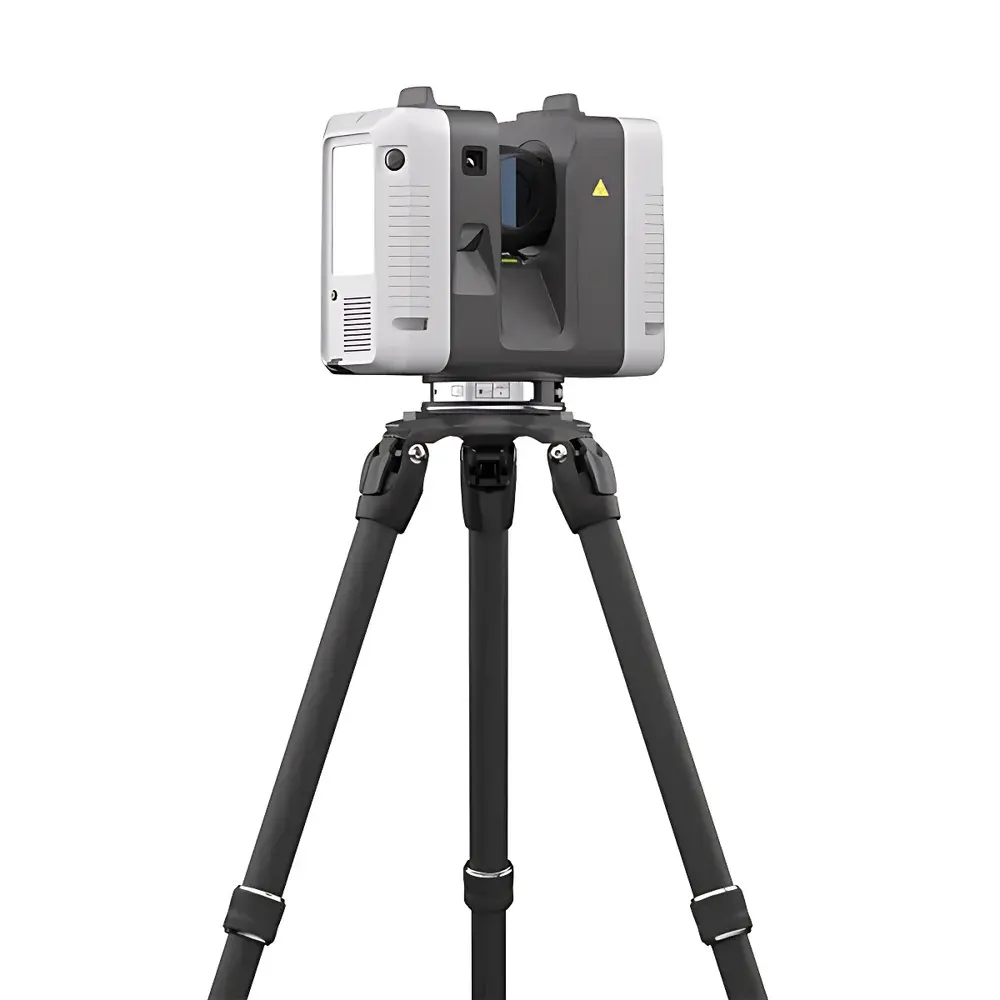
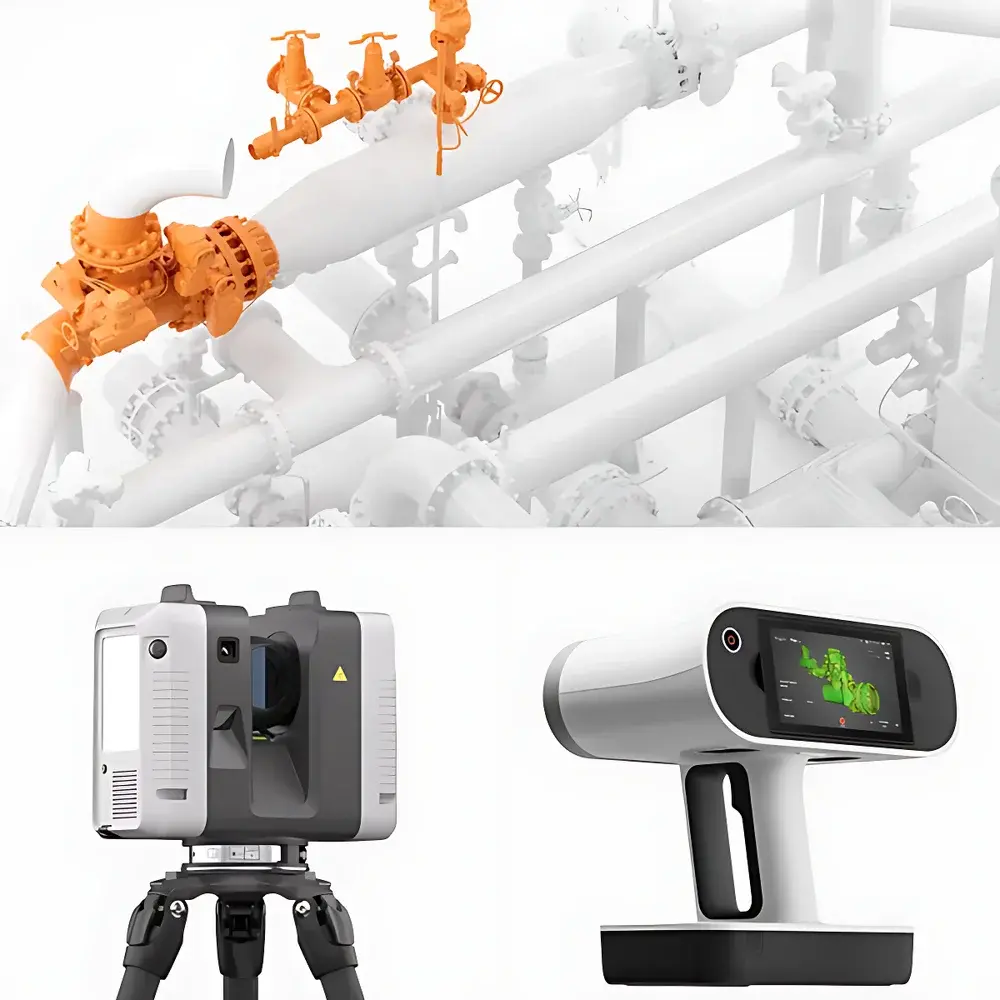
Artec Ray II Long-Range Wireless Laser 3D Scanner
| Brand | Artec |
|---|---|
| Origin | Imported |
| Manufacturer Type | Authorized Distributor |
| Instrument Category | Laser-Based 3D Scanner |
| Measurement Speed | 2,000,000 points/sec |
| Point Accuracy | 1.9 mm @ 10 m, 2.9 mm @ 20 m, 5.3 mm @ 40 m |
| Angular Accuracy | 0.87 mm @ 10 m (18 arcsec) |
| Distance Accuracy | 1.0 mm + 10 ppm |
| Range Noise | 0.4 mm @ 10 m – 0.5 mm @ 20 m |
| Maximum Scan Range | 130 m |
| Field of View | 360° horizontal × 300° vertical |
| Texture Resolution | 36 MP triple-camera HDR system |
| Operating System | Windows 10 / 11 |
| Weight | 5.35 kg |
Overview
The Artec Ray II is a professional-grade, long-range wireless laser 3D scanner engineered for high-fidelity geometric capture of large-scale objects and environments. Utilizing time-of-flight (ToF) laser triangulation with dual-axis motorized scanning, the Ray II delivers metrology-grade point cloud data across distances up to 130 meters. Its core architecture integrates a stabilized inertial measurement unit (IMU), real-time onboard processing, and synchronized multi-spectral texture acquisition—enabling simultaneous geometric and photorealistic surface reconstruction without external GNSS or registration hardware. Designed for field-deployable precision, the Ray II meets the rigorous demands of industrial metrology, forensic documentation, heritage conservation, and infrastructure monitoring where portability, repeatability, and traceable accuracy are non-negotiable.
Key Features
- Wireless operation with integrated battery and onboard storage—no tethering to laptops or external power during acquisition.
- 2 million points per second capture rate, enabling rapid coverage of complex as-built structures such as aircraft fuselages, wind turbine blades, or bridge superstructures in under two hours.
- 36-megapixel triple-camera HDR imaging system co-registered with laser data, resolving sub-millimeter surface irregularities and delivering photogrammetric-grade texture fidelity.
- 360° × 300° field of view allows single-station capture of full-volume scenes—from small machinery to multi-story buildings—minimizing repositioning and registration error accumulation.
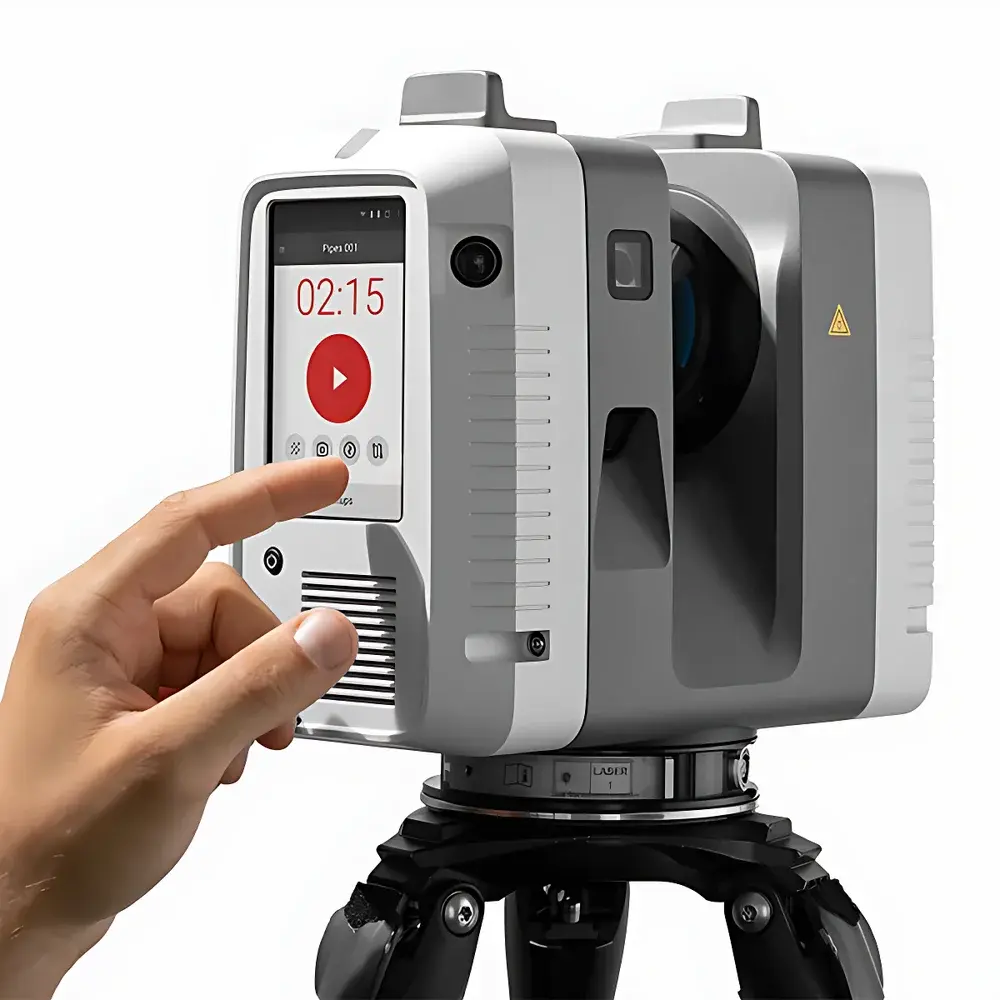
- Onboard control interface with touchscreen display and intuitive workflow navigation; supports real-time preview, scan quality assessment, and immediate post-processing initiation.
- Robust aluminum-magnesium alloy chassis rated IP54 for dust and water resistance, optimized for outdoor deployment across temperature ranges from −10 °C to +40 °C.
Sample Compatibility & Compliance
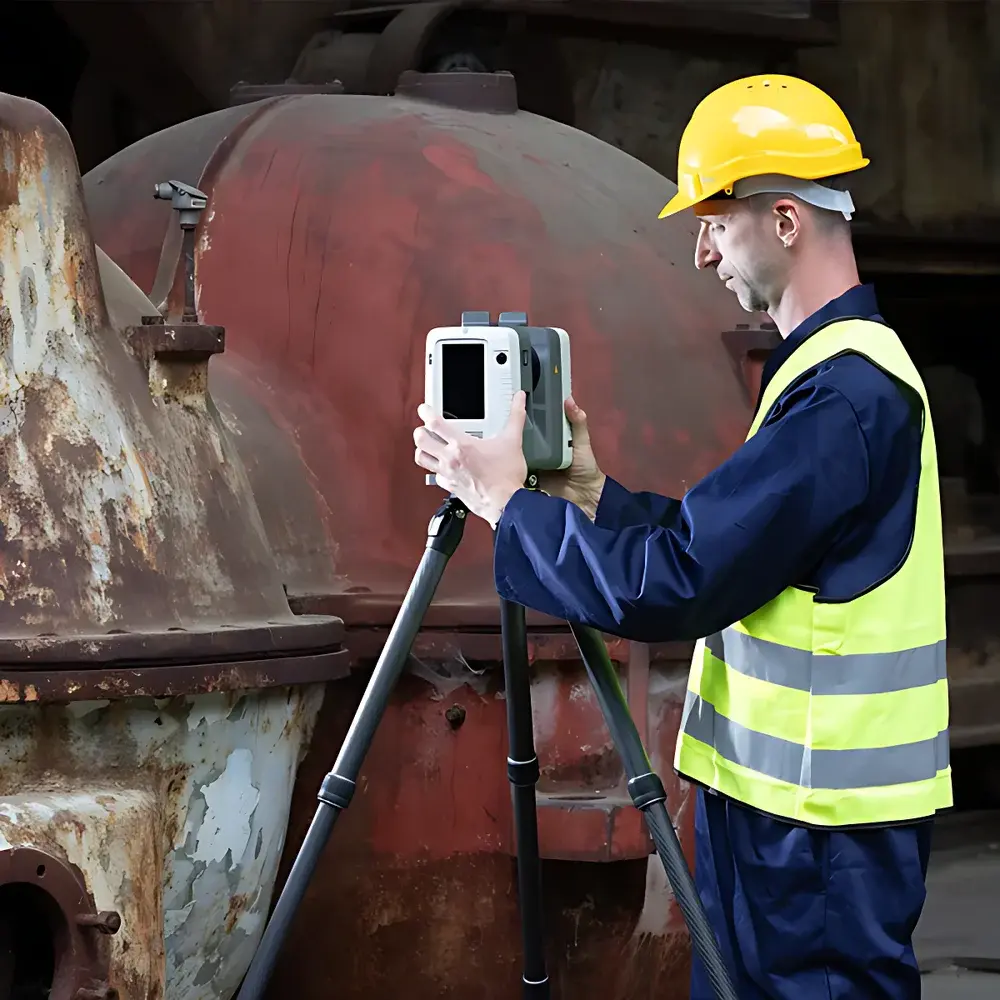
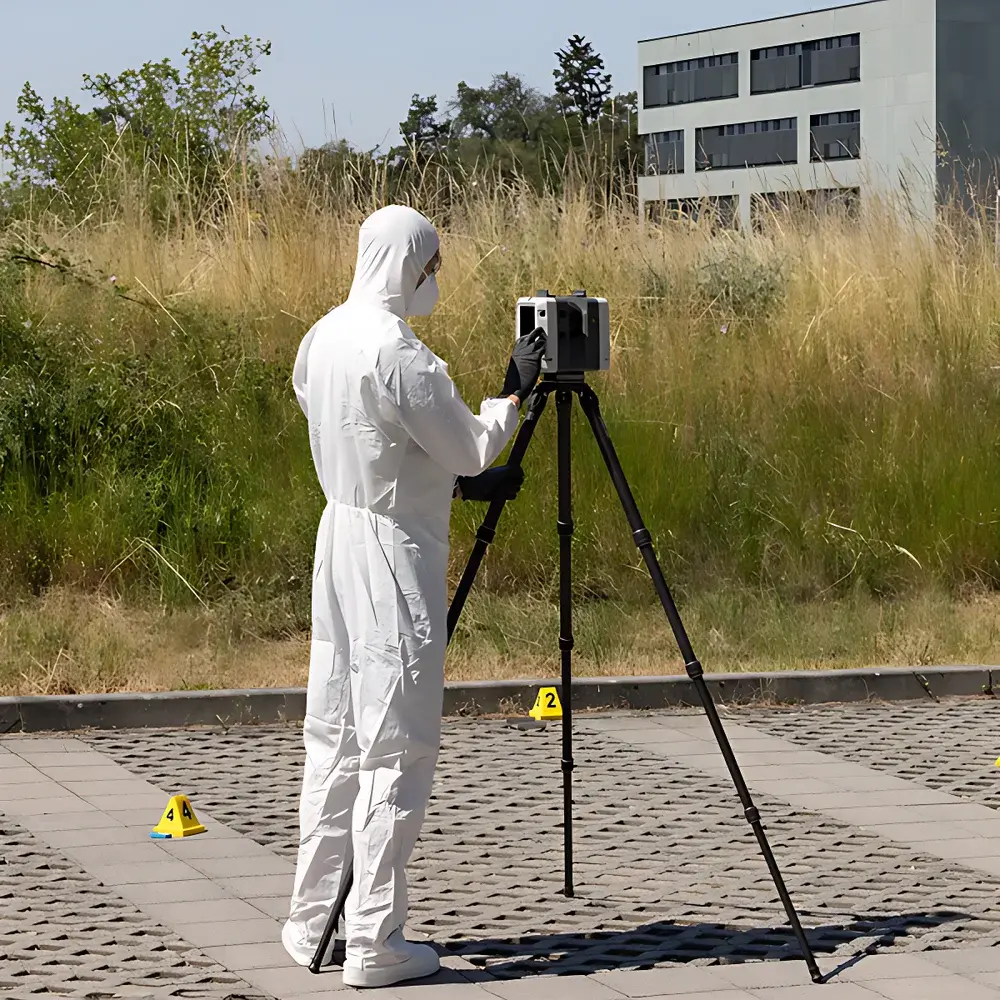
The Ray II is compatible with reflective, matte, and moderately absorptive surfaces typical of industrial materials—including painted metal, concrete, composite laminates, weathered stone, and polymer-based forensic evidence markers. It requires no target placement or spray application for most applications, though retroreflective targets may be used to enhance registration stability in low-texture environments (e.g., bare steel tanks or unmarked asphalt). The system complies with IEC 60825-1:2014 Class 1 laser safety standards and adheres to ISO 17025-aligned calibration traceability protocols when operated with certified reference artifacts. Data workflows support audit-ready documentation per ISO/IEC 17025, ASTM E2924-22 (Standard Guide for Digital Documentation of Crime Scenes), and EN 16931-1:2018 (Digital Twin Interoperability Framework).
Software & Data Management
All raw and processed data are managed through Artec Studio 19+, a dedicated metrology software platform supporting NIST-traceable calibration validation, automatic outlier filtering, and multi-scan alignment via iterative closest point (ICP) and feature-based registration. The software provides native export to industry-standard formats including .e57, .obj, .stl, .ply, and .xyz, with direct integration into SOLIDWORKS, Autodesk Fusion 360, and Geomagic Control X for GD&T analysis and first-article inspection reporting. All processing steps—including noise reduction, mesh simplification, and texture mapping—are fully logged with timestamped metadata, satisfying FDA 21 CFR Part 11 requirements for electronic records and signatures when deployed in regulated manufacturing or forensic labs.
Applications
- Aerospace: As-built verification of winglets, landing gear assemblies, and composite airframe sections; structural deformation analysis pre- and post-flight testing.
- Automotive: Rapid digitization of Class-A surfaces for gap-and-flush evaluation, crash test deformation quantification, and tooling wear monitoring.
- Digital Twin Infrastructure: High-frequency scanning of bridges, tunnels, and dams for change detection, settlement analysis, and predictive maintenance modeling.
- Forensic Documentation: Metrically accurate scene reconstruction with spatial context preservation for courtroom-admissible evidence packages.
- Cultural Heritage: Non-contact recording of archaeological excavation strata, monumental facades, and fragile organic artifacts with millimeter-level stratigraphic fidelity.
- Power Generation: Blade erosion assessment on hydroelectric turbines, thermal distortion mapping of boiler casings, and alignment verification of generator stator housings.
FAQ
What is the maximum effective range for metrologically reliable data acquisition?
At 130 m, the Ray II maintains usable point density and angular resolution for qualitative surveying; however, for dimensional metrology requiring ≤2 mm point uncertainty, optimal working distance is ≤40 m per ISO 10360-8 guidelines.
Can the Ray II be used indoors without GNSS or external positioning aids?
Yes—the onboard IMU, encoder-based motion tracking, and self-referenced scanning geometry eliminate dependency on external localization systems, making it suitable for hangars, shipyards, and underground facilities.
Does the system support automated calibration verification between scans?
Artec Studio includes built-in calibration validation tools that compare current scan geometry against certified reference spheres or planar artifacts, generating compliance reports aligned with ISO/IEC 17025 Clause 6.5.2.
Is raw laser data accessible for third-party algorithm development?
Yes—binary .ray files contain unprocessed ToF timestamps, intensity values, and IMU telemetry, accessible via Artec’s documented SDK for custom pipeline integration.
How does the Ray II handle highly reflective or dark surfaces?
The adaptive laser power modulation and multi-exposure HDR texture fusion mitigate saturation and low-signal conditions; for extreme cases (e.g., polished chrome or black anodized aluminum), optional diffuse coating or cross-polarized lighting may be applied per ASTM E3022-18 recommendations.