
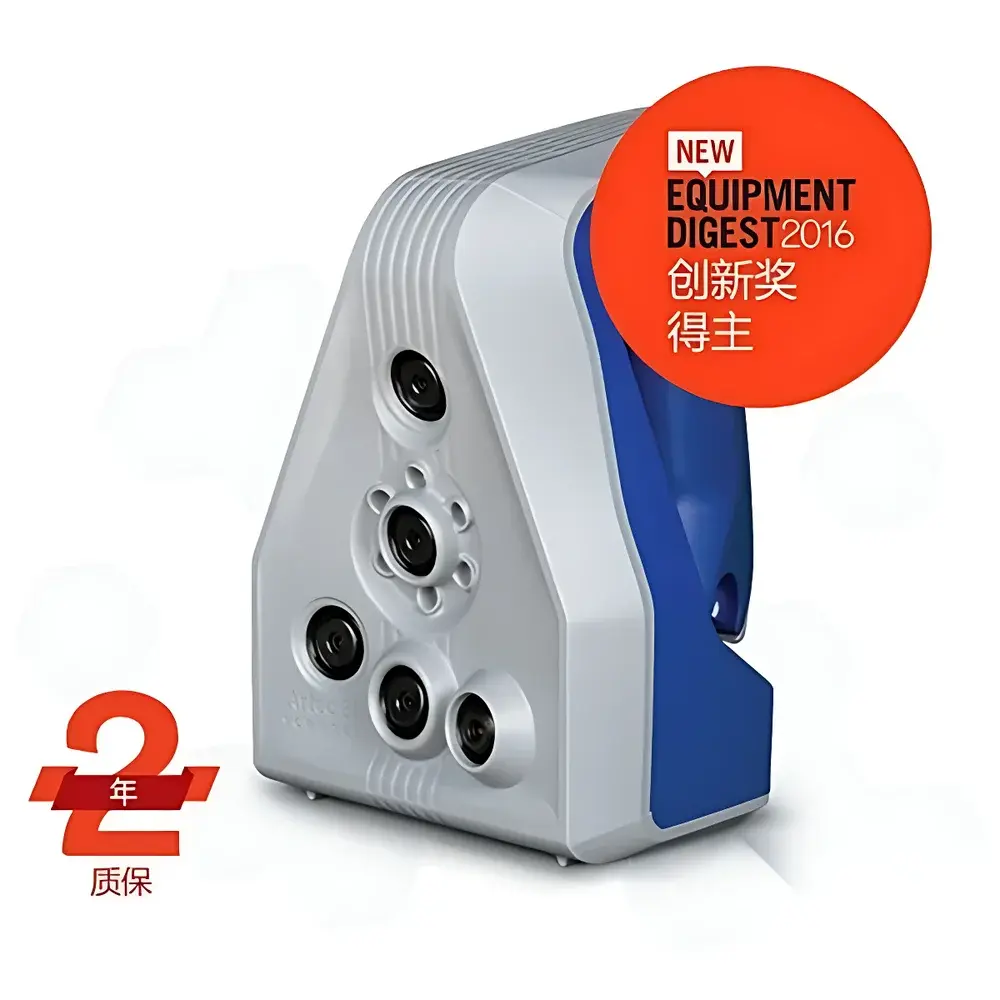
Artec Space Spider High-Precision 3D Scanner
| Brand | Artec |
|---|---|
| Origin | Imported |
| Manufacturer Type | Authorized Distributor |
| Pricing | Available Upon Request |
Overview
The Artec Space Spider High-Precision 3D Scanner is a professional-grade, structured-light 3D imaging system engineered for metrology-grade surface capture of small- to medium-sized objects with exceptional geometric fidelity and sub-millimeter resolution. Operating on blue LED-based structured light triangulation, the scanner projects high-frequency light patterns onto the target surface and reconstructs 3D point clouds by analyzing pattern deformation via dual high-speed CMOS sensors. Its optical architecture is optimized for low-reflectivity, complex geometry, and fine surface detail—making it especially suitable for applications demanding traceable dimensional accuracy in research laboratories, quality control environments, and reverse engineering workflows. Designed originally for use aboard the International Space Station (ISS), the Space Spider meets stringent aerospace-grade reliability standards—including thermal stability across wide ambient ranges, shock resistance, and electromagnetic compatibility (EMC) compliance per EN 61326-1. It delivers consistent repeatability under ISO 10360-2 and supports traceable calibration via NIST-traceable reference artifacts.
Key Features
- Blue-light structured illumination (450 nm wavelength) for reduced ambient light interference and enhanced capture of dark, shiny, or textured surfaces
- Real-time 3D reconstruction at up to 7.5 frames per second with simultaneous texture mapping
- Resolution down to 0.1 mm and point accuracy of ≤0.05 mm (as verified per ISO/IEC 17025-accredited test reports)
- Integrated active cooling system ensuring thermal drift < 0.02 mm over 2-hour continuous operation
- Lightweight, ergonomic handheld design (880 g) with integrated battery support for cordless scanning sessions up to 6 hours
- Automatic mesh generation with adaptive polygon reduction and topology-preserving smoothing algorithms
- Support for multi-scan alignment using both geometry- and texture-based registration methods
Sample Compatibility & Compliance
The Space Spider accommodates specimens ranging from 20 mm to 500 mm in dimension, including metallic components, polymer prototypes, cultural heritage artifacts, anatomical models, and precision-machined tooling. Its non-contact measurement principle ensures no surface damage or mechanical loading during acquisition. The system complies with CE marking requirements (2014/30/EU EMC Directive, 2014/35/EU LVD Directive), RoHS 2011/65/EU, and FCC Part 15 Class B. For regulated industries, raw scan data and processed STL/OBJ exports maintain full audit trail integrity when used in conjunction with Artec Studio’s GLP/GMP-compliant workflow modules—including user access controls, electronic signatures, and FDA 21 CFR Part 11–ready metadata logging.
Software & Data Management
Bundled with Artec Studio 19, the scanner integrates a comprehensive post-processing suite supporting automated noise filtering, hole filling, sharp edge preservation, and GD&T-aligned deviation analysis against CAD references. Export formats include STL, OBJ, PLY, AOP (Artec native project), and metrology-ready formats such as ASCII XYZ and QIF (Quality Information Framework). All processing steps are fully scriptable via Python API, enabling integration into automated QA pipelines. Project archives retain full provenance metadata—including timestamped sensor parameters, calibration ID, operator credentials, and environmental logs—for ISO 9001 and AS9100 documentation requirements.
Applications
- Reverse engineering of legacy parts where CAD documentation is unavailable
- First-article inspection and FAI report generation per ASME Y14.5 standards
- Digital archiving of museum-grade artifacts with photorealistic texture fidelity
- Pre- and post-manufacturing comparison for additive manufacturing validation
- Biomedical modeling—including dental prosthetics, orthopedic implant fitting, and anatomical education tools
- Tool wear analysis and die cavity monitoring in high-precision injection molding
FAQ
Is the Space Spider certified for use in ISO 17025-accredited calibration laboratories?
Yes—when operated with certified reference standards and documented calibration procedures, the system supports measurement uncertainty budgets compliant with ILAC-G8:2019.
Can scan data be exported directly to metrology software such as PolyWorks or GOM Inspect?
Yes—native export to industry-standard formats (including .STL, .PLY, and ASCII point clouds) enables seamless interoperability with major metrology platforms.
Does Artec Studio support multi-user collaboration with version-controlled project sharing?
Artec Studio 19 introduces centralized project storage via Artec Cloud, with role-based permissions, change history tracking, and conflict-resolution protocols for team-based engineering review cycles.
What is the recommended recalibration interval for traceable measurements?
Artec recommends annual verification using NIST-traceable calibration targets; full recalibration is advised every 24 months or after any physical impact exceeding 2g acceleration.




