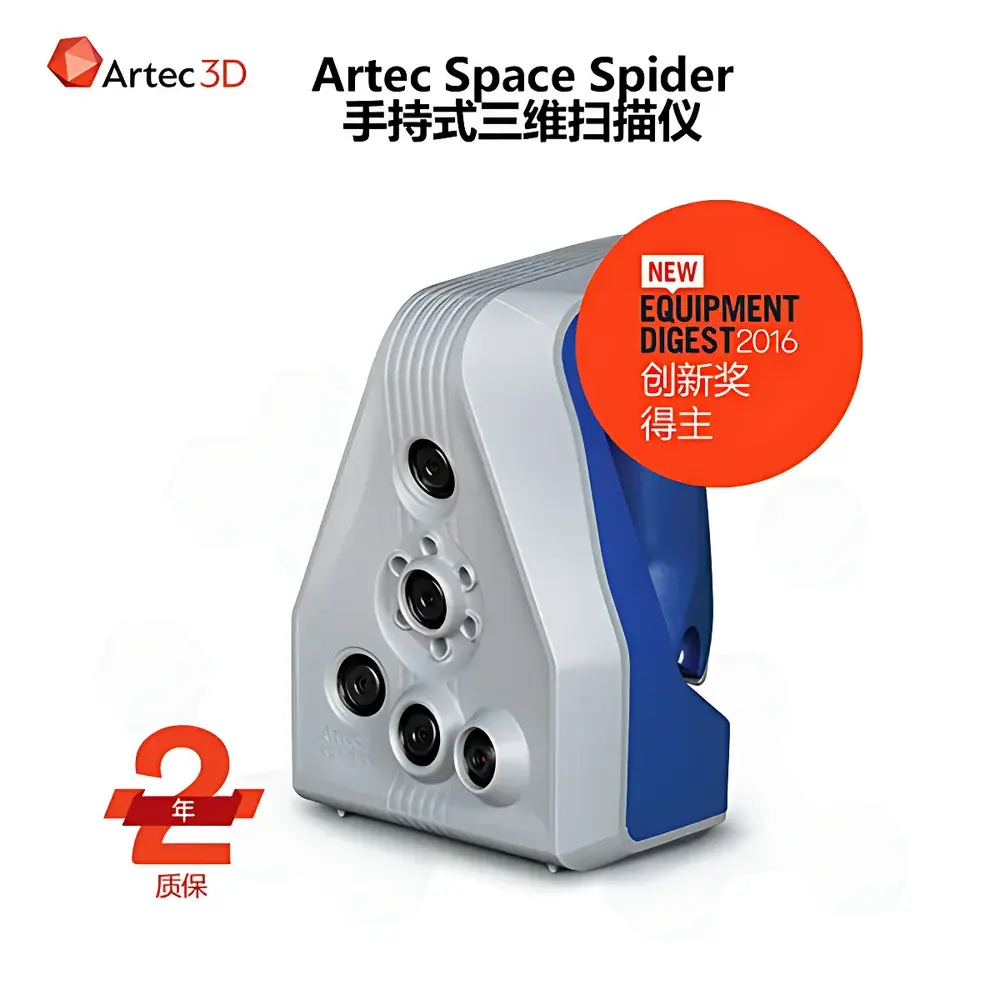

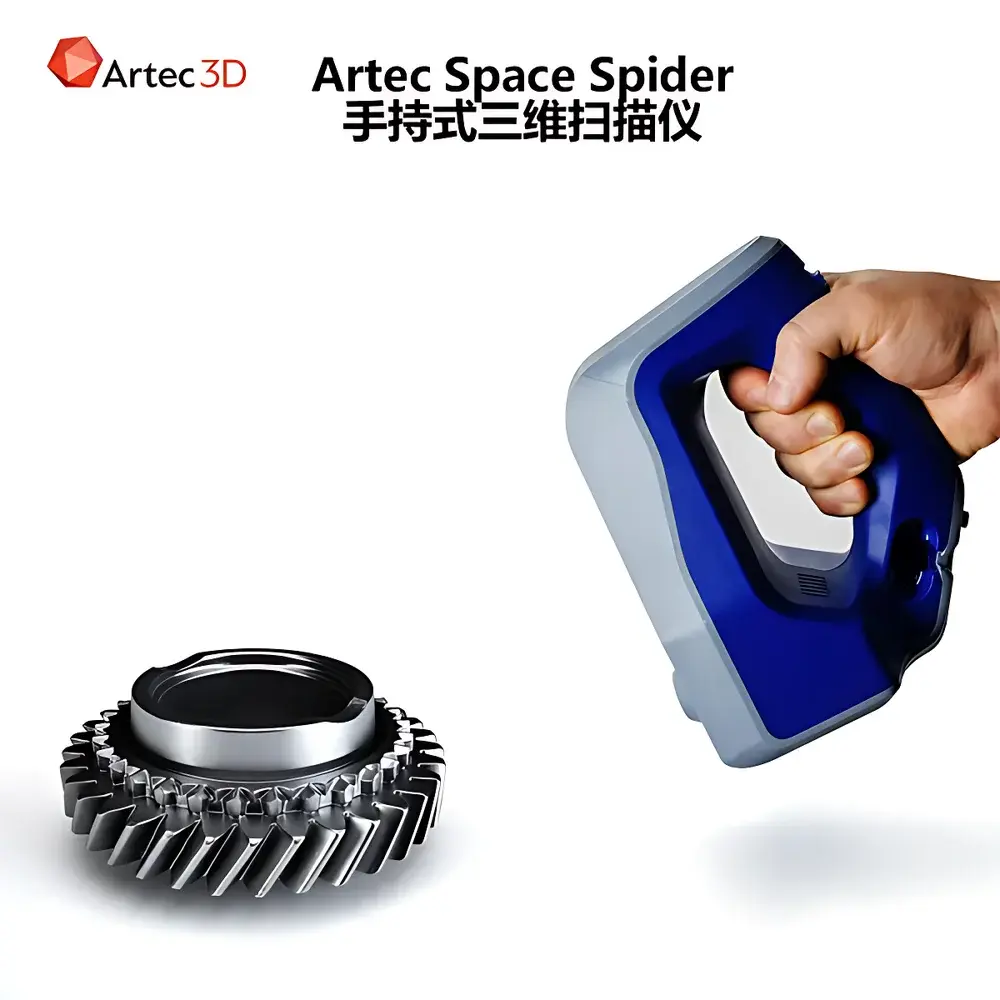
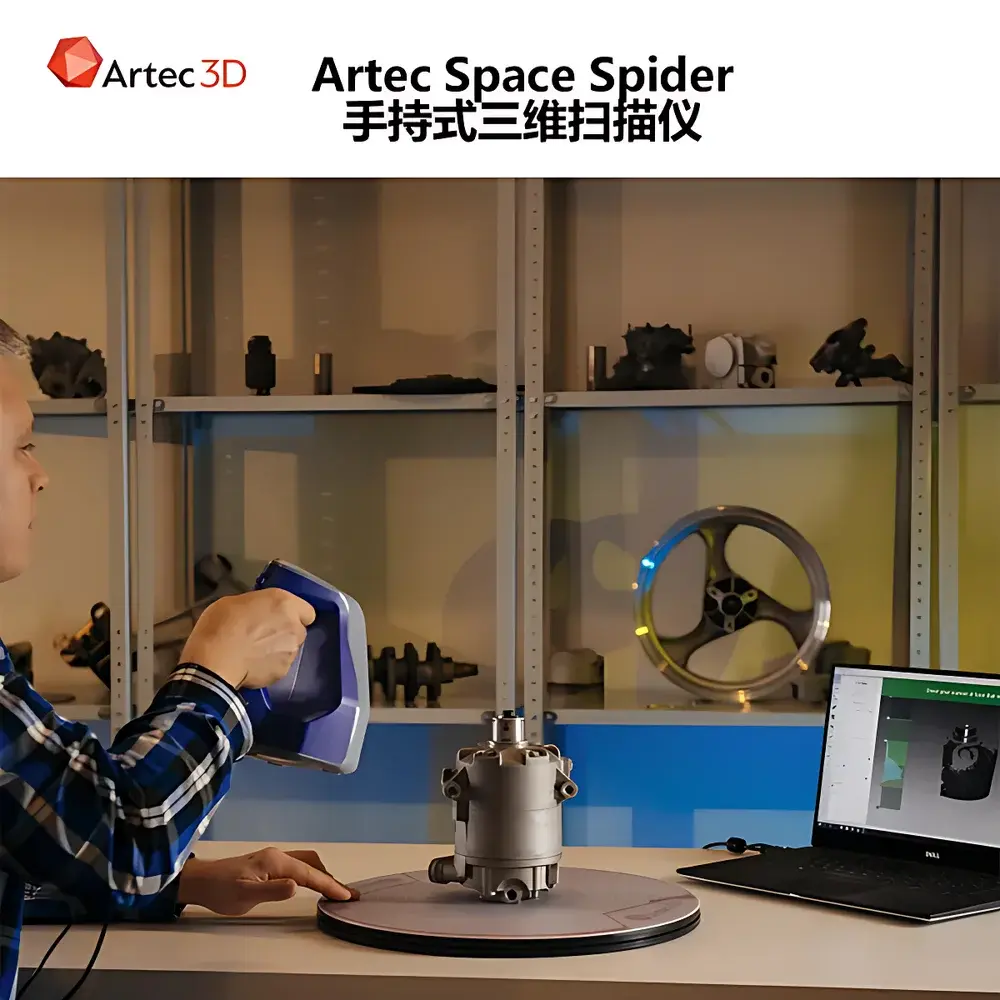
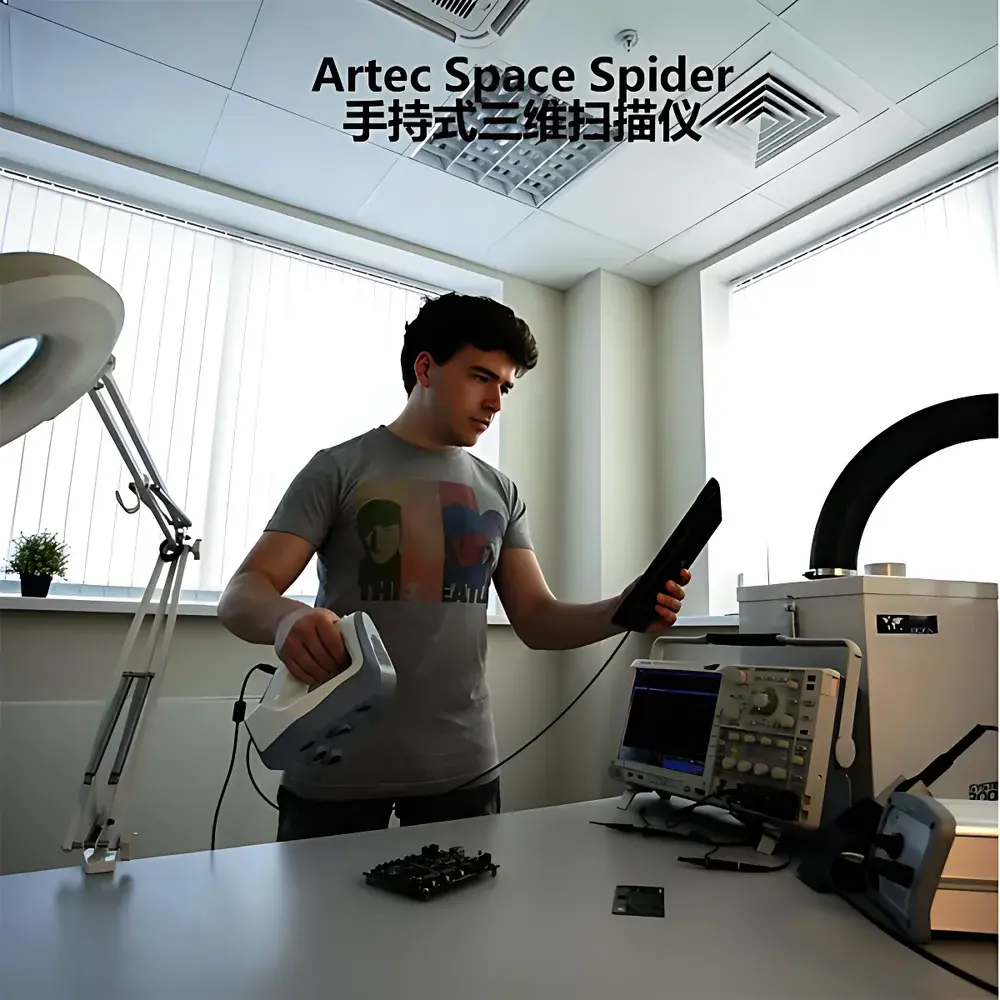
Artec Space Spider Industrial-Grade Blue-Light 3D Scanner
| Brand | Artec |
|---|---|
| Origin | Imported (EU-manufactured) |
| Manufacturer Type | Authorized Distributor |
| Instrument Category | Structured Light 3D Scanner |
| Model | ARTEC SPACE SPIDER |
| Measurement Speed | 1,000,000 points/sec |
| Accuracy | 0.05 mm |
| Maximum Scanning Volume (Single Pass) | 0.5 m³ (typical working distance: 0.18–0.3 m) |
| Operating System | Windows 11 (64-bit) |
| Weight | 0.85 kg |
| Calibration | NIST-traceable factory calibration |
| Compliance | CE, FCC, RoHS |
Overview
The Artec Space Spider is a metrology-grade, handheld structured light 3D scanner engineered for high-fidelity geometric digitization in industrial R&D, quality assurance, and reverse engineering environments. Unlike laser-based or photogrammetric systems, Space Spider employs advanced blue-light LED projection combined with dual high-resolution CMOS sensors to generate dense, noise-resistant point clouds through triangulation-based phase-shift analysis. Its optical architecture is thermally stabilized—originally developed under ESA specifications for use aboard the International Space Station—to maintain sub-50 µm volumetric accuracy across ambient temperature fluctuations from 10 °C to 30 °C. This thermal compensation ensures consistent repeatability (<0.01 mm standard deviation over 10 repeated scans of ISO 5725 reference artifacts) without requiring recalibration between sessions. The scanner operates at 1,000,000 measured points per second with native 0.05 mm single-frame accuracy (ISO 10360-8 compliant), enabling reliable capture of fine features such as thread pitch, gear tooth profiles, PCB solder joints, and micro-machined surface textures.
Key Features
- Metrology-validated accuracy: 0.05 mm volumetric accuracy verified against NIST-traceable step gauges and sphere arrays; certified for ISO/IEC 17025-compliant calibration workflows.
- Thermally adaptive optics: Patented internal thermal management system stabilizes sensor alignment and projector wavelength within ±0.1 nm over 3-minute warm-up, eliminating drift during extended QA inspections.
- Compact ergonomic design: Weighing only 0.85 kg with balanced center-of-gravity positioning, optimized for fatigue-free handheld operation during 4+ hour scanning sessions.
- Real-time mesh reconstruction: On-device GPU-accelerated processing delivers live textured polygonal mesh updates at 15 fps, supporting immediate visual validation of scan completeness and feature fidelity.
- Multi-spectral texture capture: Integrated RGB sensors synchronized with geometry acquisition produce photorealistic vertex color mapping suitable for GD&T annotation and surface finish documentation.
Sample Compatibility & Compliance
Space Spider excels at capturing highly reflective, dark, or low-contrast surfaces—including polished metals, anodized aluminum, matte-black plastics, and translucent polymers—without mandatory surface spraying. Its blue-light wavelength (450 nm) minimizes ambient interference and enables stable operation under standard laboratory lighting (300–1000 lux). The device complies with IEC 61000-6-3 (EMC emission limits) and IEC 61000-6-2 (immunity to electrostatic discharge up to 8 kV contact discharge). It supports traceable measurement chains aligned with ASME Y14.5-2018 and ISO 1101 geometric tolerancing standards. All firmware and calibration data are digitally signed and auditable per FDA 21 CFR Part 11 requirements when deployed in regulated manufacturing settings.
Software & Data Management
The scanner integrates natively with Artec Studio 19—a modular, scriptable post-processing platform supporting Python 3.9 automation, batch alignment via iterative closest point (ICP) and feature-based registration, and automated GD&T reporting (position, flatness, concentricity). Raw scan data exports directly to industry-standard formats including OBJ, STL, PLY, ASC, and STEP AP242 (with PMI embedding). For enterprise deployment, Artec Studio supports centralized license management, role-based access control, and audit trail logging compliant with GLP/GMP Annex 11. Optional SDKs enable integration into custom MES or PLM workflows via RESTful API endpoints and .NET/C++ libraries.
Applications
- Reverse engineering of legacy components where CAD data is unavailable—especially turbine blades, injection molds, and aerospace fasteners.
- In-process dimensional verification of CNC-machined parts against nominal CAD models using deviation heatmaps and cross-section analysis.
- Medical device prototyping: Accurate digitization of anatomical structures (e.g., ear canals, dental arches) for custom-fit prosthetics and hearing aid shells.
- Electronics inspection: High-resolution capture of PCB layouts, component placement, solder joint geometry, and conformal coating uniformity.
- Cultural heritage documentation: Non-contact preservation of fragile artifacts, coins, medals, and precision tooling with sub-100 µm surface texture retention.
FAQ
Does Space Spider require target markers or spray for accurate scanning?
No. Its blue-light structured light engine and adaptive exposure control enable reliable capture of unprepared surfaces—including bare metal, black rubber, and glossy composites—without developer spray or adhesive targets.
Can it be used in controlled cleanroom environments (ISO Class 5 or better)?
Yes. The sealed optical housing meets IP52 ingress protection ratings, and all internal electronics are conformally coated to prevent particulate accumulation or ESD-related interference.
Is the 0.05 mm accuracy specification valid across the full 0.5 m³ working volume?
Accuracy is specified at optimal working distance (0.22 m); volumetric uncertainty increases to ±0.12 mm at maximum range (0.3 m). For critical metrology applications, Artec recommends multi-station alignment using reference spheres traceable to NPL or PTB standards.
How is calibration maintained over time and usage cycles?
Factory calibration is stored in encrypted onboard memory and validated daily via built-in self-test patterns. Full recalibration is recommended annually or after 500 operational hours, performed by Artec-certified service centers using ISO 10360-8 test protocols.
Does the system support real-time synchronization with external CMMs or robotic arms?
Yes—via Ethernet TCP/IP and optional EtherCAT interface modules, enabling time-synchronized data fusion for hybrid metrology workflows involving articulated arm CMMs or collaborative robot-mounted scanning cells.