
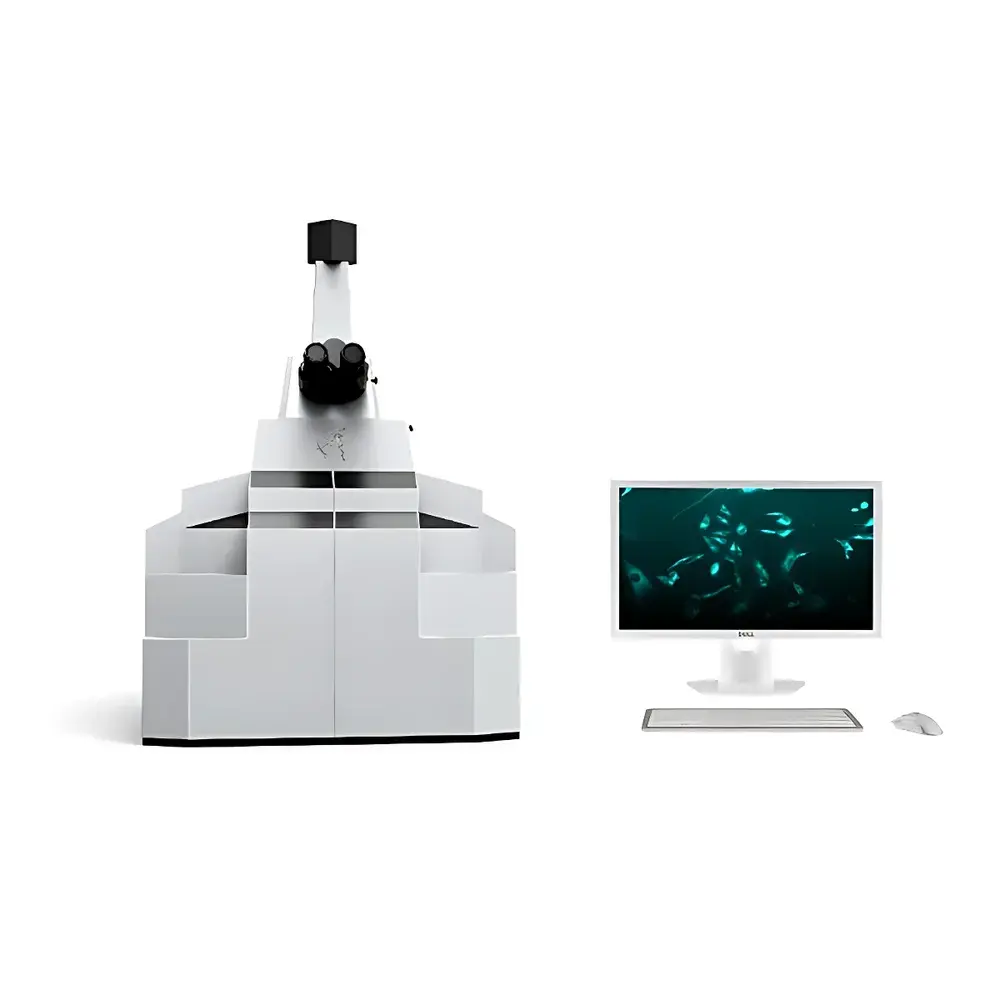
Artemis MARS-NANO High-Resolution In Vivo Microscope
| Brand | Artemis |
|---|---|
| Model | MARS-NANO |
| Type | Research-Grade Fluorescence Microscope |
| Excitation Range | 400–1700 nm |
| Optical Architecture | Upright, Modular (Confocal, Two-Photon, Hyperspectral) |
| Primary Application Domain | Small-Animal In Vivo Imaging |
| Regulatory Classification | Non-Medical Device |
| Origin | Shanghai, China |
| Manufacturer Status | Original Equipment Manufacturer (OEM) |
Overview
The Artemis MARS-NANO is a research-grade upright in vivo microscope engineered for high-resolution, multispectral optical imaging of live small-animal models. It operates on the principle of wide-spectrum fluorescence excitation and emission detection across the visible to short-wave infrared (SWIR) range (400–1700 nm), with dedicated optical path optimization for the second near-infrared window (NIR-II, 1000–1700 nm). This spectral design enables significantly improved tissue penetration depth, reduced light scattering, and enhanced signal-to-background ratio compared to conventional visible or NIR-I (700–900 nm) systems. Unlike conventional inverted or fixed-stage microscopes optimized for cultured cells or thin sections, the MARS-NANO’s upright configuration accommodates unrestrained positioning of anesthetized rodents—including mice and rats—on heated, gas-controlled stages, supporting long-term physiological stability during dynamic imaging sessions. Its modular architecture integrates three core imaging modalities: confocal laser scanning, two-photon excitation microscopy, and hyperspectral fluorescence acquisition—each independently configurable and co-aligned on a shared optical axis to ensure spatial registration across modalities.
Key Features
- Upright ergonomic platform with motorized XYZ stage and precision animal holder compatible with stereotactic frames and physiological monitoring interfaces (ECG, respiration, temperature)
- NIR-II-optimized optical train featuring low-autofluorescence lenses, high-transmission SWIR dichroics, and back-illuminated InGaAs and Si-based hybrid detectors
- Modular imaging engine supporting simultaneous or sequential acquisition modes: confocal (405/488/561/640 nm lasers), two-photon (tunable Ti:Sapphire or OPO source, 700–1300 nm), and hyperspectral fluorescence (10-nm spectral resolution, 400–1700 nm coverage)
- Real-time spectral unmixing and quantitative fluorophore deconvolution using embedded GPU-accelerated algorithms
- Integrated environmental control unit (37°C heating, 1–2% isoflurane delivery, humidity regulation) compliant with AAALAC-recommended housing standards
- Passive vibration isolation base and active thermal stabilization to maintain sub-micron optical alignment over multi-hour acquisitions
Sample Compatibility & Compliance
The MARS-NANO supports both in vivo and ex vivo preparations without hardware reconfiguration. Validated use cases include intravital imaging of cranial windows, dorsal skinfold chambers, orthotopic tumor models, and surgically exposed organs (e.g., intestine, lung, heart, kidney). Ex vivo applications extend to cryosections up to 100 µm thick, whole-mount tissues, and cleared organ samples. The system complies with ISO 13485–aligned quality management practices for research instrumentation and meets electromagnetic compatibility (EMC) requirements per IEC 61326-1. While not classified as a medical device under FDA 21 CFR Part 809 or EU MDR Annex XVI, its data output formats (TIFF, OME-TIFF, HDF5) and metadata tagging are compatible with GLP/GMP-aligned laboratory information management systems (LIMS) and support audit-trail generation per ALCOA+ principles.
Software & Data Management
Acquisition and analysis are managed through Artemis VisionSuite v4.2—a cross-platform application built on Qt and Python 3.11. Core capabilities include synchronized multimodal acquisition scheduling, real-time Z-stack reconstruction, time-lapse drift correction using fiducial-based registration, and batch-processing pipelines for spectral unmixing (e.g., ICG at 1050 nm LP, DAPI at 435–485 nm). All raw datasets are stored with FAIR-compliant metadata (instrument settings, animal ID, anesthesia protocol, probe dosing), enabling traceability in longitudinal studies. Export options include NIfTI for neuroimaging workflows, Bio-Formats-compatible files for ImageJ/Fiji integration, and direct export to MATLAB or Python (via .h5 or .zarr) for custom algorithm development. Software validation documentation—including IQ/OQ protocols—is provided for institutional QA departments.
Applications
- Neuroscience: Longitudinal tracking of dendritic spine dynamics, calcium transients in cortical layers, and blood-brain barrier permeability using NIR-II tracers
- Oncology: Quantitative assessment of tumor angiogenesis, metastatic seeding in lymph nodes/lungs, and real-time evaluation of photothermal therapy response
- Cardiovascular physiology: High-speed capillary flow velocity mapping in myocardium and cerebral microvasculature, plus inflammatory cell rolling/adhesion kinetics in atherosclerotic plaques
- Pharmacokinetics & biodistribution: Spatially resolved quantification of antibody-drug conjugates, nanocarrier accumulation, and target engagement kinetics across multiple organs
- Histopathology correlation: Seamless transition from in vivo imaging to post-mortem cryosection analysis using identical spectral signatures—enabling direct registration of functional signals to structural histology
FAQ
Is the MARS-NANO certified for clinical or diagnostic use?
No. It is designated exclusively for non-clinical, preclinical research applications and carries no regulatory clearance for human diagnostics or therapeutic monitoring.
What laser safety class does the system operate under?
All integrated laser modules comply with IEC 60825-1:2014 Class 3B or Class 4, with interlocked enclosures, beam shutters, and real-time power monitoring meeting ANSI Z136.1-2022 requirements.
Can third-party probes and dyes be used with the MARS-NANO?
Yes. The system supports open excitation/emission filter sets and customizable laser lines; compatibility has been verified for commercial NIR-II agents (e.g., CH1055, IR-1061), quantum dots, and organic fluorophores with published absorption/emission profiles.
Does the software support automated image analysis for vessel segmentation or cell counting?
Basic morphometric tools (vessel diameter, length, branching density) are included; advanced AI-based segmentation (e.g., U-Net trained on murine vasculature) is available via optional plugin modules validated on public benchmark datasets (e.g., VESSEL12, ISIC 2018).
What maintenance schedule is recommended for optimal optical performance?
Quarterly calibration of spectral response and laser power output is advised; annual alignment verification by certified Artemis field service engineers ensures lateral resolution stability ≤ 0.35 µm (at 500 nm) and axial resolution ≤ 1.2 µm (at 800 nm two-photon).
Related Products





