
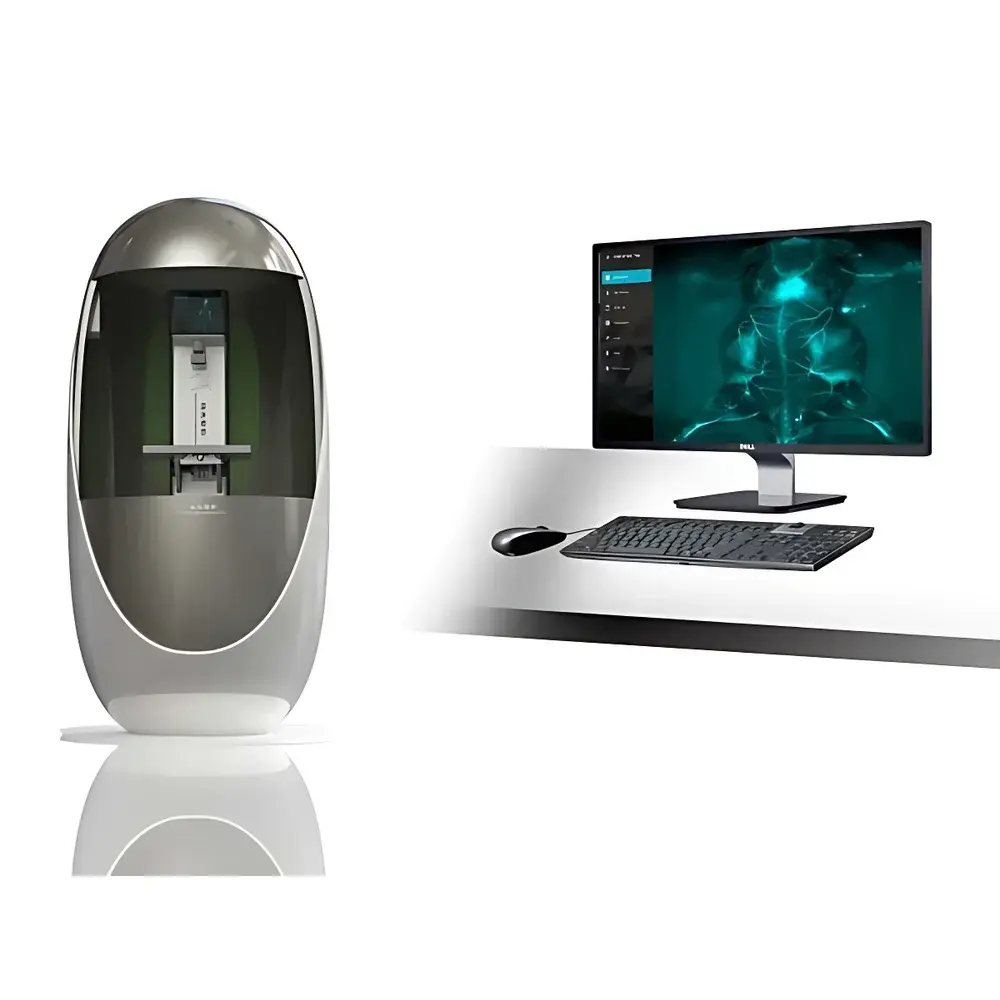
Artemis MARS Series NIR-II Small Animal In Vivo Fluorescence Imaging System
| Brand | Artemis |
|---|---|
| Origin | Shanghai, China |
| Manufacturer | Artemis Medical Technology Co., Ltd. |
| Model | MARS Series |
| Instrument Type | Optical In Vivo Imaging System |
| Spectral Range | 400–1700 nm |
| Penetration Depth | >15 mm |
| Spatial Resolution | <3 µm |
| Fluorescence Lifetime Resolution | <5 µs |
| Frame Rate | >1000 fps |
| Multimodal Options | X-ray, CT, FLIM, NIR-I, Hyperspectral In Situ Imaging, Photothermal Therapy Module |
| Sample Capacity | Single-animal (mouse/rat) positioning stage |
| Compliance | Designed for GLP-compliant preclinical research environments |
Overview
The Artemis MARS Series NIR-II Small Animal In Vivo Fluorescence Imaging System is an engineered platform for high-fidelity, quantitative optical imaging across the second near-infrared window (NIR-II, 1000–1700 nm). Unlike conventional visible or NIR-I (700–900 nm) systems, MARS leverages reduced photon scattering and minimal tissue autofluorescence in the NIR-II band to achieve superior signal-to-background ratio, deeper tissue penetration (>15 mm), and subcellular spatial resolution (<3 µm). The system integrates a high-quantum-efficiency InGaAs focal plane array detector with thermoelectric cooling, synchronized laser excitation sources (tunable 680–1650 nm), and precision optical filtering optimized for spectral unmixing of multiple fluorophores. Its core architecture supports simultaneous multimodal acquisition—fluorescence intensity, lifetime (FLIM), spectral profiling, and structural co-registration—enabling longitudinal, non-invasive monitoring of biological processes at organ, tissue, and cellular levels in awake or anesthetized rodents.
Key Features
- NIR-II–optimized optical path with broadband transmission (400–1700 nm), enabling seamless transition from UV/visible to short-wave infrared fluorescence detection
- High-speed acquisition engine supporting frame rates exceeding 1000 fps—critical for dynamic vascular perfusion mapping and real-time photothermal response monitoring
- Fluorescence lifetime imaging (FLIM) module with time-correlated single-photon counting (TCSPC) capability, resolving lifetimes down to <5 µs for molecular microenvironment sensing (e.g., pH, oxygenation, binding state)
- Integrated photothermal therapy (PTT) module with calibrated 808/1064 nm diode lasers and closed-loop thermal feedback, allowing concurrent imaging and localized ablation within the same experimental session
- Modular multimodal expansion interface supporting OEM integration of micro-CT, X-ray irradiation units, and hyperspectral in situ spectrometers without optical path realignment
- Dedicated animal handling station with temperature-controlled stage (28–37 °C), gas anesthesia port (isoflurane/O₂), and stereotactic head fixation for cranial window or spinal cord imaging
Sample Compatibility & Compliance
MARS is validated for use with murine and rat models (C57BL/6, BALB/c, nude, NSG, Sprague-Dawley), including transgenic lines expressing fluorescent reporters (e.g., tdTomato, mCherry, iRFP720) and exogenous NIR-II probes (e.g., Ag₂S QDs, SWCNTs, organic dyes such as CH1055 derivatives). The system meets mechanical and electrical safety requirements per IEC 61010-1 and electromagnetic compatibility standards (EN 61326-1). Software operation supports audit trails, user role management, and electronic signatures compliant with FDA 21 CFR Part 11 for regulated preclinical studies. All imaging protocols align with ARRIVE 2.0 guidelines and are compatible with institutional animal care and use committee (IACUC) documentation workflows.
Software & Data Management
The proprietary Artemis Imaging Suite v4.2 provides end-to-end workflow control—from acquisition parameter scripting and real-time spectral unmixing to 3D volume reconstruction and kinetic curve fitting. It includes batch processing pipelines for longitudinal data alignment (rigid + non-rigid registration), automated ROI segmentation using deep learning–assisted U-Net models trained on annotated murine anatomy atlases, and export to standardized formats (NIfTI, OME-TIFF, HDF5). Raw data files retain full metadata (excitation wavelength, exposure time, gain, laser power, animal ID, timestamp), ensuring traceability for GLP/GMP audits. Integration with MATLAB, Python (via PyArtemis SDK), and ImageJ/Fiji is supported through documented APIs.
Applications
- Tumor xenograft tracking: Quantitative assessment of metastatic burden, anti-angiogenic drug efficacy, and nanoparticle biodistribution kinetics
- Cerebrovascular imaging: High-resolution visualization of pial vessels, blood-brain barrier permeability, and ischemic penumbra evolution post-MCAO
- Lymphatic mapping: Dynamic tracing of lymph flow from peripheral sites to draining nodes using indocyanine green (ICG) analogs or custom NIR-II tracers
- Metabolic phenotyping: Real-time imaging of brown adipose tissue activation via mitochondrial-targeted NIR-II probes under cold challenge
- Gastrointestinal motility: Spatiotemporal analysis of peristalsis and mucosal barrier integrity using pH- and protease-activatable probes
- Theranostic validation: Concurrent photothermal ablation and post-treatment necrosis quantification via caspase-3–responsive NIR-II agents
FAQ
What is the minimum detectable fluorophore concentration in vivo?
Detection limits depend on probe quantum yield and extinction coefficient; typical LOD for high-performance NIR-II agents (e.g., Ag₂S QDs) is ~50 pM in subcutaneous tissue at 1 cm depth.
Can MARS be used for longitudinal studies over several weeks?
Yes—the system supports daily imaging with consistent geometric calibration and auto-alignment routines to minimize inter-session variability.
Is spectral unmixing supported for >3 fluorophores simultaneously?
Yes—up to five spectrally distinct NIR-II emitters can be resolved using constrained non-negative matrix factorization (cNMF) algorithms embedded in the software.
Does the system comply with ISO 13485 or CE marking requirements?
The MARS platform is classified as a preclinical research instrument; it is not a medical device and therefore does not carry CE marking or ISO 13485 certification—but all subsystems adhere to relevant EN/IEC safety standards.
What training and service support is provided internationally?
Artemis offers remote application onboarding, on-site installation and validation (IQ/OQ), and annual preventive maintenance contracts with certified field engineers across North America, EU, and APAC regions.
Related Products




