
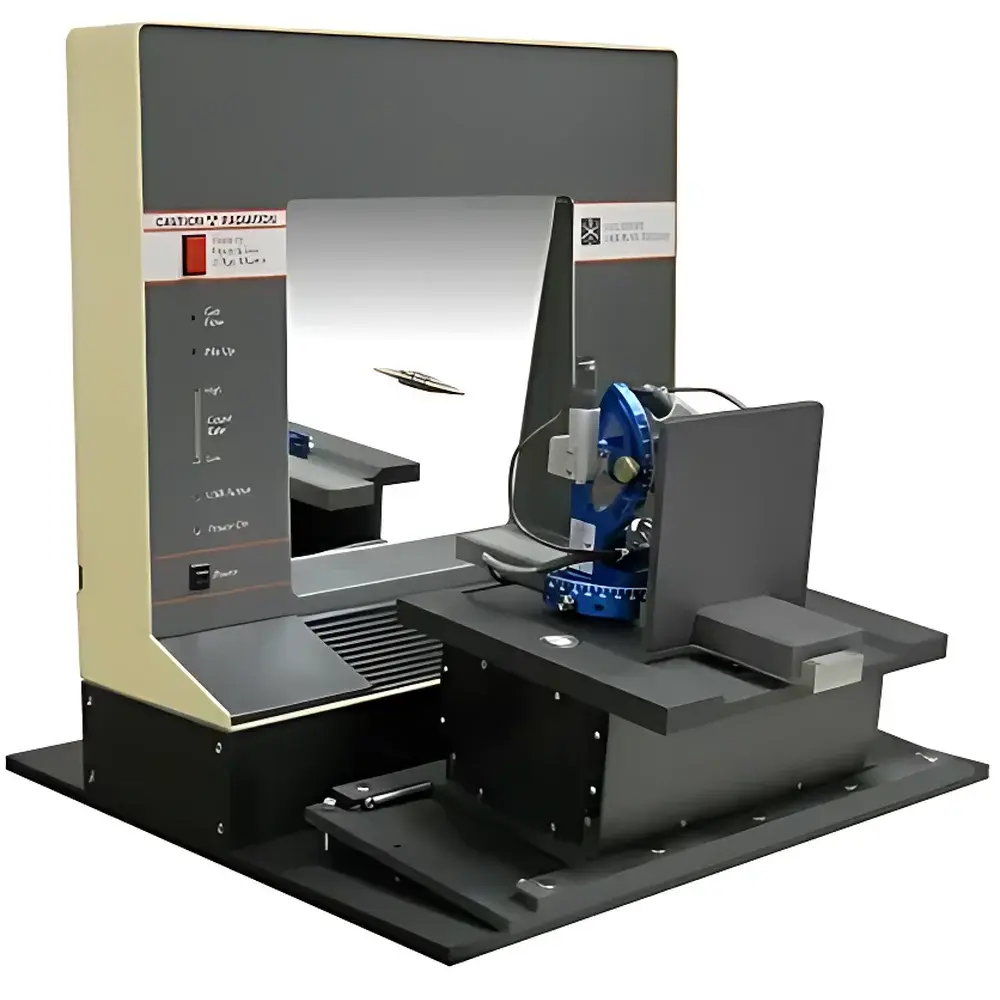
Artinis LC-3 Laue Crystal Orientation Instrument
| Brand | Artinis |
|---|---|
| Origin | USA |
| Manufacturer Type | Authorized Distributor |
| Import Status | Imported |
| Model | LC-3 |
| Effective Pixels | 1 MP (1024 × 1024) |
| Pixel Array | 2048 × 2048 |
| Pixel Size | 13.5 µm × 13.5 µm |
| Frame Rate | ≥1 fps (full-frame, real-time Laue pattern acquisition) |
| Detector Type | Scientific-grade CCD with phosphor-coated imaging plate coupling |
| Dynamic Range | >16-bit (65,536 intensity levels) |
| Cooling | Thermoelectric (−20 °C stabilized) |
Overview
The Artinis LC-3 Laue Crystal Orientation Instrument is a high-precision, laboratory- and production-grade optical system engineered for rapid, non-destructive crystallographic orientation determination using white-beam Laue diffraction. Unlike monochromatic X-ray methods, the LC-3 utilizes a broad-spectrum polychromatic X-ray source incident on a stationary single crystal, generating a geometrically rich diffraction pattern directly correlated to the crystal’s three-dimensional lattice orientation relative to the incident beam. The instrument integrates a large-area, thermoelectrically cooled scientific CCD detector coupled with a high-efficiency phosphor-based imaging plate to capture high-fidelity Laue patterns in real time—with typical acquisition and analysis completed within one second. Designed for seamless integration into materials science labs, semiconductor R&D facilities, and crystal growth production lines, the LC-3 delivers deterministic orientation solutions without sample rotation or goniometric repositioning—enabling high-throughput characterization of as-grown boules, wafers, and optoelectronic substrates.
Key Features
- Real-time Laue pattern acquisition at ≥1 frame per second with full 2048 × 2048 pixel resolution and 13.5 µm pixel pitch, optimized for angular sensitivity down to 0.05°
- Thermoelectrically stabilized CCD sensor operating at −20 °C, reducing dark current noise and enabling high signal-to-noise ratio detection of weak Laue spots
- Modular optical path design accommodating standard laboratory X-ray sources (e.g., sealed-tube Cu/Kα or Mo/Kα) and optional microfocus sources
- Integrated calibration routine for automatic geometry correction, including detector tilt, sample-to-detector distance, and beam center localization
- Rugged mechanical housing with vibration-damped baseplate, certified for continuous operation in industrial environments (IP52-rated enclosure)
- Onboard FPGA-assisted preprocessing for real-time background subtraction, spot centroiding, and intensity thresholding prior to host-based indexing
Sample Compatibility & Compliance
The LC-3 supports crystal samples ranging from 150 mm diameter boules, with no upper weight limit when mounted on compatible stage systems. Compatible substrates include Si, Ge, GaAs, InP, sapphire (Al₂O₃), LiNbO₃, quartz, and nonlinear optical crystals (e.g., BBO, LBO). Sample holders accept standard kinematic mounts, vacuum chucks, and heated/cryogenic stages (−196 °C to +300 °C). The system complies with IEC 61000-6-3 (EMC emissions) and IEC 61000-6-2 (immunity), and meets CE safety directives for Class 1 X-ray equipment when used with approved external shielding and interlock configurations. Software workflows support audit trails and electronic signatures aligned with GLP and ISO/IEC 17025 documentation requirements.
Software & Data Management
The LC-3 is operated via LaueSoft v4.2—a platform-independent application developed in C++ with Qt framework, supporting Windows 10/11, Linux (RHEL 8+), and macOS 12+. The software implements robust indexing algorithms based on the DIALS library and includes automated lattice parameter refinement, misorientation mapping, and twin-domain identification. All raw frames, processed patterns, orientation matrices (in Euler angles and rotation quaternions), and metadata (timestamp, HV settings, sample ID) are stored in HDF5 format with embedded NeXus-compatible attributes. Export options include CIF, .ang (EDAX), .ctf (Oxford Instruments), and CSV for downstream integration with Thermo Fisher Avizo, MATLAB, or Python-based crystallography toolchains (e.g., DiffPy, scikit-ued). Full 21 CFR Part 11 compliance is available via optional validation package, including role-based access control, electronic signature logging, and immutable audit trail generation.
Applications
- Determining precise crystallographic orientation of as-grown ingots prior to slicing—reducing wafer kerf loss and improving yield in semiconductor and photovoltaic manufacturing
- Validating cut-angle accuracy of optical components (e.g., laser gain media, Q-switches, frequency doublers) against specification sheets per ISO 11146
- Mapping orientation gradients across large-area single crystals to identify strain fields and domain boundaries
- Supporting rapid seed selection in Czochralski and Bridgman crystal growth processes
- Teaching crystal symmetry, reciprocal space geometry, and X-ray diffraction fundamentals in university solid-state physics laboratories
- Quality assurance of piezoelectric and ferroelectric substrates where polarization axis alignment is critical (e.g., for MEMS actuators and SAW filters)
FAQ
What X-ray source is required to operate the LC-3?
The LC-3 is source-agnostic and designed for integration with commercially available laboratory X-ray generators (e.g., Rigaku, Bruker, or custom-built tubes) emitting 5–30 keV photons. A Cu-target tube (λ ≈ 1.54 Å) is recommended for general-purpose use; Mo-target sources improve resolution for high-symmetry crystals.
Can the LC-3 determine orientation of opaque or heavily absorbing crystals?
Yes—the Laue method is transmission-based but also supports back-reflection geometry for thick or absorbing samples (e.g., silicon wafers >500 µm). Optional beam-hardening filters and high-energy detectors extend usability to metals and ceramics.
Is remote operation supported?
Yes—LaueSoft includes secure WebSocket-based API endpoints for script-driven control (Python, LabVIEW, MATLAB), enabling integration into automated metrology cells and Industry 4.0 data pipelines.
Does the system require periodic recalibration?
No routine recalibration is needed; geometric parameters are stored per-sample configuration. A full system verification using NIST-traceable silicon reference crystal is recommended annually or after mechanical shock events.
How is radiation safety managed?
The LC-3 itself contains no radioactive material or integrated X-ray source. When deployed, it must be installed within a certified X-ray enclosure meeting local regulatory standards (e.g., FDA 21 CFR 1020.40, EU Directive 2013/59/Euratom); Artinis provides shielding interface drawings and interlock wiring schematics.





