
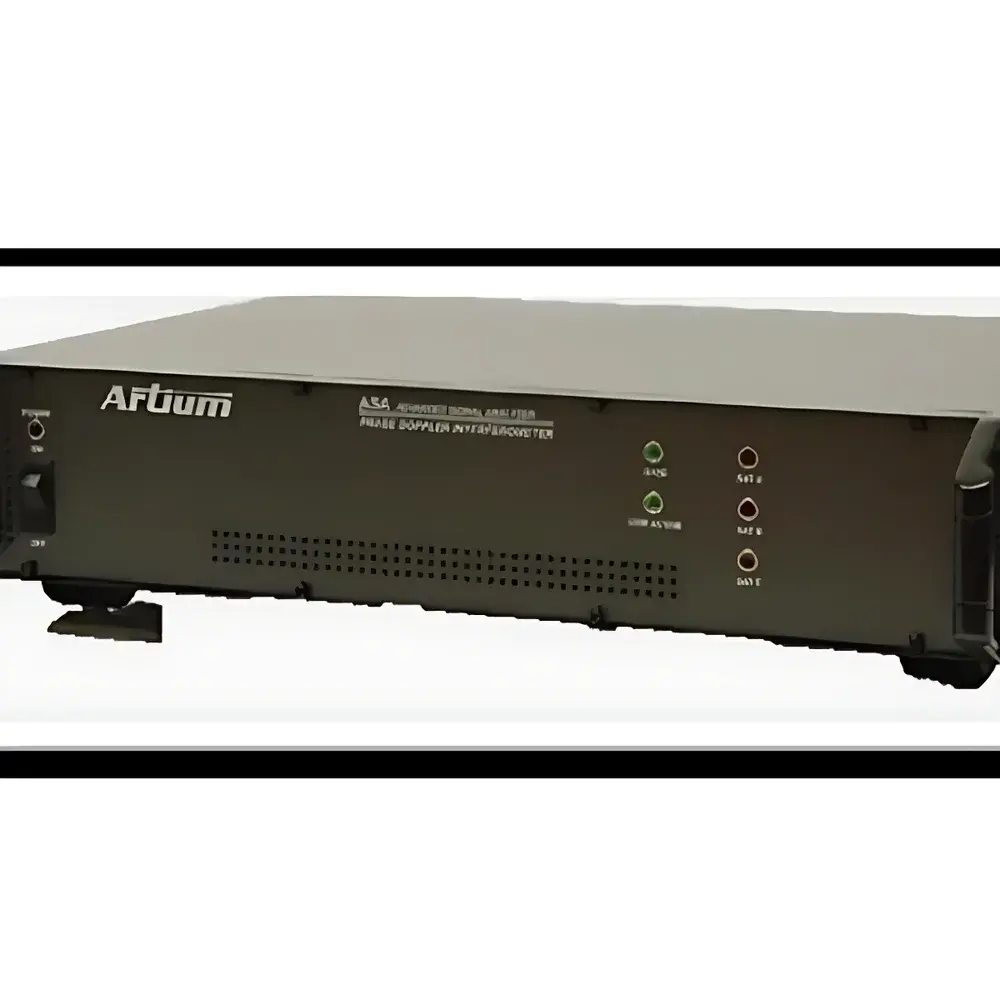
Artium ASA Advanced Signal Processor for Laser Doppler Velocimetry and Phase Doppler Interferometry
| Brand | Artium |
|---|---|
| Origin | USA |
| Model | ASA |
| Dispersion Method | Dry & Wet |
| Instrument Type | Laboratory Laser Particle Size Analyzer |
| Measurement Range | 1–1200 µm |
| Repeatability | <1% |
| Measurement Duration | Unlimited |
| Analog Bandwidth | 10–160 MHz (standard), upgradable to 10–200 MHz |
| Max Sampling Rate | 320 MHz (standard), upgradable to 400 MHz |
| Signal Processing Architecture | Quadrature-based Fourier Transform (FT) with Phase Pulse Detection (PPD) and Adaptive Sampling |
Overview
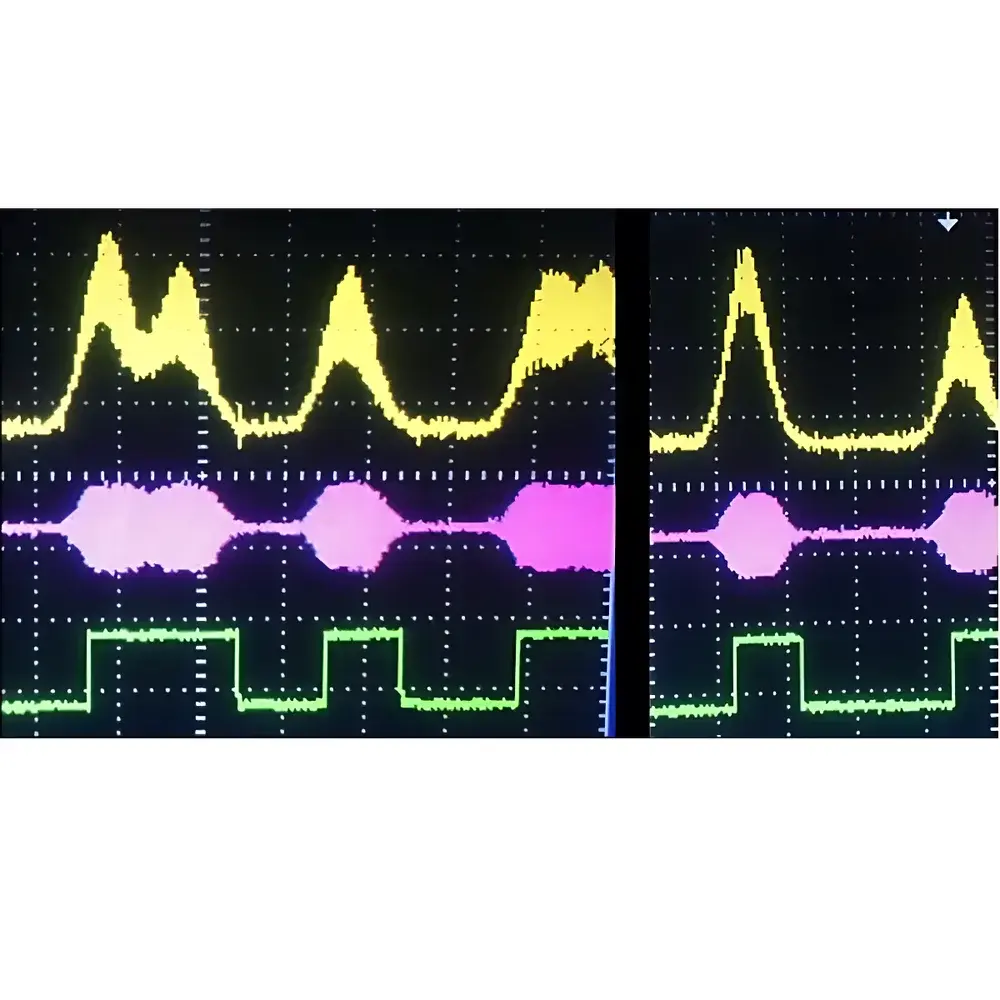
The Artium ASA Advanced Signal Processor is a purpose-built, high-fidelity digital signal processing platform engineered exclusively for Laser Doppler Velocimetry (LDV) and Phase Doppler Interferometry (PDI) applications. Unlike conventional particle sizing instruments that rely on static light scattering, the ASA operates at the core of dynamic optical measurement systems—processing time-resolved Doppler burst signals generated by moving particles traversing intersecting laser beams. Its architecture is grounded in rigorous Fourier analysis principles, implementing the Rife–Boorstyn optimal frequency estimation framework. The processor accepts analog voltage outputs from photomultiplier tube (PMT) and preamplifier stages, applies hardware-level quadrature mixing, low-pass filtering, and adaptive sampling before performing real-time spectral decomposition. This enables precise, bias-free estimation of Doppler shift frequencies—and thus particle velocity and size—under low signal-to-noise ratio (SNR) conditions where legacy counter-based or autocorrelation methods fail.
Key Features
- Quadrature-sampling architecture: Simultaneous acquisition of in-phase (R(t)) and quadrature (Q(t)) components via Hilbert-transformed orthogonal mixing—enabling unambiguous Nyquist-rate detection and eliminating aliasing-related phase ambiguity.
- Configurable analog bandwidth: Standard 10–160 MHz range (320 MHz max sampling), optionally extendable to 10–200 MHz (400 MHz sampling) to support higher-velocity flows or smaller particle regimes.
- Phase Pulse Detector (PPD): Hardware-accelerated pulse identification operating directly on the phase domain, delivering robust burst onset/offset timing independent of amplitude fluctuations.
- Adaptive sampling circuitry: Dynamically adjusts sample depth per Doppler burst based on transit time and signal morphology—maximizing data fidelity while minimizing storage overhead.
- PCI Express high-speed interface: Sustained 2.5 Gbps data throughput ensures zero-loss transmission of timestamped packets containing Doppler frequency, transit time, arrival time, and auxiliary trigger inputs.
- Fourier Transform–optimized computation: Implements N3-point FFT only over the relevant frequency band (−fs/2 to +fs/2), achieving 0.1% frequency resolution at SNR = 0 dB—validated against theoretical Cramér–Rao bounds.
Sample Compatibility & Compliance
The ASA is not a standalone particle analyzer but an embedded signal processing engine integrated into LDV/PDI optical systems used across aerosol science, spray characterization, combustion diagnostics, and microfluidic flow metrology. It supports both dry dispersion (e.g., pneumatic conveying, fluidized beds) and wet dispersion (e.g., liquid suspensions, emulsions) when coupled with appropriate PDI optics and flow cells. Its signal processing methodology complies with fundamental metrological requirements outlined in ISO 20988:2021 (Fluid flow measurement — Laser Doppler anemometry) and ASTM F3023-17 (Standard Practice for Calibration of LDV Systems). While the ASA itself does not carry CE or FDA markings, its output data structure—time-stamped, audit-trail-ready, and traceable to raw PMT voltage—is fully compatible with GLP/GMP-compliant data acquisition frameworks when deployed within validated instrument platforms.
Software & Data Management
The ASA operates under Artium’s proprietary Signal Analysis Suite (SAS), a Windows-based application supporting real-time monitoring, offline spectral reconstruction, and batch post-processing. SAS implements full 21 CFR Part 11–compliant user authentication, electronic signatures, and immutable audit trails for all parameter changes, calibration events, and data export actions. Raw burst data are stored in HDF5 format with embedded metadata (laser wavelength, beam geometry, refractive index assumptions, trigger latency compensation), enabling reproducible re-analysis without loss of provenance. Export options include ASCII, MATLAB .mat, and CSV with configurable column mapping—ensuring seamless integration into third-party statistical analysis (e.g., Python SciPy, JMP, MATLAB Statistics Toolbox) and LIMS environments.
Applications
- Aerosol dynamics: Quantifying droplet size and velocity distributions in inhaler plumes, fuel sprays, and pesticide atomization.
- Combustion research: Resolving transient soot particle sizing and axial velocity gradients in flame zones with sub-microsecond temporal resolution.
- Microfluidics & lab-on-chip: Measuring particle migration, deformability, and flow profiles in viscoelastic media using dual-beam PDI configurations.
- Pharmaceutical spray drying: Validating nozzle performance and particle trajectory consistency across multi-nozzle arrays under varying humidity and temperature conditions.
- Fundamental fluid mechanics: Characterizing turbulent boundary layers, vortex shedding, and wake structures with simultaneous three-component velocity resolution when paired with triple-beam LDV setups.
FAQ
How does the ASA differ from conventional “counter-based” Doppler processors?
Unlike counter-based systems—which measure zero-crossings and suffer from noise-induced counting errors at low SNR—the ASA uses quadrature-sampled Fourier analysis, delivering statistically optimal frequency estimates even at 0 dB SNR.
Can the ASA be integrated with non-Artium optical heads?
Yes—provided the optical head delivers standard PMT voltage outputs with bandwidth compatibility (≥160 MHz), the ASA interfaces via SMA coaxial inputs and TTL-compatible trigger lines.
Is firmware upgradeable in the field?
Yes—Artium provides signed firmware updates through SAS; all upgrades preserve calibration constants and maintain traceability to NIST-traceable reference signals.
What is the minimum detectable particle size in PDI mode?
Size resolution depends on optical configuration (laser wavelength, focal length, receiver aperture), not the ASA itself—but with 532 nm lasers and standard PDI optics, reliable sizing begins at ~1 µm for spherical dielectrics.
Does the ASA support real-time particle-by-particle classification?
Yes—via SAS’s burst-triggered classification engine, which assigns size/velocity classes based on real-time FFT peak tracking and transit-time correlation, outputting classified histograms at ≥10 kHz burst rates.



