
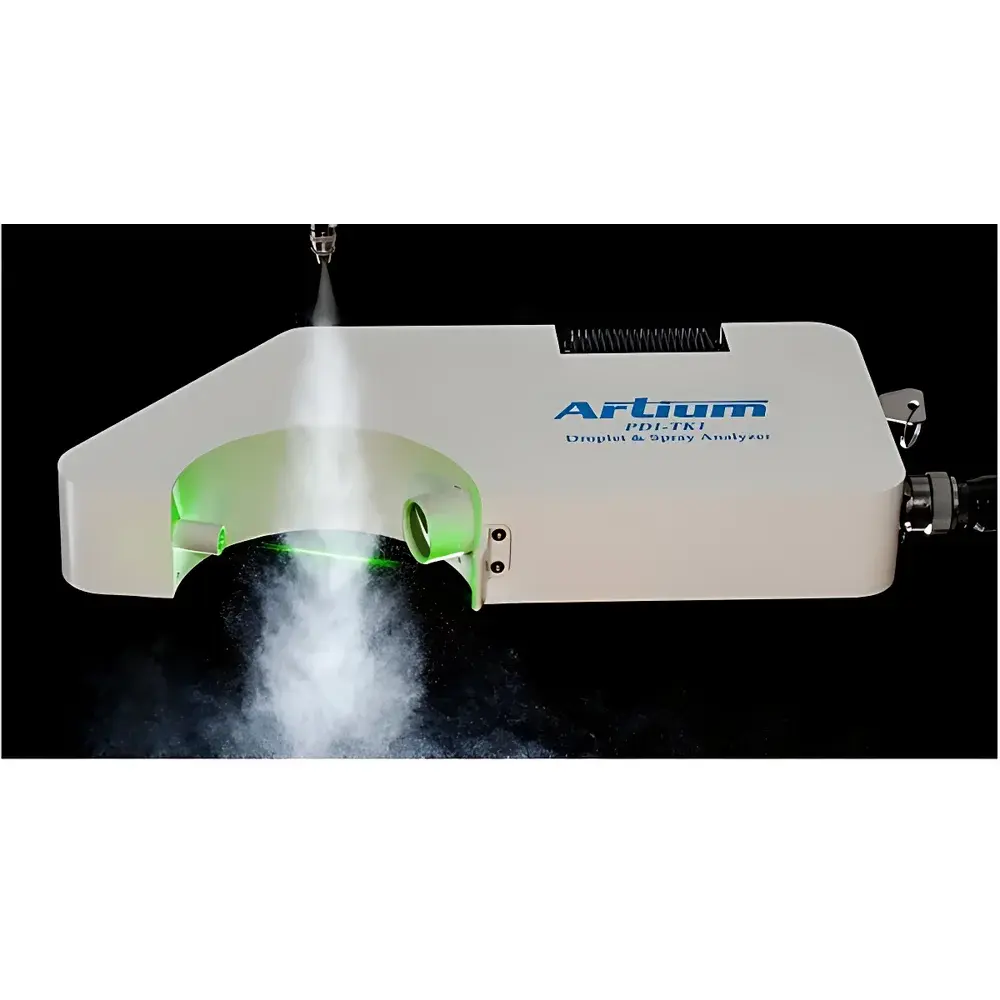
Artium PDI-TK Series Plug-and-Play Particle Size and Velocity Analyzer
| Brand | Artium |
|---|---|
| Origin | USA |
| Model | PDI-TK |
| Type | Laboratory Laser Diffraction Particle Analyzer |
| Dispersion Method | Dry & Wet |
| Measurement Range | 1–1200 µm |
| Repeatability | <1% |
| Measurement Duration | Unlimited |
| Laser Source | Diode-Pumped Solid-State (DPSSL) Laser |
| Wavelength | 532 nm |
| Optical Probe Weight | 2.63 kg (TK1), 2.86 kg (TK2) |
| IP Rating | IP66 |
| Calibration | NIST-Traceable, Single-Calibration-for-Life |
| Signal Processor | ASA2 Advanced Signal Analyzer |
| Software Platform | AIMS (Advanced Imaging & Measurement Suite) |
| Optional Accessories | Anti-Fog Window Shroud, Integrated Thermostatic Heating Module for Sub-Zero/Freezing Environments |
Overview
The Artium PDI-TK Series is a purpose-engineered plug-and-play particle size and velocity analyzer designed for rapid, in-situ or benchtop characterization of dispersed particulate systems using laser diffraction and phase-Doppler interferometry (PDI) principles. Unlike conventional laser diffraction instruments requiring optical alignment, beam profiling, or iterative calibration, the PDI-TK integrates a factory-aligned, sealed optical head with a DPSSL 532 nm laser source and sapphire observation windows—enabling immediate deployment without user intervention in optical setup. Its measurement architecture is based on dual-scatter detection geometry: forward-scattered light determines particle size distribution via Mie theory inversion, while phase-shift analysis between two spatially separated detectors yields instantaneous, directional velocity data with sub-pixel resolution. This dual-parameter capability makes the system uniquely suited for dynamic process monitoring, spray characterization, fluidized bed analysis, and aerosol research where both size and motion are critical performance indicators.
Key Features
- True plug-and-play operation: No optical alignment, no beam centering, no real-time adjustment—optical path is permanently fixed and sealed at the factory.
- IP66-rated enclosure: Fully protected against high-pressure water jets and dust ingress, enabling reliable operation in industrial environments including wash-down zones common in pharmaceutical, food, and chemical manufacturing.
- Lightweight, portable probe design: TK1 (2.63 kg) and TK2 (2.86 kg) variants facilitate handheld measurements, mounting on robotic arms, or integration into custom test rigs without structural reinforcement.
- Sapphire optical windows: Chemically inert, scratch-resistant, and thermally stable; withstand repeated cleaning with solvents or ultrasonic baths without degradation in transmission or surface flatness.
- NIST-traceable calibration: Performed once at manufacture using certified PSL and glass bead standards; eliminates periodic recalibration requirements and supports audit-ready documentation for GLP/GMP-regulated labs.
- ASA2 signal processor: Second-generation hardware-accelerated engine delivering real-time pulse analysis, noise rejection, and multi-parameter event classification at up to 10 kHz sampling rates.
Sample Compatibility & Compliance
The PDI-TK accommodates both dry and wet dispersion modes, supporting liquid suspensions (aqueous and non-aqueous), pressurized gas-phase sprays, powder jets, and dilute aerosols. It complies with ISO 13320:2020 for laser diffraction particle sizing and meets the optical stability and signal fidelity requirements outlined in ASTM E799–22 for phase-Doppler anemometry. All firmware and software modules adhere to FDA 21 CFR Part 11 for electronic records and signatures—including full audit trail logging, user access control, and electronic signature enforcement. System validation packages support IQ/OQ/PQ protocols aligned with ICH Q5, Q7, and USP <1058> analytical instrument qualification guidelines.
Software & Data Management
The AIMS (Advanced Imaging & Measurement Suite) software provides a unified interface for acquisition, visualization, and post-processing. It supports live histogram updates, time-resolved size-velocity scatter plots, binned statistical summaries (D10, D50, D90, span), and export to CSV, HDF5, or XML formats compatible with LIMS and MES platforms. Raw pulse data is retained with metadata tags (timestamp, ambient temperature, humidity, operator ID), ensuring full traceability. Batch mode scripting enables unattended multi-sample runs with auto-report generation compliant with ISO/IEC 17025 reporting templates. Data integrity safeguards include write-once storage options, cryptographic hash verification, and optional network-based backup to secure NAS infrastructure.
Applications
- Spray nozzle development and validation in inhaler and agricultural formulation R&D
- Real-time monitoring of atomization efficiency in combustion chamber testing
- Particle residence time and velocity profiling in circulating fluidized beds
- Quality-by-Design (QbD) studies for dry powder inhalers (DPIs) per USP <601>
- Process analytical technology (PAT) deployment for continuous manufacturing of granules and coated particles
- Aerosol generation and transport modeling in HVAC and cleanroom contamination control
FAQ
Does the PDI-TK require periodic recalibration?
No. The system is delivered with NIST-traceable calibration performed at the factory. Due to its monolithic optical design and sapphire window stability, recalibration is not required throughout the instrument’s operational lifetime.
Can the PDI-TK operate in humid or sub-zero environments?
Yes—optional anti-fog shrouds prevent condensation on optical surfaces, and the thermostatic heating module maintains window temperature above dew point or freezing thresholds, enabling stable operation down to –20 °C.
Is raw pulse data accessible for third-party analysis?
Yes. AIMS exports fully timestamped, unprocessed detector pulse trains in binary format with documented header structures, enabling custom algorithm development in MATLAB, Python, or LabVIEW.
What regulatory documentation is provided for GMP validation?
A complete validation toolkit is included: URS template, FAT/SAT protocols, IQ/OQ test scripts, calibration certificates, and a 21 CFR Part 11 compliance statement with signature workflow diagrams.
How does the PDI-TK differ from traditional laser diffraction analyzers?
It combines size and velocity measurement in a single optical configuration without scanning optics or moving parts—eliminating mechanical hysteresis, alignment drift, and measurement latency inherent in motorized systems.



