
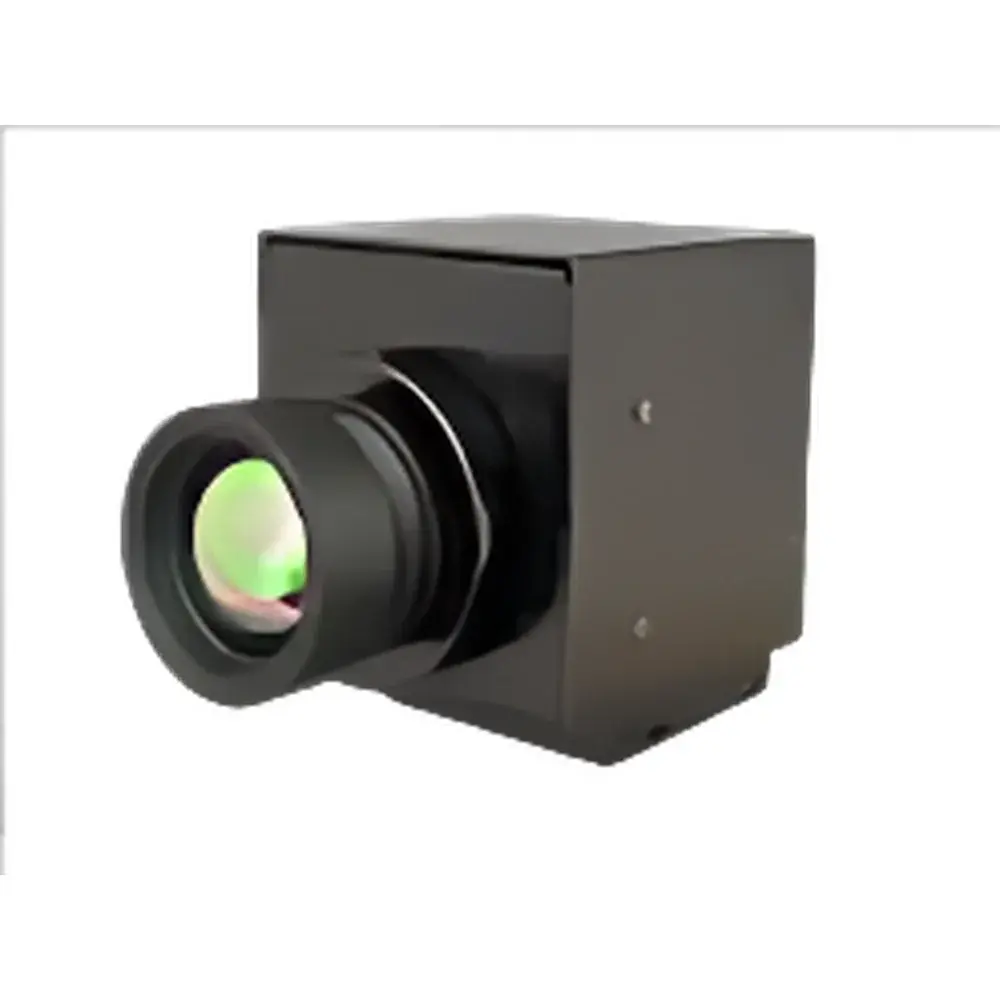
ARTRAY ARTCAM-640P2-THERMO Long-Wave Infrared Thermal Imaging Camera
| Brand | Artray |
|---|---|
| Origin | Japan |
| Model | ARTCAM-640P2-THERMO |
| Spectral Range | 8–14 µm |
| Thermal Resolution | 640 × 480 pixels |
| NETD | < 660 mK |
| Frame Rate | 50 fps |
| Temperature Range | 0–120 °C |
| Cooling Type | Thermoelectrically Cooled (TEC) |
| Detector Type | Uncooled Microbolometer Array |
| Measurement Method | Non-contact Radiometric Imaging |
| Interface | USB 2.0 |
| Software | ART-THERMO (included) |
Overview
The ARTRAY ARTCAM-640P2-THERMO is a high-performance, thermoelectrically cooled long-wave infrared (LWIR) thermal imaging camera engineered for precision radiometric temperature measurement and qualitative thermal analysis in industrial R&D, quality assurance, and non-destructive testing environments. Operating within the atmospheric transmission window of 8–14 µm, this camera leverages an uncooled microbolometer focal plane array (FPA) to detect minute thermal emissions from objects at ambient and elevated temperatures. Its spectral band selection ensures minimal atmospheric absorption and optimal sensitivity to blackbody radiation emitted by surfaces in the 0–120 °C range—making it particularly suitable for applications involving low-temperature differentials, such as electronic component thermal mapping, building envelope diagnostics, and polymer processing monitoring. Unlike photon-based detectors requiring cryogenic cooling, the microbolometer architecture delivers stable, drift-compensated performance without liquid nitrogen or Stirling coolers—reducing system complexity, power consumption, and operational overhead while maintaining high spatial and thermal reproducibility.
Key Features
- 640 × 480 pixel uncooled microbolometer detector with native LWIR response (8–14 µm)
- Thermoelectric (TEC) stabilization for improved thermal baseline stability and reduced drift over extended acquisition periods
- NETD better than 660 mK at 30 °C scene temperature, enabling reliable detection of subtle thermal gradients
- Real-time 50 Hz frame rate for dynamic thermal event capture, including transient heating/cooling cycles and moving targets
- USB 2.0 interface with plug-and-play compatibility—no external frame grabber or proprietary host hardware required
- Integrated radiometric calibration with emissivity correction, reflected apparent temperature compensation, and ambient temperature referencing
- Ruggedized aluminum housing rated for continuous operation in controlled laboratory and light industrial settings
Sample Compatibility & Compliance
The ARTCAM-640P2-THERMO supports non-contact thermal characterization of diverse materials—including metals, composites, ceramics, plastics, and biological specimens—without surface preparation or emissivity coating. Its 8–14 µm spectral response aligns with ISO 18434-1 (Condition monitoring and diagnostics of machines — Thermography — Part 1: General procedures) and complies with ASTM E1934-19 (Standard Guide for Examining Electrical and Mechanical Equipment with Infrared Thermography). While not certified for medical or hazardous-area use, the camera meets CE marking requirements for electromagnetic compatibility (EMC Directive 2014/30/EU) and low-voltage safety (LVD Directive 2014/35/EU). Data output formats (e.g., 16-bit TIFF, CSV radiometric metadata) support traceability under GLP and internal QA/QC protocols.
Software & Data Management
The included ART-THERMO software provides a dedicated platform for real-time visualization, quantitative analysis, and report generation. Key capabilities include region-of-interest (ROI) temperature statistics (min/max/mean/std dev), isotherm overlay, time-series thermal profiling, and emissivity-mapped false-color rendering. All thermal images embed embedded radiometric metadata (exposure time, lens ID, calibration date, ambient conditions) compliant with IEEE 1671-2021 (Standard for Common Data Format for Infrared Thermography). Export options support integration into MATLAB, Python (via NumPy-compatible .npy), and LabVIEW environments. Audit trail functionality records user actions, parameter changes, and calibration events—facilitating alignment with FDA 21 CFR Part 11 principles where electronic records are subject to regulatory review.
Applications
- Electronics thermal validation: PCB hotspot identification, IC junction temperature estimation, heatsink efficiency evaluation
- Materials science: Curing kinetics monitoring in composites, phase transition detection in polymers, thermal conductivity mapping
- Building diagnostics: Insulation integrity assessment, moisture ingress detection, HVAC duct leakage quantification
- Automotive R&D: Brake disc thermal distribution, battery pack thermal uniformity screening, cabin climate system optimization
- Academic research: Convective heat transfer visualization, flame structure analysis, low-temperature cryogenic surface characterization
FAQ
Is the ARTCAM-640P2-THERMO suitable for quantitative thermography in ISO/IEC 17025-accredited laboratories?
Yes—when used with documented calibration certificates (NIST-traceable), fixed-focus lenses, and validated emissivity settings, it supports measurement uncertainty budgets consistent with ISO/IEC 17025 clause 7.6.
Does the camera support external triggering or synchronization with other instruments?
No—the current firmware does not expose hardware trigger inputs; however, software-synchronized acquisition is achievable via timestamped USB polling at 50 Hz.
Can ART-THERMO export raw digital counts for custom radiometric processing?
Yes—16-bit raw sensor data (non-linearized) is accessible via SDK API for advanced users implementing custom Planck inversion or multi-wavelength algorithms.
What is the maximum operating ambient temperature for sustained use?
The unit is rated for continuous operation up to 40 °C ambient; above this, TEC cooling efficiency declines, potentially increasing NETD and baseline drift.
Is lens interchangeability supported?
Yes—standard C-mount interface allows compatibility with third-party LWIR lenses (e.g., 18 mm, 25 mm, 50 mm focal lengths), though factory calibration is lens-specific and must be re-performed after lens change.





