
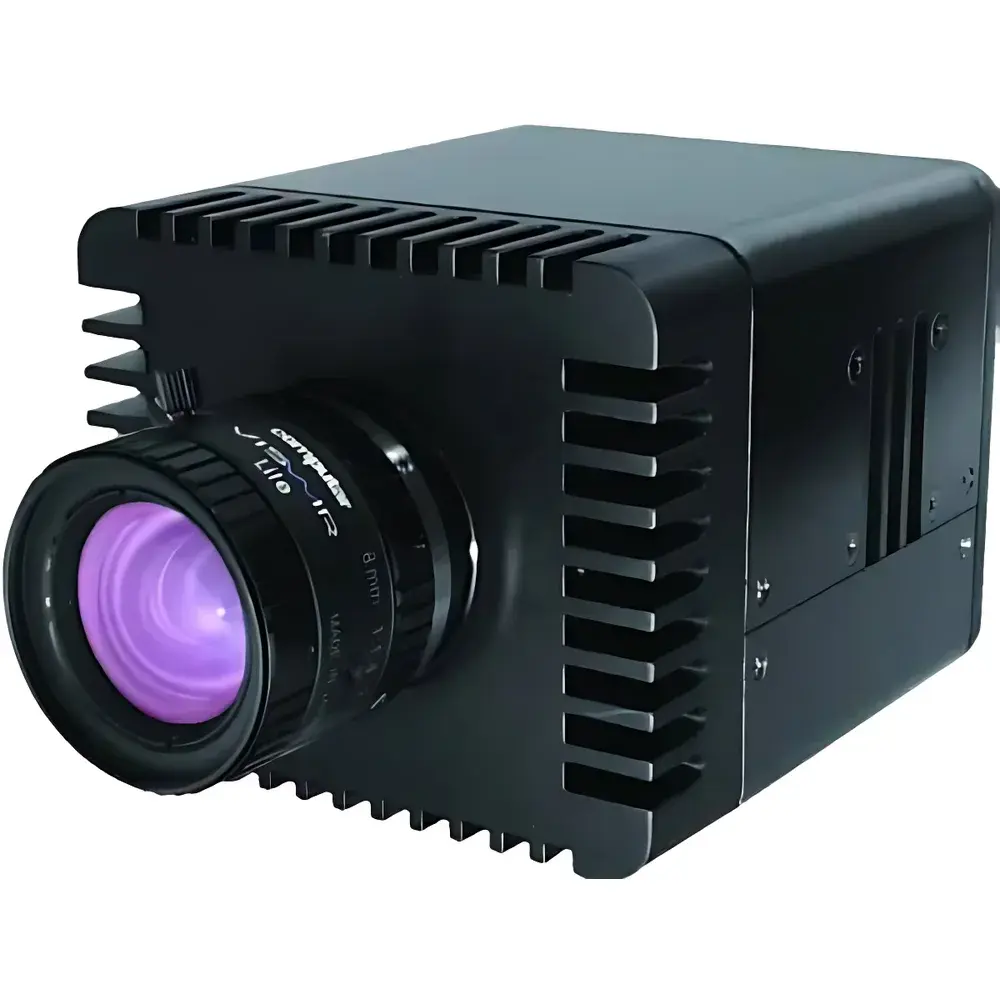
ARTRAY ARTCAM-990SWIR-TEC InGaAs Short-Wave Infrared Camera
| Brand | ARTRAY |
|---|---|
| Origin | Japan |
| Model | ARTCAM-990SWIR-TEC |
| Image Resolution | 1280 × 1024 |
| Pixel Size | 5 µm × 5 µm |
| Sensor Active Area | 6.4 mm × 5.12 mm |
| Dynamic Range | 60 dB |
| Quantum Efficiency | 80% (peak at 1300–1550 nm) |
| Spectral Range | 900–1700 nm (standard), extendable to 400–1700 nm or 1000–2500 nm |
| Interface | USB 3.0 Bulk Transfer |
| Output Bit Depth | 12-bit |
| Frame Rate | 72 fps (full resolution, 12-bit) |
| Shutter Speed | 20.3 µs – 2 s |
| Shutter Type | Global Shutter |
| Power Supply | 5 V DC via USB bus |
| Power Consumption | <11 W |
| Operating Temperature | 10–40 °C, 10–80% RH (non-condensing) |
| Storage Temperature | 0–60 °C, 10–95% RH (non-condensing) |
| Dimensions | 71.6 × 61.5 × 78.0 mm (W×H×D) |
| Weight | ~440 g |
| Lens Mount | C-mount |
Overview
The ARTRAY ARTCAM-990SWIR-TEC is a high-performance, thermoelectrically cooled (TEC) short-wave infrared (SWIR) imaging camera built around the Sony IMX990-AABA-C 1.3 MP InGaAs focal plane array. Engineered for precision in demanding scientific and industrial applications, it operates across the 900–1700 nm spectral band—covering critical wavelengths used in telecom (e.g., 1310 nm and 1550 nm laser diagnostics), semiconductor inspection, and material characterization. Unlike silicon-based CMOS/CCD sensors, the InGaAs photodiode array delivers intrinsic sensitivity in the SWIR region without requiring cryogenic cooling, while the integrated TEC stabilizes sensor temperature to suppress dark current and ensure temporal stability of responsivity. The global shutter architecture eliminates motion-induced distortion—essential for synchronized pulsed-laser imaging, high-speed machine vision, and quantitative radiometric measurements. Its USB 3.0 interface enables plug-and-play integration with standard industrial PCs, supporting sustained 12-bit data transfer at up to 72 frames per second.
Key Features
- High quantum efficiency (>80% peak) across 1300–1550 nm—optimized for telecom and laser diagnostics
- Thermoelectric cooling (TEC) for dark current reduction and long-exposure stability
- Global shutter operation ensures pixel-synchronous exposure—critical for time-resolved SWIR imaging
- 1280 × 1024 active pixels with 5 µm pitch, delivering high spatial resolution within a compact 1/2″ optical format
- 60 dB dynamic range and 51 dB SNR (typical), enabling simultaneous capture of low-contrast features and high-intensity hotspots
- USB 3.0 bulk transfer mode guarantees deterministic latency and full-bandwidth data streaming without frame dropping
- C-mount lens interface supports standardized optics, including SWIR-optimized aspheres and telecentric lenses
- Low power consumption (<11 W) and passive heat dissipation design—suitable for embedded OEM integration
Sample Compatibility & Compliance
The ARTCAM-990SWIR-TEC is compatible with a broad range of optical configurations, including collimated beam profiling, macro-scale fluorescence imaging, and micro-optical inspection setups. It accepts standard C-mount lenses with SWIR-transmissive coatings (e.g., CaF₂, ZnSe, or fused silica elements). No special illumination is required beyond broadband SWIR sources or pulsed lasers operating within its spectral response window. The camera meets CE and FCC Class B electromagnetic compatibility requirements. While not certified for medical or aerospace use out-of-the-box, its firmware architecture supports traceable calibration workflows aligned with ISO/IEC 17025 laboratory practices. Raw 12-bit image data output facilitates post-acquisition radiometric correction and compliance with internal QA/QC protocols requiring audit-ready metadata logging.
Software & Data Management
ARTRAY provides a cross-platform SDK (Windows/Linux/macOS) with C/C++, Python, and MATLAB APIs, enabling full control over exposure, gain, ROI, and trigger modes. The included acquisition software supports real-time histogram analysis, non-uniformity correction (NUC) map loading, and export to TIFF, HDF5, or AVI (uncompressed). Time-stamped metadata—including sensor temperature, exposure duration, and frame counter—is embedded in each image header. For regulated environments, the SDK supports integration with third-party platforms compliant with FDA 21 CFR Part 11 (via external audit trail modules) and GLP/GMP-aligned data archiving systems. All firmware updates are delivered via signed binary packages with SHA-256 verification.
Applications
- Laser beam profiling and M² measurement at 1064 nm, 1310 nm, and 1550 nm
- Non-destructive evaluation (NDE) of solar cells, including EL (electroluminescence) and PL (photoluminescence) defect mapping
- SWIR-based food quality inspection—detection of bruising, moisture gradients, and foreign contaminants in produce and grains
- Plastic sorting via spectral absorption fingerprinting (e.g., PET vs. PVC discrimination)
- Thin-film and wafer-level inspection in semiconductor fabrication
- Fluorescence lifetime imaging (FLIM) support when paired with gated illumination sources
- Thermal contrast enhancement in flame monitoring and combustion research
- Art conservation imaging—pigment identification and underdrawing visualization beneath varnish layers
FAQ
Does the ARTCAM-990SWIR-TEC require external power beyond USB?
No—it draws all operating power (≤11 W) from the USB 3.0 bus; no auxiliary power supply is needed.
Can I perform radiometric calibration with this camera?
Yes—the SDK provides access to raw ADC values and supports user-loaded NUC and flat-field correction matrices for quantitative intensity measurement.
Is the sensor sensitive below 900 nm?
With optional broadband AR coating and appropriate illumination, the extended spectral response reaches down to 400 nm; however, quantum efficiency drops significantly below 900 nm.
What is the maximum usable frame rate at full resolution with 12-bit output?
72 fps is guaranteed under continuous USB 3.0 bulk transfer with host-side buffering enabled.
How is sensor temperature stabilized during long acquisitions?
The integrated TEC maintains the InGaAs die within ±0.5 °C of setpoint, minimizing dark current drift over exposures exceeding 1 second.




