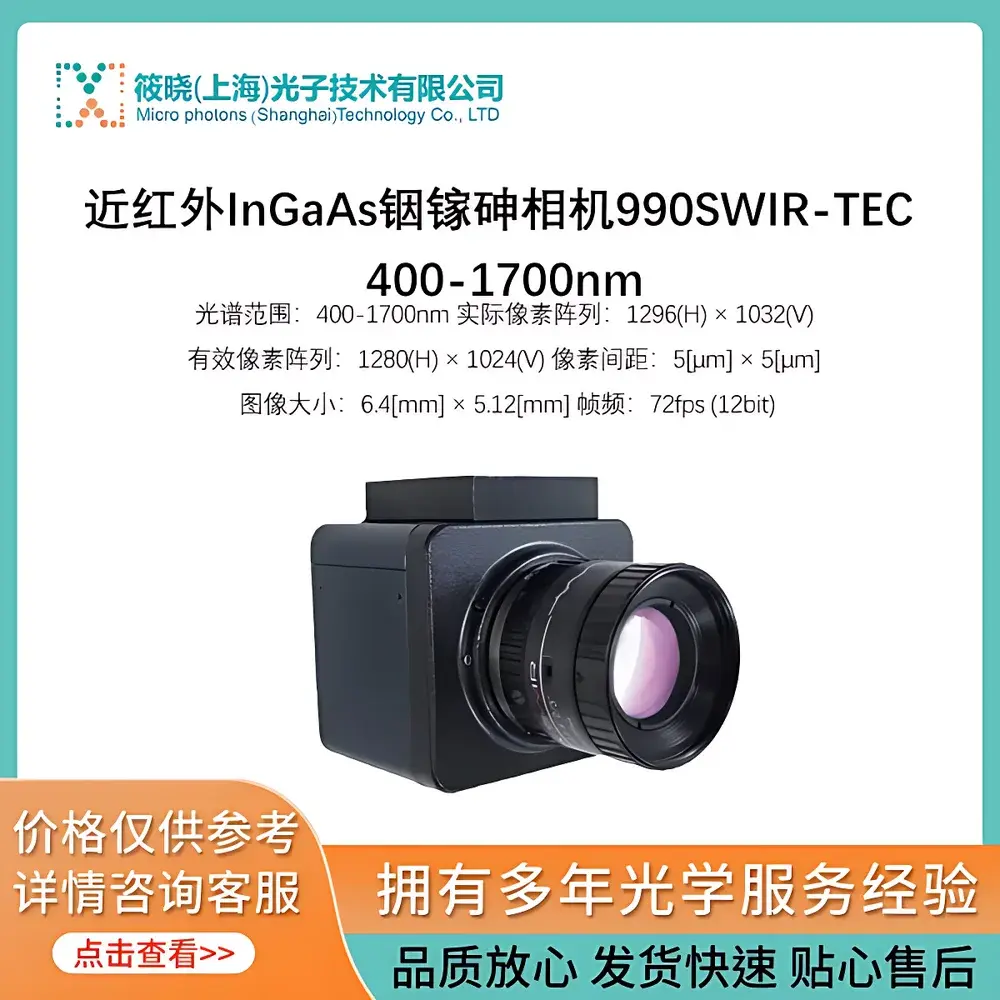
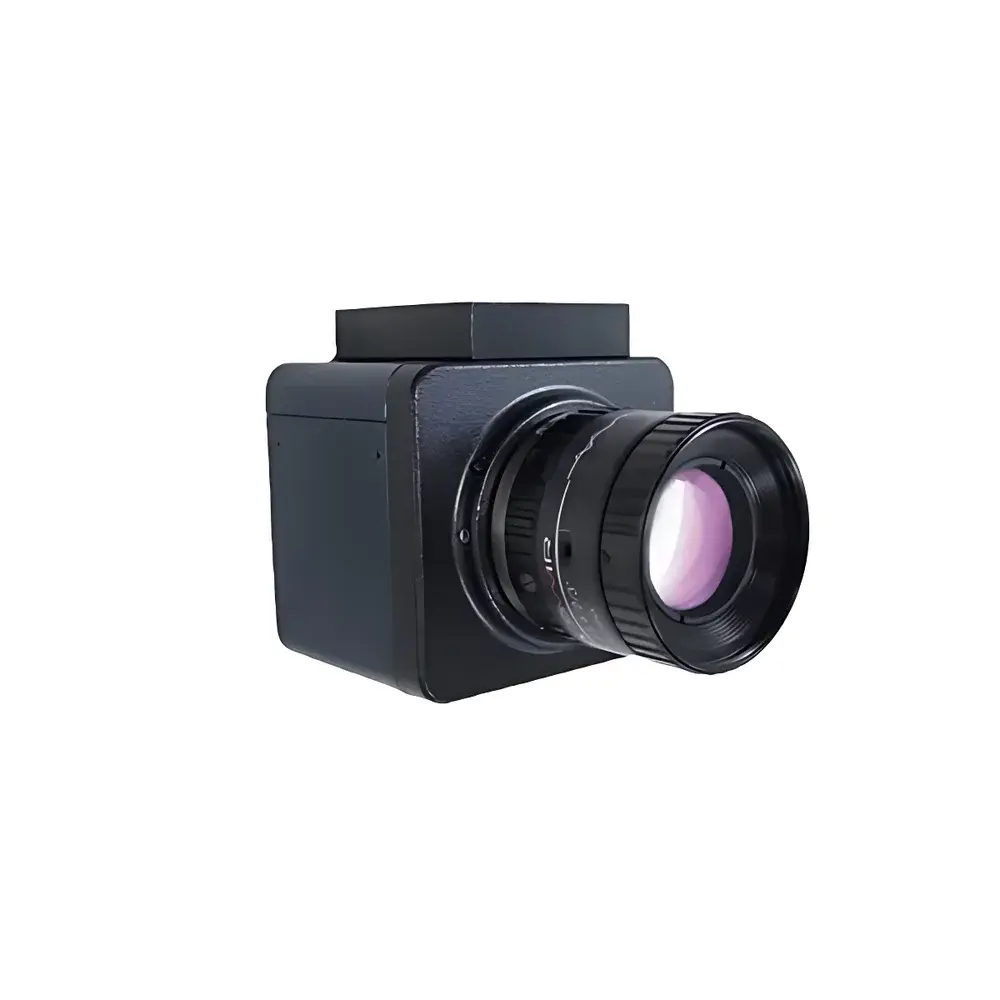
Artray ARTCAM-990SWIR-TEC InGaAs SWIR Camera
| Brand | Artray |
|---|---|
| Origin | Japan |
| Model | ARTCAM-990SWIR-TEC |
| Spectral Range | 400–1700 nm |
| Sensor Type | InGaAs (Indium Gallium Arsenide) |
| Cooling | Thermoelectrically Cooled (TEC) |
| Category | SWIR Imaging Camera |
Overview
The Artray ARTCAM-990SWIR-TEC is a high-sensitivity, thermoelectrically cooled short-wave infrared (SWIR) imaging camera engineered for precision scientific and industrial applications requiring spectral response from 400 nm to 1700 nm. Built around a high-performance InGaAs (indium gallium arsenide) focal plane array, this camera delivers low-noise, high-dynamic-range imaging in the critical SWIR band—enabling visualization of features invisible to silicon-based visible/NIR sensors. Unlike uncooled SWIR detectors, the integrated TEC stabilization maintains sensor temperature within ±0.1 °C, significantly reducing dark current drift and enabling stable, quantitative intensity measurements over extended acquisition periods. The device operates on the principle of photon detection via intrinsic absorption in the InGaAs semiconductor lattice, with optimized anti-reflection coatings and back-illuminated architecture to maximize quantum efficiency across the full 400–1700 nm range—including extended response into the visible (400–1000 nm) and conventional SWIR (900–1700 nm) bands. It is designed for integration into optical bench systems, inline process monitoring setups, and laboratory-grade spectroscopic instrumentation where spectral fidelity, thermal stability, and reproducible radiometric performance are essential.
Key Features
- Monolithic InGaAs sensor with 640 × 512 pixel resolution (standard configuration) and 15 µm pixel pitch
- Thermoelectric cooling (TEC) system maintaining sensor temperature at −10 °C to +25 °C (user-selectable setpoint), ensuring <1 e⁻/pix/sec dark current at −5 °C
- Full spectral coverage from 400 nm to 1700 nm, validated per ISO 11146 and JIS Z 8130 standards for spectral responsivity calibration
- 16-bit digitization with programmable gain and offset, supporting both global shutter and rolling shutter modes
- USB 3.2 Gen 1 interface with SDK support for Windows/Linux (C/C++, Python, MATLAB APIs included)
- Hermetically sealed, vacuum-compatible housing with SMA905 and M42 lens mounts; compliant with IEC 60529 IP52 for dust resistance
Sample Compatibility & Compliance
The ARTCAM-990SWIR-TEC supports non-contact, label-free imaging of diverse materials exhibiting characteristic SWIR absorption features—including silicon wafers, polymer films, pharmaceutical tablets, agricultural biomass, and semiconductor packaging. Its spectral range enables identification of O–H, C–H, and N–H vibrational overtones, making it suitable for moisture mapping, compositional analysis, and defect detection in GMP-regulated manufacturing environments. The camera complies with electromagnetic compatibility requirements per EN 61326-1:2013 (industrial environment), safety standards per IEC 61010-1:2010, and RoHS 2015/863/EU. While not FDA-cleared as a medical device, its radiometric stability and audit-trail-capable SDK facilitate use in GLP-compliant laboratories under controlled SOPs. Calibration certificates traceable to NMIJ (National Metrology Institute of Japan) are available upon request.
Software & Data Management
Artray provides the ART-VIEW suite—a modular, configurable application framework supporting real-time image acquisition, multi-frame averaging, region-of-interest (ROI) photometry, and linear/nonlinear radiometric correction. The SDK includes timestamped frame metadata (exposure time, sensor temperature, TEC voltage, trigger status), enabling full experimental traceability required for ISO/IEC 17025 accreditation. Export formats include 16-bit TIFF, HDF5, and CSV with embedded EXIF-like headers. For regulated environments, optional software modules support 21 CFR Part 11 compliance—including electronic signatures, user access control tiers, and immutable audit logs of all acquisition and processing parameters.
Applications
- Non-destructive evaluation (NDE) of solar cell metallization and wafer cracks
- In-line quality inspection of plastic sorting, food contamination screening, and tablet coating uniformity
- Time-resolved pump-probe experiments in ultrafast spectroscopy (with external sync input)
- Thermal emission imaging of low-temperature objects (e.g., electronics thermal profiling at 50–200 °C)
- Optical coherence tomography (OCT) source characterization and beam profiling
- Research in quantum optics involving telecom-band photon counting (when operated in photon-starved regimes with frame averaging)
FAQ
What is the typical integration time range for quantitative SWIR imaging?
Minimum exposure is 10 µs; maximum is 10 s (with TEC active). Optimal SNR is achieved between 1 ms and 500 ms depending on illumination intensity and scene reflectivity.
Is factory recalibration required annually?
No mandatory annual recalibration is specified; however, NMIJ-traceable recalibration is recommended every 24 months for metrology-critical applications or after mechanical shock events.
Can the camera be synchronized with external laser sources?
Yes—via TTL-compatible trigger input (rising-edge sensitive) with jitter <100 ns; supports master/slave timing configurations with programmable delay (0–100 ms, 1 µs resolution).
Does the SDK support third-party acquisition platforms like LabVIEW or NI Vision?
Yes—NI-DAQmx and LabVIEW 2020+ compatible drivers are provided; native support for HALCON, OpenCV 4.5+, and PyTorch-based inference pipelines is also included.
What environmental conditions are supported during continuous operation?
Ambient operating range: 0 °C to 40 °C, <80% RH non-condensing; storage range: −20 °C to 60 °C; no condensation permitted on cold window surface during cooldown ramp-up.