
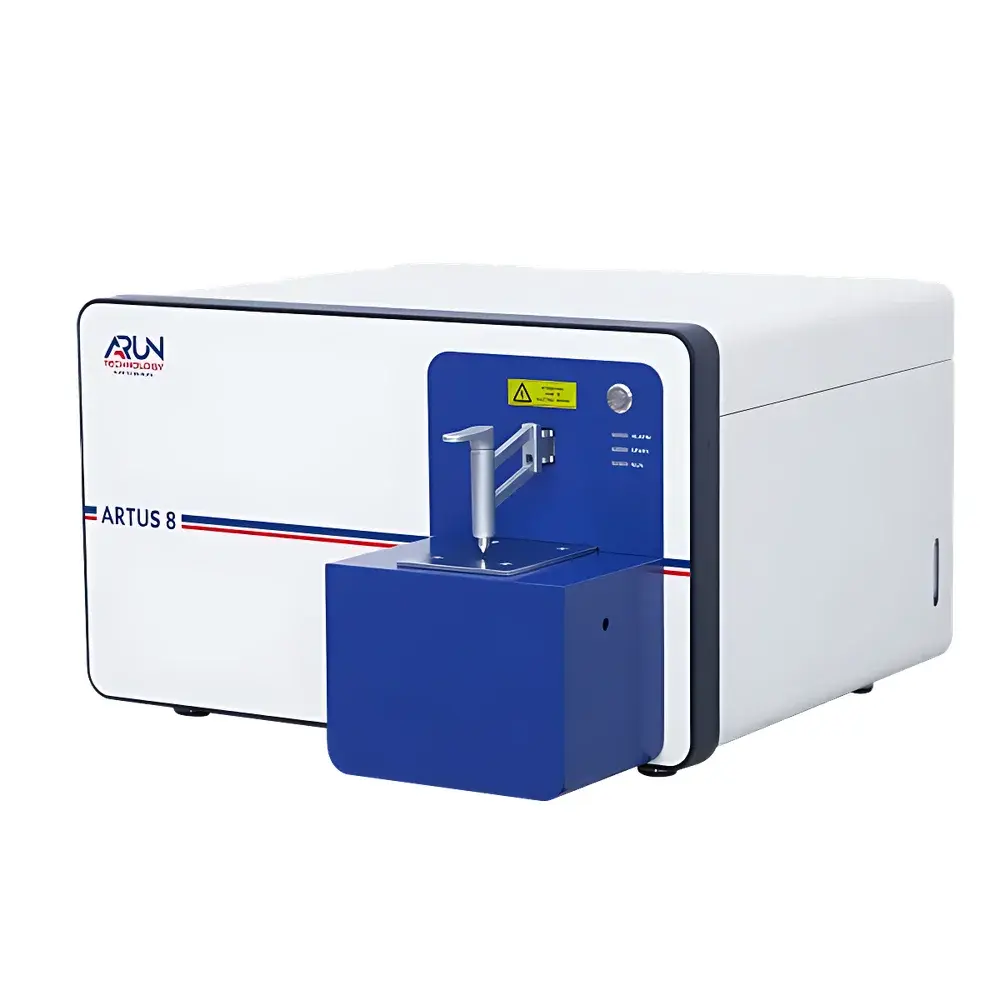
ARTUS 8 CCD-Based Full-Spectrum Spark Emission Spectrometer
| Brand | ARUN TECHNOLOGY LTD. |
|---|---|
| Origin | United Kingdom |
| Instrument Type | Benchtop |
| Excitation Method | Spark |
| Detector Type | High-Resolution CCD Array |
| Spectral Range | 130–700 nm |
| Optical Design | Paschen–Runge Mount with Dual Optical Chambers |
| Cooling | Thermostatically Controlled Enclosure (±0.1 °C) |
| Purge Medium | Argon |
| Compliance | ISO/IEC 17025-ready architecture, GLP/GMP-supporting data integrity features |
Overview
The ARTUS 8 is a benchtop, full-spectrum spark emission spectrometer engineered for high-precision elemental analysis of metallic materials. It operates on the principle of optical emission spectroscopy (OES), where a controlled spark discharge vaporizes and excites surface atoms of a conductive sample; the resulting element-specific spectral lines are dispersed and simultaneously detected across the ultraviolet–visible range (130–700 nm) using two independent Paschen–Runge optical chambers and high-quantum-efficiency CCD sensors. This dual-chamber configuration enables optimized detection of both vacuum UV elements (e.g., C, N, P, S) and visible-range elements (e.g., Fe, Al, Cu, Mn, Cr, Ni) within a single analysis cycle—without mechanical wavelength scanning or sequential channel switching. Designed for metrological robustness in production and R&D environments, the ARTUS 8 integrates thermal stabilization, argon-purged optics, real-time spectral drift correction, and digital pulse-controlled spark generation to deliver reproducible quantitative results at sub-ppm detection limits for key alloying and trace elements.
Key Features
- Dual Paschen–Runge optical chambers: One chamber optimized for UV transmission (130–190 nm) with enhanced MgF₂-coated optics; second chamber covering 190–700 nm with high-line-density gratings and minimized stray light.
- High-resolution CCD detection: Two back-illuminated, thermoelectrically cooled CCD arrays provide simultaneous acquisition of the entire spectrum, eliminating sequential readout delays and enabling post-acquisition reprocessing of calibration models.
- Argon-purged, pressure-stabilized optical enclosure: Maintains constant internal pressure differential to prevent mechanical deformation of optical mounts under ambient barometric fluctuations—critical for long-term wavelength fidelity.
- Precision thermostatic control: Optical chamber temperature regulated to ±0.1 °C via dual-stage Peltier modules, exceeding industry-standard stability requirements and minimizing thermal lensing effects.
- Real-time spectral alignment correction (RTSAC): Uses internal reference lines and dynamic centroid tracking to compensate for thermal or mechanical drift—ensuring peak position stability across operating temperatures from 15 °C to 35 °C.
- High-energy digital spark source: Fully programmable pulse synthesis engine allows independent control of pre-spark, integration, and tail phases; configurable per matrix and element group to maximize signal-to-background ratio and reduce oxide interference.
Sample Compatibility & Compliance
The ARTUS 8 supports solid, electrically conductive metallic samples—including cast iron, stainless steel, aluminum alloys, titanium, copper-based alloys, and nickel superalloys—without requiring matrix-specific hardware changes. Sample preparation follows ASTM E415, ISO 11577, and GB/T 4336 standards. The instrument’s firmware and software architecture support audit trails, electronic signatures, and data immutability in accordance with FDA 21 CFR Part 11 and EU Annex 11 requirements when deployed with optional Mini-LIMS (SQL-based) configuration. All calibration and validation procedures are documented to meet ISO/IEC 17025 clause 5.4 and 5.9 requirements for testing laboratories.
Software & Data Management
The ARTUS 8 runs on a Windows-based, fully graphical user interface with intuitive workflow navigation—requiring less than two hours for operator proficiency. Core functions include automatic grade identification (iAPS algorithm), pass/fail result flagging against user-defined specification limits, and multi-matrix calibration management. Quantitative analysis employs Optimized Multivariate Regression (OMVR), which corrects for inter-element interference and matrix effects more effectively than classical univariate methods. The ASR (Aberrant Spark Removal) algorithm filters out non-representative discharges in real time using statistical outlier detection on intensity, background, and line-ratio metrics. Optional Mini-LIMS integration provides structured SQL database storage, role-based access control, instrument usage logging, and remote diagnostic telemetry via TLS-secured HTTPS endpoints.
Applications
The ARTUS 8 is routinely deployed in foundry quality assurance, scrap metal sorting, incoming raw material verification, aerospace component certification, and academic metallurgical research. Typical use cases include rapid verification of carbon equivalency in structural steels, sulfur segregation mapping in large ingots, phosphorus content control in low-alloy steels, nitrogen determination in austenitic stainless grades, and trace boron quantification in high-strength aluminum alloys. Its analytical repeatability (RSD < 0.8% for major elements, < 3.5% for trace elements at 10 ppm level) supports compliance with ASTM E1086, ISO 6892-1, and EN 10088-3 reporting requirements.
FAQ
What sample forms can be analyzed on the ARTUS 8?
Solid, flat, or cylindrical metallic specimens up to 32 kg—compatible with standard 32-mm-diameter electrodes and gravity-driven clamping.
Is vacuum pumping required for operation?
No. The optical system uses continuous argon purge at regulated flow and pressure—eliminating vacuum pumps, oil contamination risks, and associated maintenance.
Can the ARTUS 8 analyze non-ferrous matrices without hardware modification?
Yes. Multi-matrix calibrations (Fe-, Al-, Cu-, Ni-, Ti-, and Mg-based) are implemented entirely in software; no optical or detector reconfiguration is needed.
How is measurement traceability maintained?
Each analysis includes embedded metadata: timestamp, operator ID, calibration version, spark count, spectral SNR, and environmental sensor readings (temperature, pressure, humidity)—all stored with SHA-256 hash integrity verification.
Does the system support remote diagnostics and software updates?
Yes. With enabled network mode, ARUN-certified engineers can initiate secure remote sessions for performance validation, spectral recalibration assistance, and firmware patch deployment—subject to customer-configured firewall policies.
Related Products





