
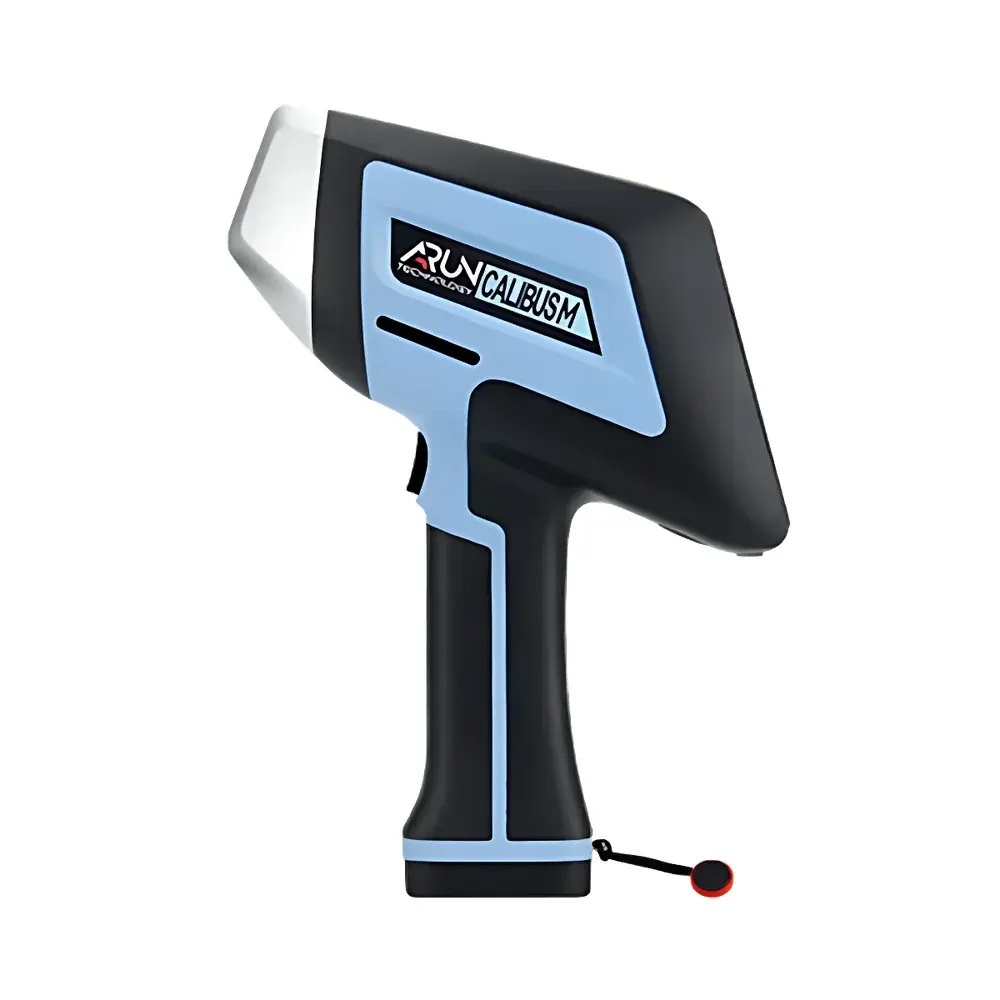
ARUN Calibus M Handheld Laser-Induced Breakdown Spectroscopy (LIBS) Analyzer
| Brand | ARUN TECHNOLOGY LTD. |
|---|---|
| Origin | United Kingdom |
| Model | Calibus M |
| Instrument Type | Portable / Field-Deployable LIBS Analyzer |
| Optical Range | 190–700 nm |
| Detector | CMOS Array |
| Laser | Q-switched Nanosecond Solid-State, <0.1 °C Thermal Stability Control |
| Pulse Width | Nanosecond |
| Argon Purge | Integrated Recirculating System (≥200 analyses per charge) |
| Operating Temperature | –10 °C to +40 °C |
| Safety | Class 4 Laser (IEC 60825-1 compliant), Interlocked Trigger, Zero X-ray Emission |
| Quantification Method | Empirical Calibration with Multi-Parameter Spectral Correction (Background Subtraction, Matrix Correction, Spectral Drift Compensation) |
Overview
The ARUN Calibus M is a field-deployable handheld Laser-Induced Breakdown Spectroscopy (LIBS) analyzer engineered for rapid, in-situ elemental analysis of solid materials without sample preparation. It operates on the fundamental principle of laser ablation: a focused nanosecond-pulse solid-state laser generates a transient microplasma on the sample surface; emitted atomic and ionic line spectra are collected and resolved across a broad spectral window (190–700 nm) to identify and quantify elemental composition. Unlike XRF or OES-based systems, LIBS enables direct detection of light elements—including Li, Be, and B—critical for lithium- and beryllium-bearing ore evaluation, battery cathode material screening, and secondary resource recovery workflows. Its robust mechanical architecture, integrated thermal management, and argon-purged optical path ensure analytical stability under variable ambient conditions—from mining sites to recycling facilities—making it suitable for GLP-aligned field laboratories and QA/QC operations requiring trace-level light-element sensitivity.
Key Features
- High-repetition-rate nanosecond solid-state laser with active thermal stabilization (<0.1 °C precision), ensuring plasma reproducibility and signal consistency across extended measurement sequences.
- Triple-chamber optical design optimized for spectral resolution and stray-light suppression, delivering high-fidelity line profiles across the full 190–700 nm range—enabling simultaneous detection of >30 elements including C, P, S, Si, Al, Mg, Fe, Mn, Cr, Ni, Co, Li, Be, and B.
- Back-thinned CMOS detector with low read noise and high quantum efficiency, supporting sub-ppm detection limits for select elements in optimized matrices (e.g., Li in spodumene, Be in bertrandite).
- Onboard argon recirculation system: proprietary sealed-loop purge mechanism eliminates consumable gas cylinders; single charge supports ≥200 consecutive analyses with background noise reduction below 0.5% RMS baseline fluctuation.
- Integrated HD imaging module with real-time overlay of laser spot location and spectral acquisition zone—enabling micro-area targeting (spot size ≈ 50–100 µm), image-annotated data logging, and spatial mapping of heterogeneity.
- Embedded PID-controlled thermal regulation maintains optical alignment and grating calibration across –10 °C to +40 °C ambient operation—validated per IEC 61326-1 environmental testing protocols.
Sample Compatibility & Compliance
The Calibus M is validated for direct analysis of conductive and non-conductive solids—including ores, slags, battery electrode scrap, ceramics, alloys, and geological core fragments—without polishing, pressing, or vacuum requirements. It complies with IEC 60825-1:2014 (Class 4 laser safety), carries CE marking under the EU Machinery Directive 2006/42/EC and EMC Directive 2014/30/EU, and meets RoHS 2011/65/EU substance restrictions. While not a regulated medical device, its quantitative outputs support ASTM E2926-21 (Standard Test Method for Analysis of Lithium Ion Battery Cathode Materials by LIBS) and ISO 11885:2019 (water and wastewater analysis reference methodology adaptation). Full audit trails, user-access logs, and instrument parameter locking align with FDA 21 CFR Part 11 readiness for regulated industrial QA environments.
Software & Data Management
The embedded ARUN SpectraSuite™ v4.2 firmware includes factory-calibrated quantification models derived from >1,000 certified reference materials spanning ferrous/non-ferrous metals, geological standards (e.g., USGS, CANMET), and battery-grade cathode powders. Algorithms incorporate iterative background subtraction (including proprietary carbon-peak modeling), inter-element interference correction (e.g., Fe II 238.204 nm overlap on V I 238.202 nm), real-time spectral drift compensation via internal reference lines, and matrix-matched normalization. Data export supports CSV, XML, and ASTM E1382-compliant spectral metadata formats. Optional cloud synchronization (ARUN CloudLink™) enables centralized method deployment, cross-instrument calibration harmonization, and secure multi-user role management (Admin, Analyst, Viewer) with TLS 1.3 encryption.
Applications
- Lithium exploration & grade control: Rapid Li quantification in pegmatites (spodumene, lepidolite), brine concentrates, and recycled black mass—supporting ASTM D8288-22 decision thresholds.
- Beryllium-bearing mineral assessment: Direct Be detection in bertrandite and beryl ores at ≤100 ppm LOD, eliminating hazardous HF digestion required by ICP-MS.
- Electric vehicle battery recycling: On-line sorting of NMC/NCA/LFP cathodes, anode graphite carbon content verification, and Cu/Al foil contamination screening.
- Scrap metal trading: Alloy identification (e.g., Ti-6Al-4V vs. CP-Ti), tramp element verification (Sn, Pb, Bi), and regulatory compliance checks against ELV Directive Annex II limits.
- Geochemical field surveys: Real-time lithological discrimination, pathfinder element mapping (e.g., As-Sb-Bi in gold exploration), and drill-core logging integration via GPS-tagged spectral records.
FAQ
Does the Calibus M require external gas supply or consumables?
No. It uses an integrated recirculating argon system with a proprietary pressure-regulated reservoir; no disposable cylinders, filters, or laser replacement parts are required over its operational lifetime.
Can it quantify carbon in steel or graphite electrodes?
Yes. Its 193 nm C I line detection, combined with dynamic background subtraction and atmospheric correction algorithms, enables carbon quantification in metallic and carbonaceous matrices with ±0.02 wt% repeatability (n=10, CRMs).
Is spectral data export compatible with third-party chemometric software?
Yes. Raw and processed spectra are exportable as ASCII-encoded .csv or .jdx files, retaining full wavelength-intensity metadata, enabling PCA, PLS-R, or SVM modeling in MATLAB, Python (scikit-learn), or Unscrambler®.
How is calibration maintained during temperature fluctuations?
A dual-stage thermal control system—comprising Peltier-cooled detector housing and grating chamber, regulated by adaptive PID loops—holds optical path length and dispersion stability within ±0.05 pixels across the specified operating range.
What safety certifications does the instrument hold?
It is certified to IEC 60825-1:2014 (Class 4 laser product), EN 61000-6-2/6-4 (EMC immunity/emission), and carries UKCA and CE marks. No radiation safety licensing is required due to zero X-ray generation.



