
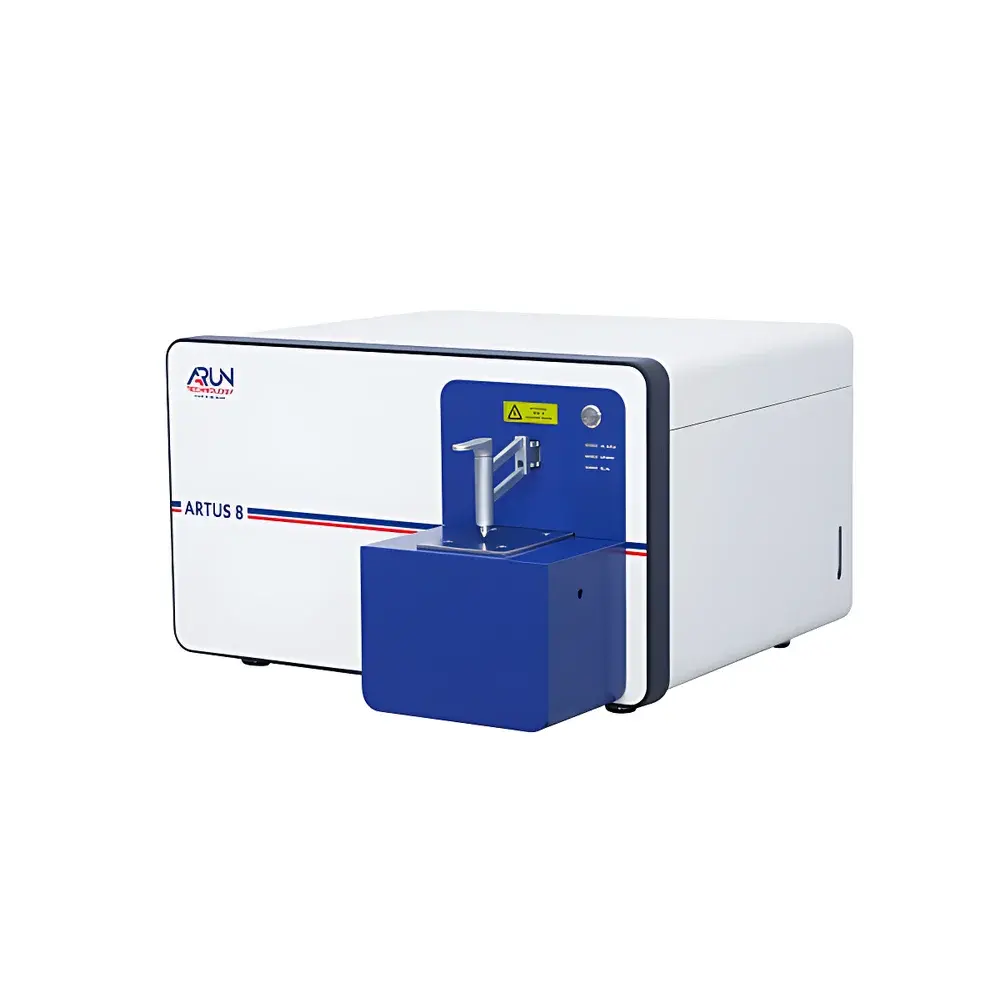
Arun Technology ARTUS 8 Benchtop CCD Spark Emission Spectrometer
| Brand | Arun Technology Ltd. |
|---|---|
| Origin | United Kingdom |
| Instrument Type | Benchtop |
| Excitation Method | Spark |
| Detector Type | Charge-Coupled Device (CCD) |
| Spectral Range | Configurable (130–700 nm) |
| Optical Design | Paschen-Runge Mount with Long Focal Length |
| Gas Environment | Argon-Flushed Optical Chamber |
| Temperature Control Accuracy | ±0.1 °C |
| Software Compliance | Supports 21 CFR Part 11 Audit Trail & GLP/GMP Data Integrity Requirements |
| Sample Handling | Open-Design Spark Stand with Gravity-Driven Electrode, 32 kg Max Load |
Overview
The Arun Technology ARTUS 8 is a benchtop spark emission spectrometer engineered for high-precision elemental analysis of metallic samples in industrial and research laboratories. It operates on the principle of optical emission spectroscopy (OES), where a controlled spark discharge vaporizes and excites surface atoms of a conductive sample; the emitted light is dispersed via a Paschen-Runge optical system and captured simultaneously across the full spectral range (130–700 nm) by a high-sensitivity CCD detector. Unlike sequential or PMT-based instruments, the ARTUS 8’s full-spectrum acquisition architecture enables multi-element quantification without mechanical wavelength scanning—ensuring rapid, reproducible results with inherent calibration stability. Its dual-optical-chamber design isolates ultraviolet-sensitive elements (C, N, P, S) from visible-range transitions, significantly improving detection fidelity for low-wavelength emitters critical in alloy certification and process control.
Key Features
- Dual Paschen-Runge optical chambers optimized for UV and VIS/NIR spectral regions, enhancing resolution and signal-to-noise ratio for carbon, nitrogen, phosphorus, and sulfur
- High quantum-efficiency CCD detector with full-frame readout, enabling simultaneous capture of all spectral lines within the 130–700 nm range
- Argon-purged optical chamber maintained at constant overpressure (not vacuum), eliminating mechanical stress on gratings and mirrors caused by pressure differentials
- Active thermal stabilization system with ±0.1 °C precision—more than twice the industry-standard temperature control accuracy—minimizing thermal drift of spectral line positions
- Integrated optical pressure compensation mechanism to maintain consistent mechanical alignment of optical components under ambient environmental fluctuations
- Real-time spectral shift correction algorithm that dynamically adjusts peak integration windows during analysis, preserving quantitative accuracy across wide ambient temperature ranges (15–35 °C)
- Digitally synthesized high-energy pre-ignition pulse source with independently programmable spark parameters per element/matrix combination
- Aberrant Spark Removal (ASR) algorithm that identifies and excludes non-representative discharges from integration, improving measurement robustness for heterogeneous or oxidized surfaces
Sample Compatibility & Compliance
The ARTUS 8 accepts solid, electrically conductive metal samples—including ferrous and non-ferrous alloys, castings, forgings, and machined parts—without requiring dissolution or matrix-matching standards. Its open-design spark stand accommodates irregular geometries up to 32 kg, while gravity-driven electrode compression ensures uniform plasma contact across flat, curved, or rough surfaces. The instrument complies with ISO 11577:2020 (Metallic materials — Spark optical emission spectrometry), ASTM E415-22 (Standard Test Method for Analysis of Carbon and Low-Alloy Steel), and supports traceability frameworks required under ISO/IEC 17025:2017. Full audit trail logging, electronic signature support, and secure user-role management align with FDA 21 CFR Part 11 and EU Annex 11 requirements for regulated environments.
Software & Data Management
The ARTUS 8 is operated via a fully graphical Windows-based software suite with intuitive workflow navigation—requiring less than two hours for routine operator proficiency. Key modules include: iAPS (intelligent Alloy Pattern Search), which auto-classifies unknown samples against a configurable library of international grade specifications (e.g., ASTM, EN, GB, JIS); OMVR (Optimized Multivariate Regression) calibration engine for enhanced matrix-effect correction; and Mini-LIMS option with SQL backend for structured data storage, report generation, and cross-instrument result comparison. Remote diagnostics and firmware updates are supported via encrypted TLS-secured network protocols, enabling centralized fleet management without on-site intervention.
Applications
Primary deployment domains include foundry quality assurance (Fe, Al, Cu, Mg, Ni, and Ti-based alloys), incoming material verification in automotive and aerospace supply chains, scrap metal sorting, R&D metallurgy labs, and third-party testing facilities performing ISO/IEC 17025-accredited analyses. The instrument delivers reliable ppm-level quantification for residual and tramp elements (e.g., Sn, Pb, As, Bi in steels), critical interstitials (C, N, O, S), and major alloying constituents (Cr, Mo, V, Co, Nb)—supporting compliance with specification limits defined in ASTM A751, EN 10027, and MIL-STD-882.
FAQ
Does the ARTUS 8 require vacuum pumping for operation?
No—the optical chamber uses continuous argon purging at slight overpressure, eliminating vacuum pumps, associated maintenance, and risk of chamber deformation.
Can calibration models be transferred between ARTUS 8 units?
Yes—calibration files, including OMVR coefficients and spectral libraries, are portable across identical ARTUS 8 configurations when validated per ISO 17025 transfer protocols.
Is the system compatible with existing LIMS infrastructure?
The optional Mini-LIMS module provides ODBC and REST API interfaces for bidirectional data exchange with enterprise laboratory information management systems.
What maintenance intervals are recommended for routine operation?
Daily argon flow verification, weekly electrode cleaning, and quarterly optical window inspection constitute the standard preventive maintenance schedule—no lamp replacement or grating recalibration is required during normal service life.
Related Products




