
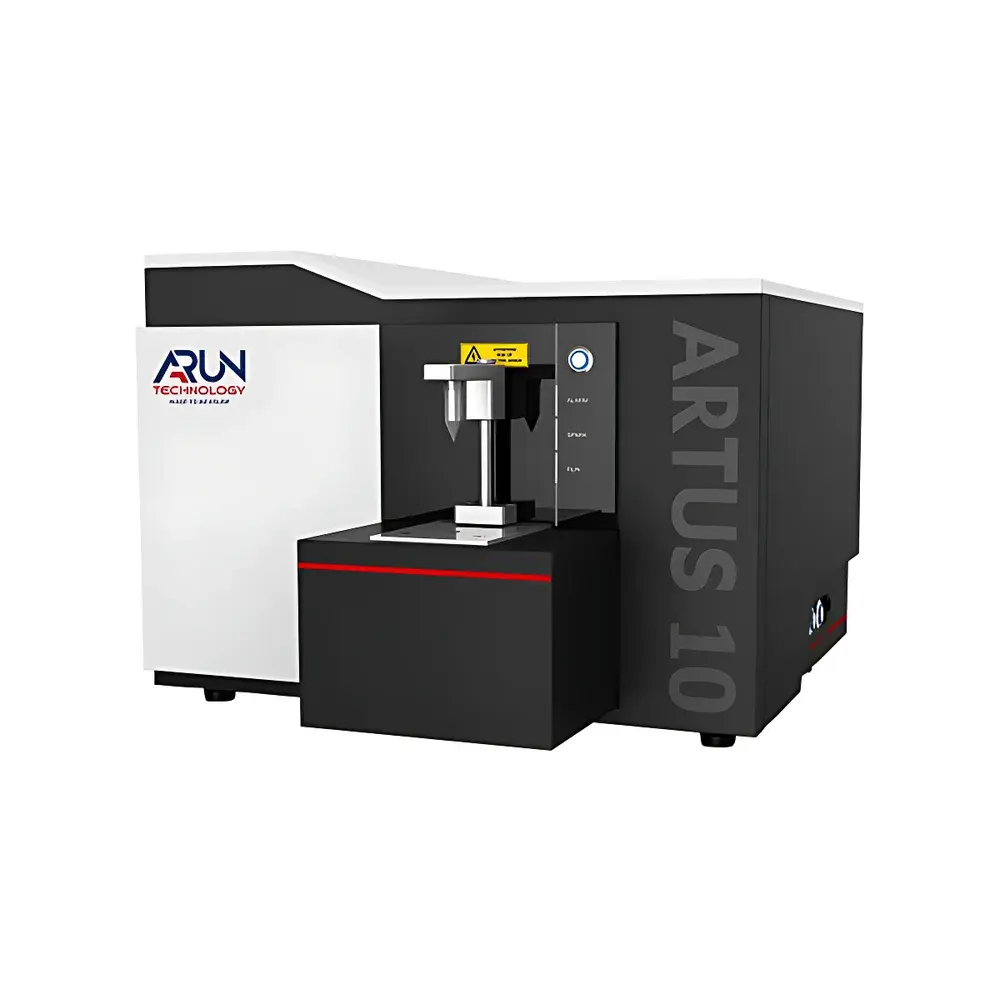
ARUN TECHNOLOGY ARTUS 8 U Benchtop Direct-Reading Spark Optical Emission Spectrometer
| Brand | ARUN TECHNOLOGY LTD. |
|---|---|
| Origin | United Kingdom |
| Model | ARTUS 8 U |
| Instrument Type | Benchtop |
| Excitation Method | Spark |
| Detector Type | High-Resolution CCD Array |
| Focal Length | 400 mm |
| Grating Line Density | 2400 l/mm (Visible), 3600 l/mm (UV) |
| Wavelength Range | 140–680 nm |
| Spectral Acquisition Mode | Full-Spectrum Direct Reading |
Overview
The ARUN TECHNOLOGY ARTUS 8 U is a benchtop spark optical emission spectrometer (OES) engineered for high-precision elemental analysis of metallic alloys in production, quality control, and research laboratory environments. Based on the Paschen–Runge optical configuration with a 400 mm focal length, the instrument employs dual optical chambers—each optimized for distinct spectral regions—to ensure superior resolution and sensitivity across the full UV–VIS range (140–680 nm). The system utilizes a high-quantum-efficiency CCD detector array to capture the entire spectrum simultaneously, enabling true full-spectrum direct reading without mechanical scanning. This architecture supports quantitative multi-element analysis—including light elements such as C, N, P, and S—with detection limits routinely reaching sub-ppm levels in solid metal matrices. The ARTUS 8 U is designed for robust operation under variable ambient conditions, incorporating active thermal stabilization (±0.1 °C), argon-purged optical chambers, and real-time spectral drift correction—ensuring long-term measurement reproducibility and compliance with ISO 17025, ASTM E415, and EN 10052 requirements.
Key Features
- Dual optical chamber design: Separate UV-optimized and visible-optimized optical paths enhance signal-to-noise ratio for critical light elements (C, N, P, S) and transition metals alike.
- Full-spectrum CCD acquisition: Captures all wavelengths from 140 nm to 680 nm in a single exposure, eliminating sequential scanning delays and enabling retrospective re-analysis of stored spectra.
- Paschen–Runge mount with 400 mm focal length and high-line-density gratings (2400 l/mm visible, 3600 l/mm UV): Delivers >30% increase in usable spectral line density versus conventional 350 mm systems, improving peak separation and reducing inter-element interference.
- Argon-purged optical chamber with pressure-balanced sealing: Maintains stable internal pressure differential to prevent mechanical deformation during extended operation—critical for maintaining optical alignment over months of continuous use.
- High-energy digital spark source with independently programmable pulse parameters: Enables precise tuning of pre-spark, integration, and tailing phases per element/matrix combination, supporting standardized and custom excitation protocols per ASTM E1479 and ISO 11577.
- Active thermal management: Integrated Peltier-based chamber cooling and air-circulated housing maintain optical path temperature stability within ±0.1 °C—exceeding typical industry benchmarks by a factor of two—and minimizing thermally induced wavelength drift.
- ASR (Aberrant Spark Removal) algorithm: Automatically identifies and excludes outlier sparks caused by surface contamination or microstructural heterogeneity, improving precision in heterogeneous castings or recycled scrap.
Sample Compatibility & Compliance
The ARTUS 8 U accepts flat, cylindrical, or irregularly shaped metallic samples up to 32 kg via its gravity-driven, open-type spark stand with rapid thermal dissipation. Compatible with ferrous (steels, cast irons), non-ferrous (Al, Cu, Mg, Zn, Ti, Ni alloys), and precious metal matrices, it supports analysis according to ISO 11577 (spark OES general requirements), ASTM E1479 (standard practice for calibration of OES), and ASTM E415 (carbon and low-alloy steels). Its optical design meets the spectral resolution criteria defined in ISO 14284 for carbon determination in steel. The instrument’s firmware and software architecture support audit trails, electronic signatures, and data integrity features aligned with FDA 21 CFR Part 11 and EU Annex 11 when configured with optional Mini-LIMS modules.
Software & Data Management
The ARTUS 8 U runs on a Windows-based, fully graphical user interface with intuitive workflow navigation—requiring less than two hours for operator proficiency. Core analytical functions include automatic grade identification (iAPS), pass/fail evaluation against user-defined specification limits, and multivariate calibration using Optimized Multi-Variable Regression (OMVR). All spectral data are stored in vendor-neutral HDF5 format; optional SQL-backed Mini-LIMS enables traceability across batches, operators, and instruments. Remote diagnostics and firmware updates are supported via secure TLS-encrypted network connections. Software validation documentation (IQ/OQ/PQ templates) and GxP-compliant audit trail logs are available upon request.
Applications
- Foundry process control: Rapid verification of melt chemistry prior to casting, including residual element monitoring (e.g., Sn, As, Pb) in aluminum alloys.
- Scrap sorting and recycling: Identification of alloy families and quantification of tramp elements affecting recyclability.
- Mechanical manufacturing QA/QC: Incoming material verification, heat treatment validation, and weld deposit analysis.
- R&D laboratories: Development of new alloy compositions, phase diagram studies, and corrosion resistance correlation with elemental partitioning.
- Third-party testing labs: Accredited testing per ISO/IEC 17025, with documented uncertainty budgets and inter-laboratory comparison reporting capabilities.
FAQ
What sample preparation is required for spark OES analysis?
Flat, clean, and representative surfaces must be ground or milled immediately before analysis; no chemical dissolution or pelletization is needed.
Can the ARTUS 8 U analyze coated or plated metals?
Yes—depth profiling is achievable via controlled spark erosion; however, quantitative results reflect bulk composition unless calibrated for coating thickness and matrix effects.
Is vacuum pumping required for UV spectral lines?
No—the argon-purged optical chamber eliminates oxygen absorption below 190 nm, enabling reliable C, P, S, and N measurement without vacuum maintenance.
How frequently does the instrument require recalibration?
Typical recalibration intervals range from 8–12 hours of continuous operation or after major environmental shifts; automated daily standardization routines minimize downtime.
Does the system support GLP/GMP documentation workflows?
Yes—when deployed with Mini-LIMS and enabled audit trail settings, it satisfies ALCOA+ data integrity principles and supports full electronic record retention for regulatory audits.




