
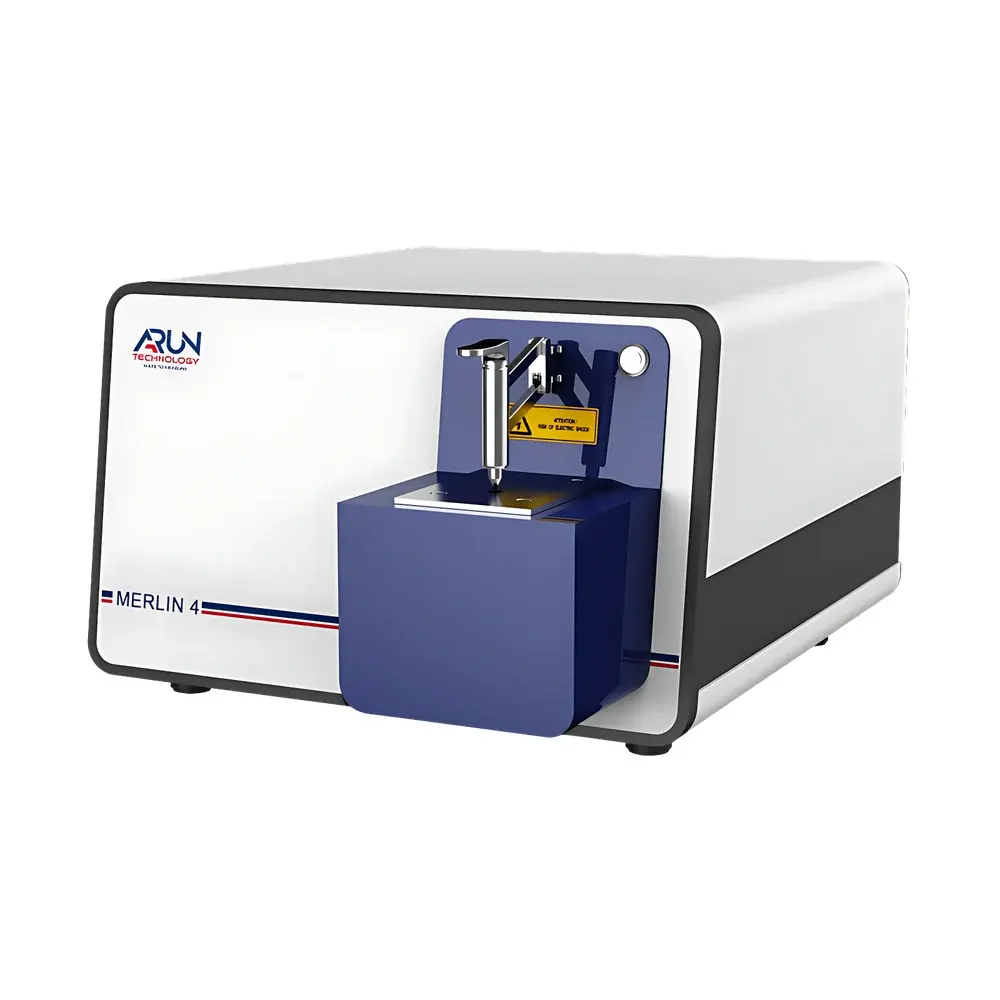
Arun Technology MERLIN 4 Full-Spectrum Direct-Reading Optical Emission Spectrometer
| Brand | Arun Technology Ltd. |
|---|---|
| Origin | United Kingdom |
| Instrument Type | Benchtop |
| Model | MERLIN 4 |
| Excitation | Spark Source |
| Optical System | Paschen-Runge Mount with Holographic Concave Grating |
| Detector | High-Resolution CCD Array |
| Spectral Range | 130–800 nm |
| Resolution | ≤ 10 pm at 200 nm |
| Sample Stage | Motorized X-Y Translation with Open Spark Stand |
| Compliance | ASTM E415, ISO 11577, GB/T 4336 |
Overview
The Arun Technology MERLIN 4 is a benchtop full-spectrum direct-reading optical emission spectrometer (OES) engineered for high-precision elemental analysis of metallic alloys in industrial and research environments. It operates on the principle of spark-induced atomic emission spectroscopy: a controlled high-voltage spark excites atoms in a solid metal sample, causing them to emit characteristic wavelengths of ultraviolet and visible light. These emissions are dispersed by a holographic concave grating within a sealed, vacuum-free Paschen-Runge optical bench and simultaneously detected across the full spectral range (130–800 nm) using a thermoelectrically cooled, back-thinned CCD array. This architecture eliminates the need for vacuum pumping or purging—reducing operational complexity while maintaining long-term wavelength stability and signal-to-noise ratio. Designed for routine QC/QA workflows, the MERLIN 4 delivers rapid, multi-element quantification (from C, P, S, N to trace rare earths and transition metals) with analytical repeatability < 1.5% RSD for major alloying elements under standardized conditions.
Key Features
- Benchtop footprint with robust cast-aluminum optical housing, optimized for vibration resistance and thermal stability in factory-floor or lab environments.
- Open-type spark stand with motorized X-Y sample positioning—enabling precise alignment of irregular, large, or low-height specimens (e.g., castings, forgings, machined parts) without reconfiguration.
- Full-spectrum acquisition via high-resolution CCD detector (2048 × 512 pixels), supporting post-acquisition spectral re-evaluation and method expansion without hardware modification.
- Holographic concave grating (groove density ≥ 2400 mm⁻¹) ensures minimal stray light, high linearity, and sub-pm wavelength fidelity across the UV-VIS-NIR range.
- Integrated spark source with adjustable energy, frequency, and pre-spark cleaning cycles—calibrated for reproducible ablation across ferrous, non-ferrous, and superalloy matrices.
- Self-diagnostic optical alignment system with real-time intensity monitoring and automatic lamp-based wavelength calibration (traceable to NIST SRM standards).
Sample Compatibility & Compliance
The MERLIN 4 accommodates solid conductive metallic samples up to Ø 40 mm × 50 mm height, including as-cast, heat-treated, machined, or surface-ground specimens. Non-conductive coatings (e.g., paint, oxide layers) are removed automatically during pre-spark conditioning. The instrument supports standardized reference materials per ASTM E2925 (certified OES reference samples) and is validated for compliance with ISO 11577 (metallic materials — spark discharge atomic emission spectrometry), ASTM E415 (standard test method for analysis of carbon and low-alloy steel), and GB/T 4336 (Chinese national standard for carbon steel and medium/low alloy steel analysis). Its audit trail, user access control, and electronic signature functionality align with GLP and GMP requirements; data integrity meets FDA 21 CFR Part 11 criteria when deployed with optional secure software modules.
Software & Data Management
Controlled via Arun’s proprietary SpectraLink v5.x software, the MERLIN 4 provides intuitive workflow management—from method creation and calibration curve generation (linear, polynomial, or matrix-matched) to automated grade identification and statistical process control (SPC) charting. All spectra, raw intensities, background corrections, and calibration parameters are stored in a relational SQLite database with timestamped metadata. Export formats include CSV, XML, PDF reports (with configurable templates), and ASTM E1382-compliant data exchange files. Optional integration with LIMS (via ODBC or HL7) enables bidirectional sample tracking and result dissemination across enterprise QA systems.
Applications
The MERLIN 4 serves as a primary analytical tool for incoming material verification (IMV), in-process melt control, and final product certification across metallurgical supply chains. Typical use cases include: quantitative analysis of stainless steels (Cr, Ni, Mo, N), aluminum alloys (Mg, Si, Cu, Fe), titanium grades (Al, V, O), copper-based alloys (Zn, Sn, Pb), and high-temperature superalloys (Co, W, Re, Ta). It is routinely deployed in foundries for ladle-to-ladle chemistry monitoring, in aerospace OEMs for turbine disk and fastener certification, in nuclear component manufacturers for trace boron and cobalt screening, and in third-party testing laboratories accredited to ISO/IEC 17025. Universities and national institutes utilize its full-spectrum capability for method development, inter-laboratory comparison studies, and teaching advanced emission spectroscopy principles.
FAQ
Does the MERLIN 4 require external vacuum or argon purge?
No. Its sealed optical chamber and holographic grating design enable stable operation without vacuum pumps or continuous argon flushing—reducing consumables cost and maintenance downtime.
Can it analyze coated or painted metal parts?
Yes. The spark source includes programmable pre-ablation cycles to remove surface contaminants prior to analytical measurement, ensuring representative bulk composition.
Is calibration transfer possible between MERLIN 4 units?
Yes. Spectral response normalization and multi-point intensity mapping allow cross-instrument calibration portability when using identical reference material sets and operating conditions.
What sample preparation is required?
Flat, clean, electrically conductive surfaces are optimal. Grinding with 120–240 grit SiC paper is recommended; no acid etching or special mounting is needed for routine analysis.
How is trace element detection supported?
Detection limits (e.g., 0.2 ppm for Pb in Al, 3 ppm for C in low-carbon steel) are achieved through extended integration times, background subtraction algorithms, and optimized spark parameters—configurable per application in SpectraLink software.






