
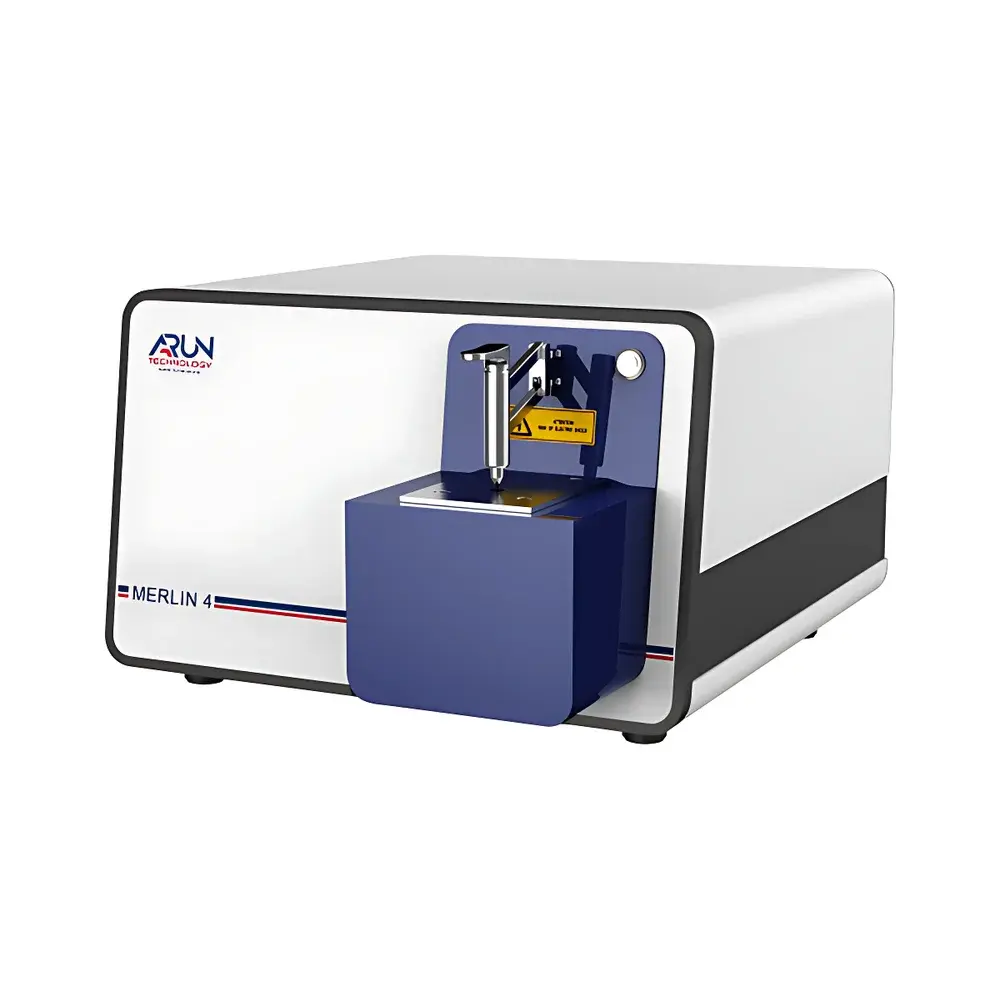
Arun Technology MERLIN 4U Direct-Reading Optical Emission Spectrometer
| Brand | Arun Technology Ltd. |
|---|---|
| Origin | United Kingdom |
| Instrument Type | Benchtop |
| Excitation Method | Spark |
| Detector Type | Charge-Coupled Device (CCD) |
| Optical Design | Full-Spectrum Holographic Grating |
| Sample Handling | Open-Style Horizontal/Vertical Translational Spark Stand |
| Compliance | Designed for ISO/IEC 17025-aligned laboratories, supports ASTM E415, E1086, and ISO 6892-1 elemental analysis workflows |
| Software | ARUN SpectraSuite with audit trail, user access levels, and data export compliant with FDA 21 CFR Part 11 requirements |
Overview
The Arun Technology MERLIN 4U is a benchtop direct-reading optical emission spectrometer (OES) engineered for high-precision, multi-matrix elemental analysis of metallic alloys in industrial quality control and R&D environments. It operates on the principle of spark-induced plasma emission spectroscopy: a controlled high-voltage spark excites atoms in a solid metal sample, causing them to emit characteristic wavelengths of ultraviolet–visible light. These emissions are dispersed via a high-efficiency holographic concave grating and simultaneously captured across the full spectral range by a thermoelectrically cooled CCD detector array. Unlike vacuum or purged spectrometers, the MERLIN 4U employs an optimized sealed optical path with nitrogen purge capability (optional), enabling stable performance without mechanical vacuum pumps—reducing maintenance, footprint, and operational complexity while maintaining detection limits suitable for ppm-level quantification of major, minor, and trace elements (e.g., C, S, P, N, B, Sn, Pb, As in Fe-, Al-, Cu-, Mg-, Ni-, and Ti-based alloys).
Key Features
- Compact benchtop architecture with integrated spark source and open-type sample stand—designed for rapid sample loading and operator ergonomics in high-throughput QC labs.
- Full-spectrum acquisition using a high-resolution, back-illuminated CCD detector ensures simultaneous measurement of all analyte lines without sequential scanning or channel reconfiguration.
- Holographic concave grating optics deliver superior stray-light suppression and wavelength stability over time and temperature fluctuations—critical for long-term calibration retention.
- Modular spark stand with motorized X–Y translation enables precise positioning of irregular or large samples (up to Ø100 mm × 50 mm height) and reproducible ablation geometry across heterogeneous castings or forgings.
- Pre-aligned optical train and factory-calibrated intensity response eliminate routine optical realignment; system validation includes daily drift correction using internal reference lines and certified CRMs.
- Robust hardware design meets IEC 61326-1 electromagnetic compatibility standards and IP20 environmental rating for deployment in foundry floors, machining cells, and metrology labs.
Sample Compatibility & Compliance
The MERLIN 4U supports solid conductive metallic samples—including ferrous (carbon steels, stainless steels, cast irons), non-ferrous (aluminum, copper, zinc, titanium, nickel, magnesium alloys), and superalloys—without matrix-specific hardware changes. Sample surface preparation follows ISO 11573 and ASTM E1184 guidelines: flat, clean, and spark-polished surfaces ≥ 20 mm diameter are recommended. The instrument complies with ISO/IEC 17025 documentation requirements for method validation and uncertainty estimation. Its software enforces role-based access control, electronic signatures, and immutable audit trails—fully supporting GLP and GMP environments subject to FDA 21 CFR Part 11 and EU Annex 11 regulatory audits.
Software & Data Management
ARUN SpectraSuite v5.x provides comprehensive spectral acquisition, multivariate calibration modeling (PLS, MLR), and statistical process control (SPC) integration. Calibration libraries include pre-validated models for >40 alloy families (e.g., UNS, EN, ASTM, GB/T grades), each traceable to NIST SRM or equivalent certified reference materials. Data export formats include CSV, XML, and PDF reports with embedded metadata (operator ID, timestamp, instrument ID, CRM batch). All raw spectra and processed results are stored in a relational SQLite database with automatic backup scheduling and optional networked server synchronization for centralized lab data governance.
Applications
The MERLIN 4U is routinely deployed for incoming raw material verification (scrap, ingots, billets), in-process melt analysis during casting/forging, final product certification (fasteners, flanges, turbine blades, rail components), and failure analysis investigations (e.g., intergranular corrosion root cause identification via trace element segregation mapping). Its speed (<30 s per analysis), repeatability (RSD < 1.5% for major elements), and low detection limits (e.g., 5 ppm C in low-alloy steel) make it suitable for ISO 9001-certified production lines, third-party testing laboratories accredited to ISO/IEC 17025, and university metallurgy departments conducting alloy development research.
FAQ
Does the MERLIN 4U require vacuum pumping or argon purging to operate?
No—the optical chamber uses a sealed, nitrogen-purge-ready design that eliminates the need for continuous vacuum or high-flow argon, reducing consumable costs and infrastructure dependencies.
Can it analyze non-conductive or coated samples?
Only conductive metallic solids are compatible; non-metals, ceramics, or painted/coated surfaces must be mechanically prepared to expose bare metal prior to analysis.
Is method transfer possible between different MERLIN units?
Yes—calibration models and spectral databases are portable across instruments of the same generation when validated using common CRMs and standardized operating procedures.
What maintenance intervals are recommended?
Spark electrode cleaning every 500–1,000 analyses; optical window inspection quarterly; annual performance verification using certified reference materials per ISO 17025 clause 7.7.
Does ARUN provide IQ/OQ/PQ documentation support?
Yes—comprehensive qualification templates, test protocols, and vendor-supervised execution services are available for regulated pharmaceutical, aerospace, and nuclear applications.
Related Products






