
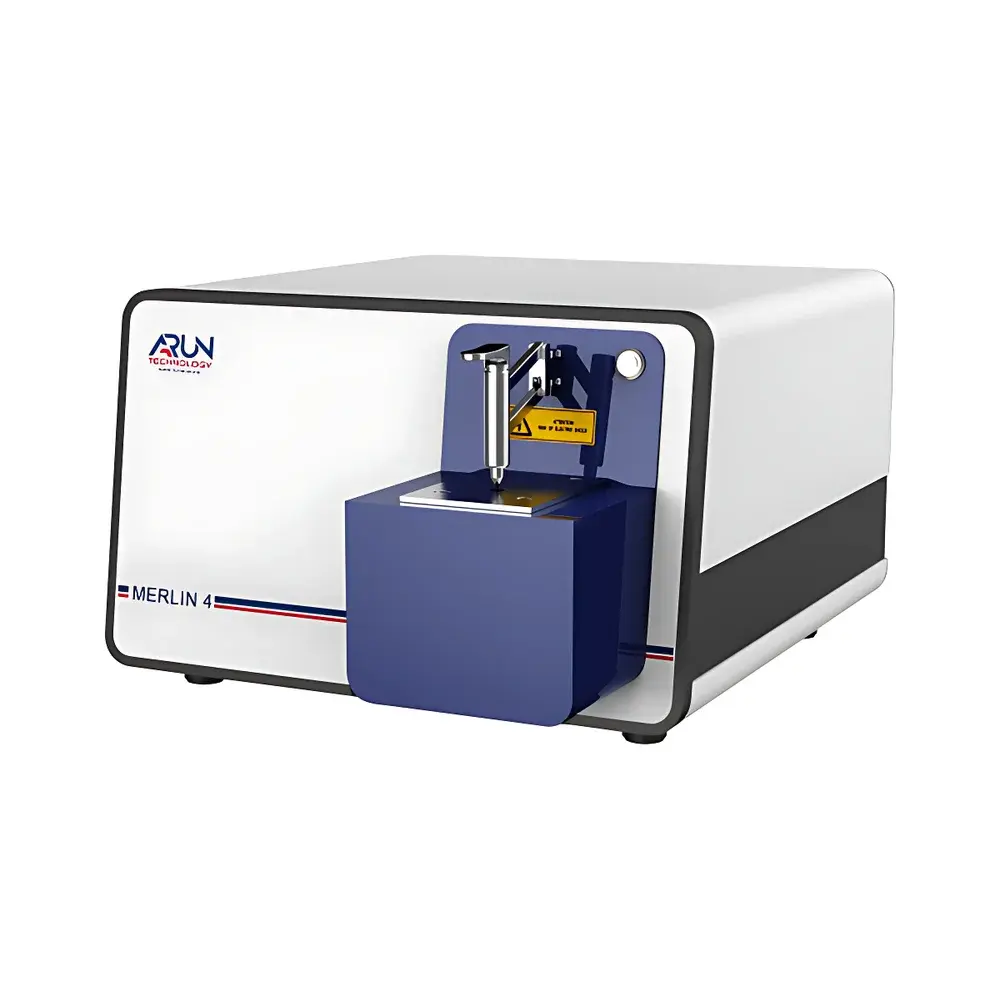
Arun Technology MERLIN 4V Direct-Reading Optical Emission Spectrometer
| Brand | Arun Technology Ltd. |
|---|---|
| Origin | United Kingdom |
| Instrument Type | Benchtop |
| Excitation Method | Spark |
| Detector Type | Charge-Coupled Device (CCD) |
| Optical Design | Full-Spectrum Holographic Grating |
| Sample Handling | Open-Type Adjustable Spark Stand with X-Y Translation |
| Compliance | Designed for ISO/IEC 17025-compliant laboratories, supports ASTM E415, E1086, and ISO 6892-2 traceable analysis workflows |
Overview
The Arun Technology MERLIN 4V is a benchtop, full-spectrum direct-reading optical emission spectrometer (OES) engineered for high-precision elemental analysis of metallic alloys in industrial quality control and R&D environments. Based on spark source atomic emission spectroscopy, the instrument ionizes sample surfaces using controlled high-voltage spark discharges, generating characteristic atomic line emissions across the ultraviolet to visible spectrum (typically ~130–800 nm). Unlike sequential or PMT-based systems, the MERLIN 4V employs a high-resolution CCD detector coupled with a holographic concave grating optical system—enabling simultaneous acquisition of the entire spectral range without mechanical scanning or vacuum pumping. This architecture ensures rapid multi-element quantification (including C, P, S, N, B, and trace metals) with excellent inter-run reproducibility and long-term stability. Its compact footprint and open spark stand design facilitate integration into production labs, foundry floors, and third-party testing facilities where space efficiency and operational flexibility are critical.
Key Features
- Benchtop form factor with robust aluminum alloy chassis and thermally stabilized optical bench for vibration resistance and thermal drift minimization
- Open-type spark stand featuring motorized X-Y translation stage and adjustable sample clamping geometry—compatible with irregular shapes, large castings, and small machined parts (diameter ≥ 10 mm, thickness ≥ 2 mm)
- Full-spectrum CCD detection system with >3,600 effective pixels per order, delivering high signal-to-noise ratio and sub-pixel wavelength calibration accuracy
- Holographic concave grating with optimized groove density and aberration correction—eliminates need for vacuum or purge gas while maintaining resolution < 10 pm at 200 nm
- Integrated spark generator with programmable energy, frequency, and pre-spark conditioning—optimized for ferrous, non-ferrous, and superalloy matrices
- Self-diagnostic optical alignment monitoring and automatic wavelength recalibration using internal Ne/Ar reference lines
Sample Compatibility & Compliance
The MERLIN 4V supports solid metallic samples including cast iron, carbon and stainless steels, aluminum, copper, nickel, titanium, magnesium, and zinc-based alloys. Surface preparation requirements follow ISO 11084 and ASTM E1361 guidelines—flat, clean, and spark-polished surfaces yield optimal precision. The system complies with electromagnetic compatibility (EMC) standards IEC 61326-1 and safety standard IEC 61010-1. Software workflows support audit trails, electronic signatures, and data integrity controls aligned with FDA 21 CFR Part 11 and ISO/IEC 17025 documentation requirements. Calibration verification is traceable to NIST SRM reference materials (e.g., SRM 2165, 2166, 1251 series) and certified CRM blocks from BASF, SGS, and Wilson.
Software & Data Management
Controlled via Arun’s proprietary SpectraSuite v4.x software, the MERLIN 4V provides method-driven operation with intuitive wizard-guided setup for calibration, validation, and routine analysis. All spectra are stored in vendor-neutral HDF5 format with embedded metadata (operator ID, timestamp, environmental conditions, instrument status). The software includes multivariate regression (PLS), matrix-matched calibration libraries, limit-of-detection estimation, and automated outlier rejection based on robust statistical criteria (e.g., Huber M-estimators). Export options include CSV, XML, and LIMS-compatible ASTM E1382-compliant output. Remote diagnostics, firmware updates, and method synchronization are supported over secure TLS 1.2 connections.
Applications
The MERLIN 4V serves as a primary analytical tool in incoming raw material inspection (e.g., scrap sorting, alloy grade verification), in-process melt analysis during casting and forging, final product certification for ASME, EN 10204 3.1/3.2, and MIL-STD-882 compliance, and failure investigation in aerospace component manufacturing. It is routinely deployed in steel service centers validating AISI/SAE grades, aluminum extrusion plants verifying 6061 vs. 6063 composition, and nuclear-grade valve manufacturers confirming Cr-Mo-V balance in ASTM A182 F22 forgings. Universities and national metrology institutes utilize its full-spectrum capability for fundamental plasma parameter studies and development of new calibration models for low-abundance elements (e.g., Sn, As, Pb in lead-free brass).
FAQ
Does the MERLIN 4V require argon purging or vacuum pumping?
No—it operates in ambient air using sealed optical path design and holographic grating optimized for UV transmission without gas purge.
Can it analyze coated or painted metal samples?
Surface coatings must be fully removed prior to analysis; spark ablation requires direct conductive contact with bulk metal.
What is the typical detection limit for carbon in low-alloy steel?
Under optimized conditions (polished surface, 10-shot averaging), C detection limits range between 15–30 ppm depending on matrix and calibration strategy.
Is method transfer possible between different MERLIN units?
Yes—spectral library files and calibration coefficients are portable across MERLIN 4V instruments using identical optical configurations and detector batches.
How frequently does the system require wavelength calibration?
Automatic recalibration occurs before each analytical sequence using built-in spectral references; manual verification is recommended weekly or after major environmental shifts.




