
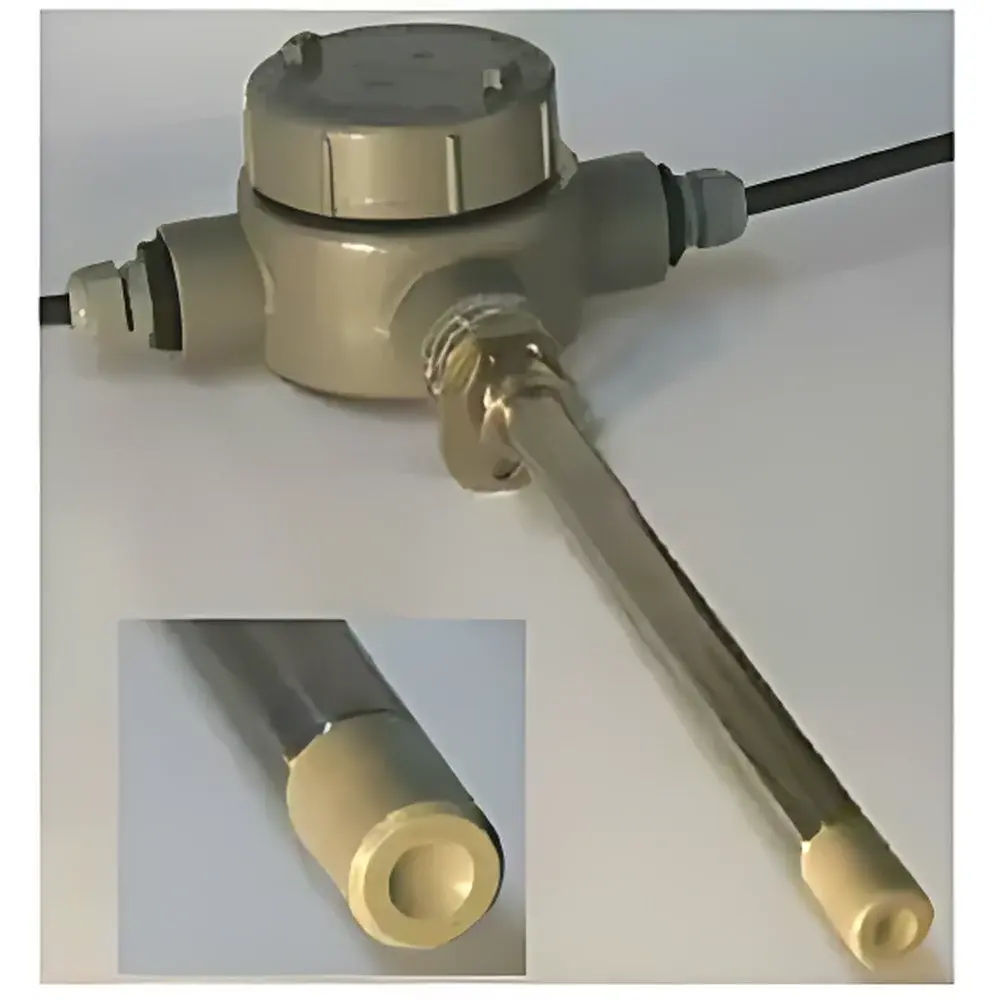
AS3 Online Ultrasonic Suspended Solids Concentration Analyzer
| Origin | USA |
|---|---|
| Manufacturer Type | Authorized Distributor |
| Origin Category | Imported |
| Model | AS3 |
| Price | Upon Request |
Overview
The AS3 Online Ultrasonic Suspended Solids Concentration Analyzer is an industrial-grade, non-invasive process monitoring instrument engineered for continuous, real-time quantification of suspended particulate concentration in liquid streams. It operates on the principle of high-frequency ultrasonic pulse reflection—emitting controlled acoustic waves (5 MHz and 15 MHz) into the medium and analyzing the amplitude, time-of-flight, and spectral attenuation of reflected echoes from solid–liquid interfaces. Unlike optical or scattering-based methods, ultrasonic interrogation is inherently insensitive to color, turbidity, dye concentration, or surface fouling, making it uniquely suited for challenging wastewater, chemical process, and bioprocessing applications where optical sensors fail. The system delivers stable, drift-free measurements across a wide dynamic range—from trace levels (0–10 ppm) up to concentrated suspensions (0–10,000 ppm), equivalent to ≤1% total suspended solids (TSS) by mass. Its robust transducer architecture enables deployment directly in pressurized pipelines, open channels, or stirred reactors without flow interruption or process shutdown.
Key Features
- Ultrasonic reflection measurement at dual frequencies (5 MHz and 15 MHz) for optimized sensitivity across particle size distributions
- No moving parts, no consumables, and no optical windows—eliminating mechanical wear and calibration drift
- Inherent self-cleaning effect via high-intensity ultrasonic pulsing, minimizing sensor fouling in sludge, pulp, or biofilm-prone environments
- NEMA 4X / IP65-rated electronics enclosure for outdoor and washdown-capable installations
- Hot-tap insertion design with sanitary ball-valve coupling—enabling installation and maintenance under pressure up to 5 bar without process isolation
- Maximum operating pressure: 20 bar (custom configurations available for higher-pressure systems)
- Temperature tolerance: up to 90°C continuously; up to 110°C with optional air-cooling jacket
- Explosion-proof sensor variants certified for hazardous locations: ATEX Zone 1 & Zone 2, IECEx, and UL Class I, Division 1
- Configurable output units: ppm, mg/L, % w/w, g/L, or user-defined scaling
- Measurement accuracy: ±1% of full scale under calibrated conditions, validated per ISO 5725 repeatability protocols
Sample Compatibility & Compliance
The AS3 analyzer is compatible with aqueous and non-aqueous liquids containing suspended solids—including activated sludge, cellulose fibers, catalyst particles, yeast biomass, pigment dispersions, and emulsified oil–water mixtures. It maintains performance in highly viscous, aerated, or chemically aggressive media due to its PEEK and 316 stainless steel wetted materials (custom alloys available upon request). Sensor insertion depth and probe geometry are configurable to accommodate pipe diameters from DN50 to DN600 and channel depths up to 3 m. The system complies with electromagnetic compatibility (EMC) standards EN 61326-1 and safety standard EN 61010-1. For regulated industries, firmware supports audit-trail logging and user-access control aligned with FDA 21 CFR Part 11 requirements when integrated with compliant SCADA or LIMS platforms.
Software & Data Management
The AS3 interfaces via 4–20 mA analog output, Modbus RTU (RS-485), or optional Ethernet/IP for integration into DCS, PLC, or cloud-based IIoT architectures. The companion AT3 transmitter unit supports multi-point calibration using up to 16 reference samples—enabling generation of application-specific transfer curves for nonlinear suspension behavior. All configuration, diagnostics, and historical trend data are accessible via a web-based HTML5 interface (no proprietary software required). Data logging intervals are programmable from 1 second to 24 hours; raw echo waveform capture is available for advanced troubleshooting and method validation. Firmware updates are delivered over-the-air (OTA) with cryptographic signature verification to ensure integrity and traceability.
Applications
- Drinking water treatment: real-time monitoring of coagulation/flocculation efficiency and filter backwash optimization
- Wastewater plants: activated sludge concentration control in aeration basins and secondary clarifiers
- Pulp & paper: fiber consistency measurement in stock preparation, whitewater systems, and coating slurries
- Pharmaceutical & biotech: cell density tracking in upstream bioreactors and harvest clarification lines
- Chemical manufacturing: catalyst loading verification in fixed-bed reactors and crystallizer slurry density control
- Food & beverage: pulp content in fruit juice processing and yeast concentration in fermentation tanks
- Oil & gas: water-in-oil and oil-in-water emulsion stability assessment in produced water treatment
- Membrane filtration: fouling onset detection in ultrafiltration and microfiltration skids
FAQ
How does ultrasonic reflection differ from optical turbidity measurement?
Ultrasonic reflection measures acoustic impedance mismatch between solids and liquid—making it immune to color, dye, or dissolved organics that interfere with light transmission. Turbidity meters rely on scattered light intensity, which degrades significantly in colored or fluorescent solutions.
Can the AS3 be installed in a pressurized pipeline without shutting down the process?
Yes—the hot-tap insertion assembly with integral ball valve allows safe sensor deployment and removal at pressures up to 5 bar without interrupting flow or depressurizing the line.
Is calibration required after initial setup?
A factory baseline calibration is provided. Field recalibration is optional and performed using representative slurries traceable to NIST-certified reference materials; AT3 supports multi-point curve fitting for improved accuracy across variable particle size distributions.
What hazardous area certifications are available?
ATEX II 2G Ex db IIB T4 Gb, IECEx Ex db IIB T4 Gb, and UL Class I, Division 1, Groups B, C, D—certified for both sensor and transmitter housing.
What is the maximum cable length between sensor and transmitter?
Standard configuration supports 100 m of shielded twisted-pair cable; extended lengths up to 300 m are achievable with signal conditioning and noise mitigation.







