
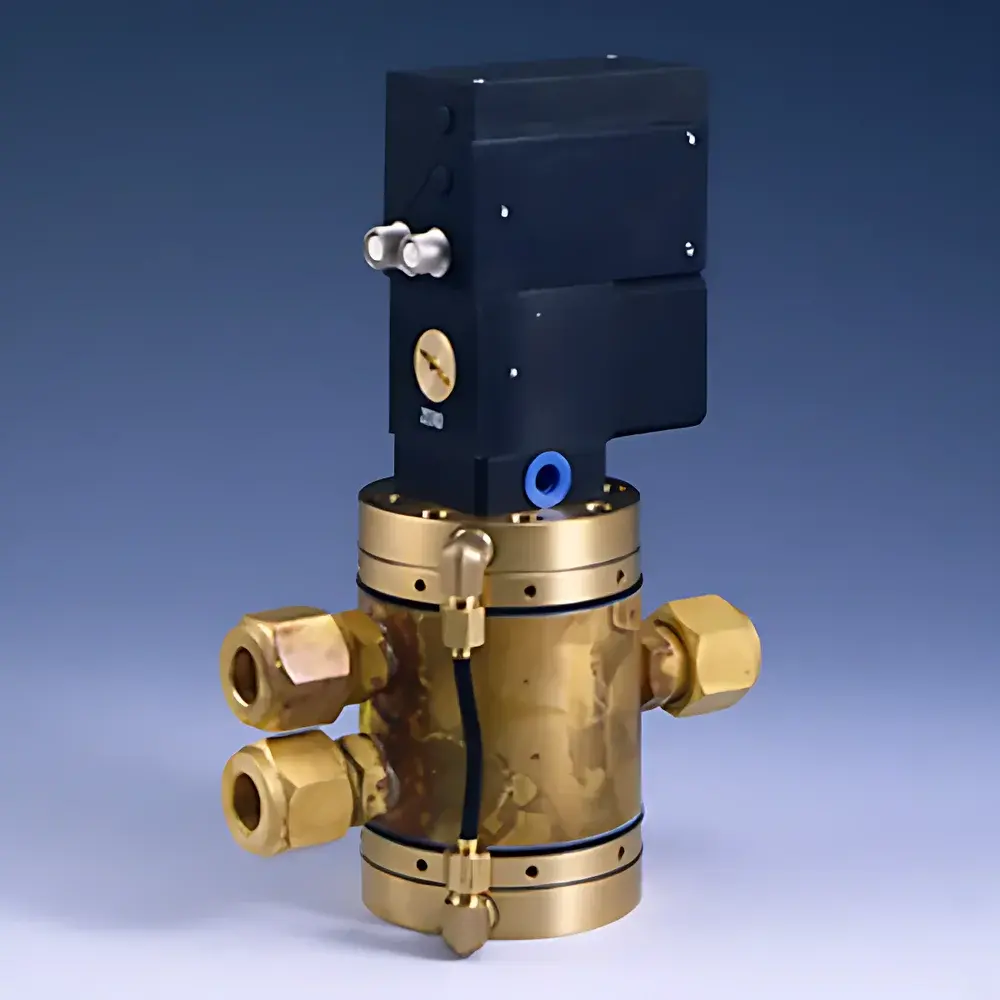
ASAHI Precision 913BA1 High-Accuracy Pneumatic Proportional Pressure Regulator
| Brand | A&D (AND) |
|---|---|
| Origin | Japan |
| Model | 913BA1 / 914BA1 / 916BA1 |
| Operating Pressure Range | Up to 1.5 MPa |
| Input Signal | 0–10 V DC, 4–20 mA (configurable) |
| Pilot Pressure | 0.3 MPa |
| Supply Voltage | 24 V DC |
| Port Size | 1/4", 3/8", 1/2" |
| Fluid Compatibility | Liquids and gases non-corrosive to PTFE, Viton®, and brass |
| Input Impedance | ≥1 kΩ (voltage), ≤300 Ω (current) |
| Control Principle | Force-Balance + PI Algorithm |
| Hysteresis | ≤±0.2% FS |
| Linearity | ≤±1% FS |
| Response Time | <0.5 s (no-load) |
| Flow Consumption | ≤1.5 L/min (standard), ≤5 L/min (high-speed) |
| Weight | 2.2 kg / 3.4 kg / 6.8 kg |
| Valve Body Material | Brass |
| Diaphragm | PTFE |
| Seal Material | Viton® |
| Insulation Resistance | >1 MΩ |
| Mounting Orientation | Omnidirectional (zero-point drift ≤±1% FS dependent on orientation) |
| Orifice Diameter | 6 mm / 10 mm / 14 mm |
Overview
The ASAHI Precision 913BA1 is a high-accuracy, pneumatically actuated proportional pressure regulator engineered for stable, repeatable downstream pressure control in precision industrial automation, analytical instrumentation, and laboratory gas delivery systems. Based on a force-balance sensing principle combined with analog PI (Proportional-Integral) feedback control, the device dynamically adjusts its internal valve opening in response to real-time deviations between setpoint and measured output pressure—ensuring minimal overshoot and rapid stabilization. Unlike simple mechanical regulators, the 913BA1 integrates electronic input signal conditioning (0–10 V or 4–20 mA) to accept external setpoint commands from PLCs, data acquisition systems, or process controllers—enabling closed-loop integration into larger automation architectures. Its design prioritizes metrological integrity: low hysteresis (≤±0.2% FS), tight linearity (≤±1% FS), and sub-500 ms dynamic response under no-load conditions make it suitable for applications requiring traceable, auditable pressure control—such as calibration laboratories, semiconductor purge lines, and inert gas blanketing in pharmaceutical reactors.
Key Features
- Force-balance + PI control architecture ensures high reproducibility and minimal steady-state error across operating ranges
- Configurable analog input (0–10 V DC or 4–20 mA) with selectable scaling via internal DIP switches
- PTFE diaphragm and Viton® seals provide broad chemical compatibility with non-aggressive gases and liquids—including N₂, Ar, CO₂, compressed air, deionized water, and alcohols
- Omnidirectional mounting capability with documented zero-point stability (drift ≤±1% FS regardless of orientation)
- Low power consumption: operates exclusively on 24 V DC with no auxiliary heating or active cooling required
- Robust brass valve body machined to ISO 228-1 thread standards; compatible with standard NPT and BSPP fittings
- Integrated pilot pressure regulation at 0.3 MPa ensures consistent actuator responsiveness independent of upstream supply fluctuations
Sample Compatibility & Compliance
The 913BA1 is certified for use with fluids that do not chemically degrade PTFE, Viton®, or brass—covering the majority of clean process gases and low-conductivity liquids encountered in ISO Class 5–8 cleanrooms and GMP-compliant manufacturing environments. It complies with IEC 61000-6-2 (immunity) and IEC 61000-6-4 (emissions) for industrial electromagnetic compatibility. While not intrinsically safe, the unit may be deployed in Zone 2 hazardous locations when installed behind approved safety barriers per IEC 60079-11. Its mechanical construction adheres to JIS B 8391 for pneumatic control valves, and its performance specifications are traceable to JCSS-accredited calibration procedures in Japan. Documentation supports audit readiness for FDA 21 CFR Part 11 (when paired with compliant SCADA logging) and ISO/IEC 17025 calibration records.
Software & Data Management
As a purely analog field device, the 913BA1 does not incorporate embedded firmware, network interfaces, or onboard data storage. However, it is fully interoperable with industry-standard control systems via its voltage/current input interface. When integrated into a validated system (e.g., Siemens S7, Rockwell Logix, or LabVIEW-based DAQ), full audit trails—including setpoint history, output pressure logs, and timestamped fault events—can be generated and archived in accordance with GLP/GMP requirements. Optional external analog-to-digital converters with 16-bit resolution and cold-junction compensation enable sub-0.1% FS measurement uncertainty when used with calibrated pressure transducers downstream.
Applications
- Precision gas flow control in GC carrier gas manifolds and mass spectrometer inlet systems
- Pressure regulation for liquid chromatography solvent delivery modules requiring pulse-free output
- Blanket gas pressure control in glovebox and dry-room environments (N₂, Ar)
- Calibration bench setups for pressure sensor verification against deadweight testers
- Automated test fixtures for valve actuator characterization and leak testing
- Controlled atmosphere sintering furnaces where ramp-and-soak pressure profiles are critical
FAQ
Is the 913BA1 suitable for use with oxygen or chlorine?
No. Oxygen service requires oxygen-cleaned components and materials rated per CGA G-4.1; chlorine demands Hastelloy or Monel construction. The 913BA1’s brass body and Viton® seals are incompatible.
Can it regulate vacuum or negative pressure?
No. The 913BA1 is designed exclusively for positive-pressure regulation up to 1.5 MPa. It cannot function as a vacuum regulator or back-pressure controller.
What is the recommended maintenance interval?
Under clean, dry gas conditions, inspection and diaphragm replacement are advised every 24 months or after 10,000 operational cycles—whichever occurs first—as defined in A&D Technical Bulletin TB-913-REV3.
Does it support HART or Fieldbus communication?
No. The 913BA1 is an analog-only device. For digital integration, pair with a HART-enabled I/P converter or use a programmable logic controller with analog I/O modules.
Is CE marking applicable?
Yes. Units shipped to the EU carry CE marking under the EMC Directive 2014/30/EU and Low Voltage Directive 2014/35/EU, with Declaration of Conformity available upon request.



