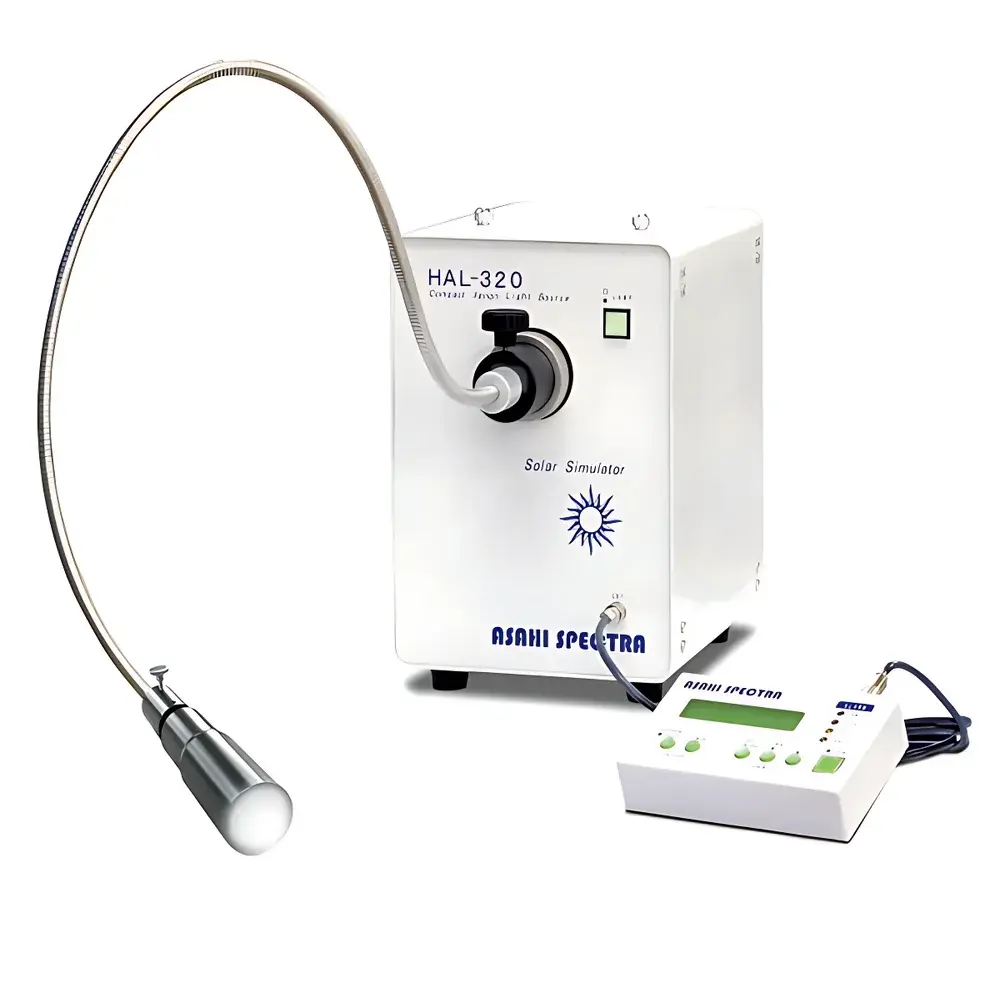
Asahi Spectra HAL-320 Solar Simulator
| Brand | Asahi Spectra |
|---|---|
| Origin | Japan |
| Model | HAL-320 |
| Light Source | 300 W Xenon Arc Lamp |
| Spectral Range | 350–1100 nm |
| Spectral Match Class | JIS/IEC Class A (AM1.5G) |
| Spatial Uniformity | ≤±2% (over 30×30 mm, ND-filtered) |
| Temporal Stability | ≤±1% (over 1 h, RMS) |
| Illumination Mode | Steady-State |
| Control Interface | RS232C |
| Power Input | AC 90–264 V, 50/60 Hz |
| Max Power Consumption | <510 VA |
| Cooling | Forced Air |
| Lamp Lifetime | 500 h (avg.) |
| Dimensions (Host) | 200 × 300 × 292 mm |
| Weight (Host) | 11.3 kg |
Overview
The Asahi Spectra HAL-320 Solar Simulator is a Class A (JIS/IEC-compliant) steady-state illumination system engineered for photovoltaic (PV) device characterization under standardized terrestrial solar irradiance conditions. It employs a stabilized 300 W xenon short-arc lamp as its primary broadband source, coupled with a proprietary air mass 1.5 global (AM1.5G) spectral correction filter. This optical architecture achieves high-fidelity spectral matching across the 350–1100 nm range—covering the critical response bands of crystalline silicon (c-Si), copper indium gallium selenide (CIGS), dye-sensitized (DSSC), and perovskite solar cells. Unlike collimated or direct-optics simulators, the HAL-320 utilizes a flexible light-guide delivery system, decoupling the lamp housing from the illumination point and enabling adaptable beam orientation without mechanical realignment. Its alignment-free optical design eliminates the need for iterative collimation or beam-centering procedures, reducing setup time and operator dependency. The system operates in continuous (DC) mode only, optimized for steady-state current–voltage (I–V) measurements, quantum efficiency mapping, and accelerated aging protocols compliant with IEC 60904-9, ASTM E927-22, and JIS C 8912.
Key Features
- Class A spectral match per JIS C 8912 and IEC 60904-9: Spectral deviation ≤±12.5% across six defined wavelength intervals (400–1100 nm), validated by factory-measured relative spectral irradiance data.
- Integrated AM1.5G interference filter: Engineered to suppress xenon emission lines while preserving broadband continuum output—enabling accurate spectral weighting for PV reference cell calibration and spectral responsivity testing.
- Fiber-coupled illumination: Flexible 1.5 m light guide permits omnidirectional beam placement; ideal for non-planar samples, multi-angle incidence studies, or integration into custom environmental chambers.
- Adjustable irradiance control: Neutral density (ND) attenuation (100–30 steps, continuous) enables precise tuning from sub-0.1 sun to >1.2 sun intensity levels—referenced to 100 mW/cm² at 30×30 mm field size.
- Self-contained power management: Built-in switching-mode power supply accepts universal AC input (90–264 V); includes over-temperature, lamp-failure, and door-interlock safety interlocks compliant with IEC 61010-1.
- Remote operation via RS232C interface: Enables automated sequencing of exposure duration (0.5–99999.9 s), ND position, and shutter actuation—supporting integration into LabVIEW, Python, or MATLAB-based test platforms.
Sample Compatibility & Compliance
The HAL-320 accommodates a broad range of photovoltaic and optoelectronic devices, including but not limited to: single-junction and tandem solar cells (c-Si, GaAs, CIGS, CdTe, organic, perovskite), photoelectrochemical cells, luminescent down-shifting layers, and UV–VIS–NIR photodetectors. Its 30×30 mm uniform irradiance zone (A-class certified at 1 sun, ±2% spatial non-uniformity) meets minimum test area requirements for IEC 60904-9 Ed. 3 Annex A. The system supports GLP-aligned workflows through traceable lamp-hour logging, controller firmware revision tracking, and external data timestamping. While the HAL-320 does not include built-in radiometric calibration certificates, it is compatible with NIST-traceable reference detectors (e.g., calibrated Si or Ge photodiodes) for user-performed irradiance validation prior to qualification testing.
Software & Data Management
The HAL-320 operates without proprietary software—its RS232C command set uses ASCII-based SCPI-like syntax for seamless integration into existing laboratory automation frameworks. Supported commands include EXPOSURE TIME SET, ND POSITION QUERY, SHUTTER OPEN/CLOSE, and LAMP STATUS READ. All operational parameters—including cumulative lamp hours, thermal sensor readings, and error logs—are accessible via serial polling. For audit-ready environments, users may log command-response sequences alongside external measurement data (e.g., source meter outputs) to satisfy FDA 21 CFR Part 11 electronic record requirements when paired with appropriate system-level validation documentation.
Applications
- Steady-state I–V characterization of lab-scale and mini-module PV devices under standard test conditions (STC).
- Spectral responsivity mapping using monochromator-coupled configurations (with optional fiber adapter).
- Light-soaking and bias-assisted stability testing per IEC 61215-2 MQT 18 and ISOS-L-3 protocols.
- Photoelectrochemical cell performance evaluation under simulated solar flux.
- Optical coating transmittance/absorptance validation across the AM1.5G spectrum.
- Educational demonstrations of solar energy conversion principles with reproducible, standards-aligned illumination.
FAQ
Is the HAL-320 certified to IEC 60904-9 Ed. 3?
Yes—the HAL-320 meets Class A spectral match, Class A spatial uniformity (when ND-filtered to 30×30 mm), and Class A temporal stability specifications per IEC 60904-9 Ed. 3, verified during factory acceptance testing against JIS C 8912.
Can the HAL-320 be used for pulsed illumination or MPPT tracking?
No—it is designed exclusively for steady-state (DC) operation. It lacks flash-capability or fast-rise-time modulation required for transient analysis or maximum power point tracking under dynamic conditions.
What is the recommended maintenance interval for the xenon lamp?
Lamp replacement is advised after 500 hours of cumulative operation; output degradation beyond ±5% of initial irradiance at 1 sun typically occurs after this threshold. Asahi Spectra recommends using a regulated AC supply to minimize voltage ripple-induced instability.
Does the system include radiometric calibration data?
The HAL-320 ships with factory-measured relative spectral irradiance curves and uniformity maps. Absolute irradiance calibration requires user-provided NIST-traceable reference detectors and is performed externally per ISO/IEC 17025 laboratory practice.
Is the light guide compatible with third-party spectrometers or monochromators?
Yes—the standard SMA905 connector allows direct coupling to most commercial fiber-input optical instruments; users should verify numerical aperture (NA ≤ 0.22) and core diameter (typically 600 µm) compatibility.