
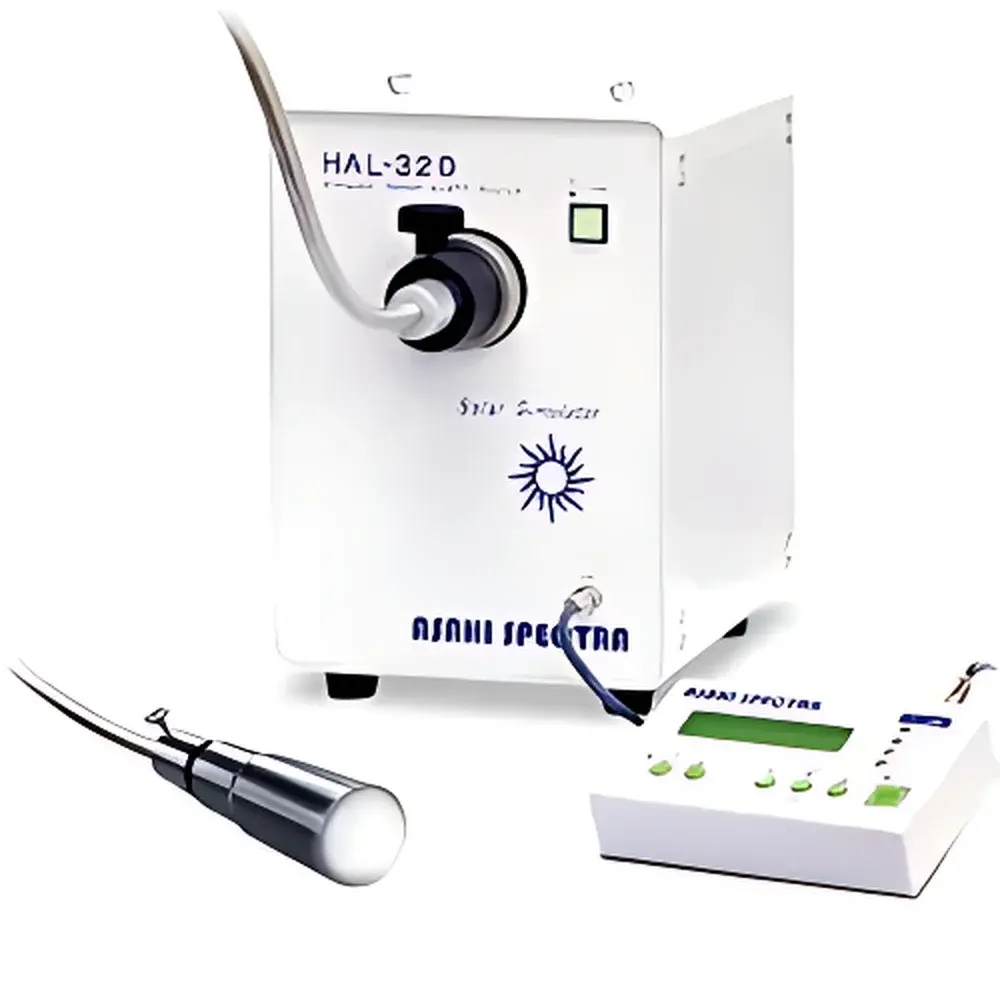
Asahi Spectra HAL320 AAA-Class Solar Simulator with AM1.5G Filter and Fiber-Optic Output
| Brand | Asahi Spectra |
|---|---|
| Origin | Japan |
| Model | HAL-320 |
| Light Source | Compact Xenon Lamp (300 W) |
| Spectral Range | 350–1100 nm |
| Spectral Match Class | JIS/IEC AAA (AM1.5G) |
| Illumination Method | External via Bundled Light Guide |
| Optical Alignment | Cartridge-Type (Alignment-Free) |
| Power Supply | Switching Type, AC 90–264 V, 50/60 Hz |
| Apparent Power | ≤510 VA |
| Lamp Voltage/Current | 14 V / 21 A (DC) |
| Lamp Life | 500 h (avg.) |
| Cooling | Forced Air |
| Shutter | Solenoid-Driven |
| Exposure Time | 0.5–99999.9 s |
| Intensity Control | 100–30 Steps + Continuous Adjustment |
| AM Filter | Integrated Air Mass 1.5G |
| Controller Interface | RS232C (cable ≤3 m), Remote Handheld (2 m) |
| Safety Interlocks | Lamp Fault, Top Door Open, Lamp Usage >500 h, Fan Failure, Thermal Anomaly |
| Operating Environment | 10–35 °C, 20–80% RH (non-condensing) |
| Dimensions (Main Unit) | 200 × 300 × 292 mm |
| Weight (Main Unit) | 11.3 kg |
Overview
The Asahi Spectra HAL320 is a compact, high-fidelity solar simulator engineered for laboratory-grade photovoltaic (PV) device characterization and materials testing under standardized terrestrial sunlight conditions. It operates on the principle of broadband spectral synthesis using a stabilized 300 W short-arc xenon lamp, whose native emission—rich in UV and visible continuum but excessive in near-infrared—is spectrally reshaped via a precisely engineered, integrated Air Mass 1.5 Global (AM1.5G) filter. This filter conforms to JIS C 8912 (equivalent to IEC 60904-9 Ed. 3), delivering AAA-class performance across the 350–1100 nm range: spectral match (0.75–1.25), irradiance uniformity (≤±2%), and temporal stability (≤±1%) over 10-second intervals. Unlike collimated or direct-optics simulators, the HAL320 employs a bundled quartz light guide output, decoupling illumination geometry from source positioning and eliminating alignment sensitivity—a critical advantage for integration into custom test fixtures, gloveboxes, or multi-instrument platforms.
Key Features
- AAA-class spectral match per JIS/IEC 60904-9: validated spectral distribution across six wavelength bands (400–1100 nm), with match ratios between 0.92 and 1.12
- Alignment-free cartridge lamp module ensures repeatable optical coupling and eliminates beam walk during lamp replacement
- Fiber-optic delivery enables flexible, vibration-isolated illumination at variable working distances (default 370 mm) without realignment
- Dual-mode intensity control: discrete 100–30 step attenuation plus continuously variable analog adjustment for fine-tuning irradiance levels
- Integrated solenoid shutter with programmable exposure timing (0.5–99999.9 s) supports transient photocurrent measurements and accelerated aging protocols
- Comprehensive safety architecture including thermal monitoring, fan status verification, top-door interlock, and lamp-hour tracking with automatic disable after 500 h
- RS232C digital interface enables remote operation, script-driven sequencing, and integration into automated test systems compliant with GLP/GMP data integrity requirements
Sample Compatibility & Compliance
The HAL320 is validated for use with crystalline silicon (c-Si), thin-film (CIGS, CdTe), organic photovoltaics (OPV), perovskite solar cells (PSCs), dye-sensitized solar cells (DSSCs), and photoelectrochemical (PEC) devices. Its 30×30 mm A-class uniformity zone (at ~75 mW/cm², 1-sun equivalent) meets the spatial criteria defined in ASTM E927-20 and IEC 60904-9 for reference cell calibration and module-level power rating. The system’s spectral fidelity supports accurate quantum efficiency (QE) mapping when paired with monochromator-based external quantum efficiency (EQE) setups. All electrical and optical safety functions comply with IEC 61010-1 (Safety Requirements for Electrical Equipment for Measurement, Control, and Laboratory Use), and firmware logging adheres to FDA 21 CFR Part 11 principles for audit-trail generation in regulated R&D environments.
Software & Data Management
The HAL320 operates natively via its dedicated handheld controller, which provides intuitive access to exposure time, intensity level, shutter activation, and lamp status. For advanced integration, the RS232C port supports ASCII command protocol—including “EXPOSURE ON”, “INTENSITY 75”, and “QUERY LAMP_HOURS”—enabling seamless interoperability with LabVIEW, Python (pySerial), MATLAB, or custom SCADA platforms. Logged operational parameters (lamp-on time, cumulative exposure seconds, thermal sensor readings) are retained in non-volatile memory and retrievable via serial query, forming a traceable usage record essential for ISO/IEC 17025-accredited laboratories. No proprietary software installation is required; configuration remains hardware-resident to ensure long-term reproducibility and eliminate version drift.
Applications
- Primary and secondary calibration of reference solar cells traceable to NIST or AIST standards
- J-V curve acquisition and maximum power point tracking (MPPT) under controlled AM1.5G illumination
- Light-soaking studies and bias-assisted stability testing of perovskite and organic photovoltaics
- Photoelectrochemical water-splitting efficiency quantification using three-electrode configurations
- Spectral response validation of multispectral imaging sensors and satellite solar monitors
- Accelerated photostability screening of UV-curable resins and photocatalytic coatings
FAQ
What does “AAA-class” mean for this solar simulator?
It denotes compliance with the highest tier of IEC 60904-9 (and JIS C 8912) for spectral match (0.75–1.25), spatial uniformity (≤±2%), and temporal stability (≤±1%)—required for reference-grade PV testing.
Can the HAL320 be used inside a nitrogen-filled glovebox?
Yes—the fiber-optic output allows full separation of the lamp housing from the sample chamber; only the light guide tip needs physical access to the glovebox interior.
Is lamp replacement a user-serviceable procedure?
Yes—cartridge-style lamp modules enable tool-free replacement in under 90 seconds without optical realignment or recalibration.
Does the system support automated exposure sequences?
Yes—via RS232C commands, users can program multi-step irradiation profiles (e.g., 5 s ON / 10 s OFF cycles repeated 1000×) for fatigue or degradation studies.
How is irradiance calibrated and maintained over lamp lifetime?
Initial calibration is performed at factory using NIST-traceable reference cells; intensity drift due to lamp aging is compensated in real time using the built-in continuous adjustment function, preserving absolute irradiance accuracy without recalibration.





