
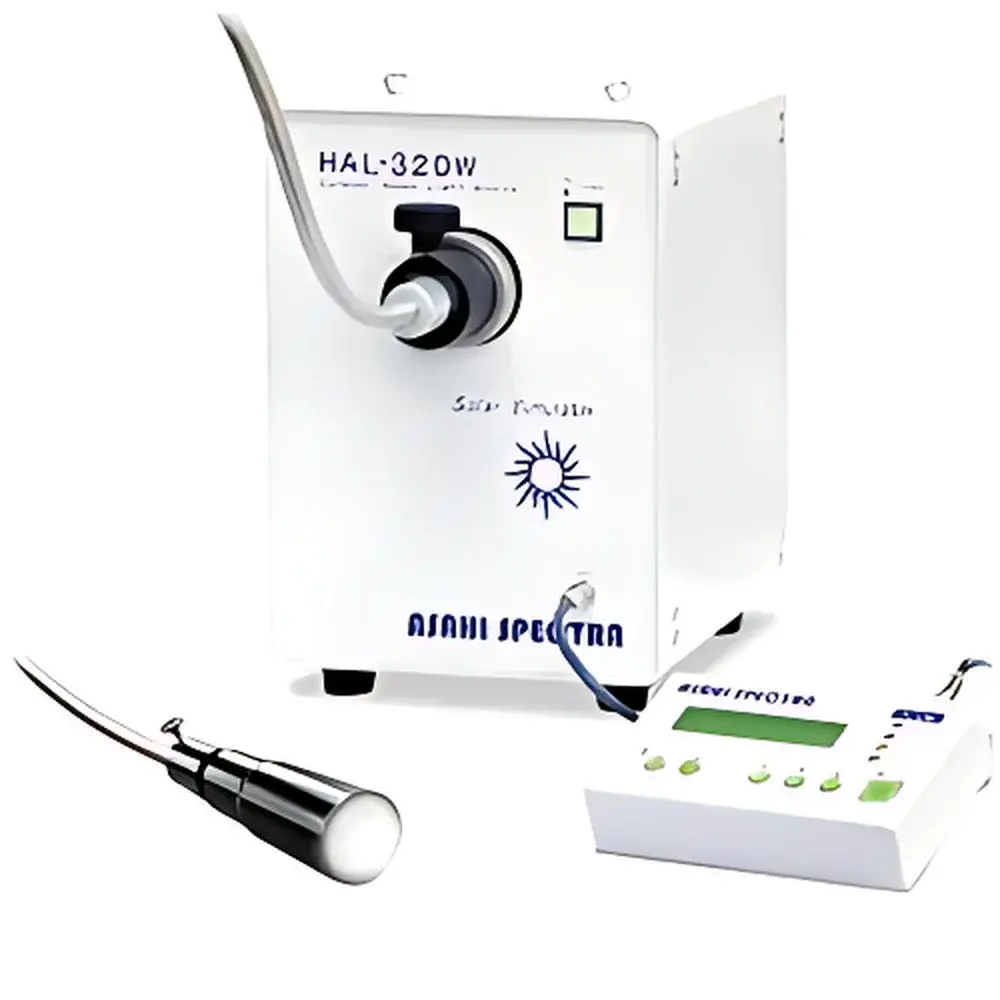
Asahi Spectra HAL320W Fiber-Coupled Solar Simulator
| Brand | Asahi Spectra |
|---|---|
| Model | HAL320W |
| Light Source | Compact Xenon Lamp (300 W) |
| Spectral Range | 350–1800 nm |
| Spectral Match Class | JIS/IEC AAA (per JIS C8912:2011 & C8933:2011) |
| Output Method | Bundled Optical Fiber (Cartridge-Type, Alignment-Free) |
| AM Filter | Integrated Air Mass 1.5G |
| Irradiance Stability | ≤ ±1% (temporal, over 1 h) |
| Spatial Uniformity | ≤ ±2% (30 × 30 mm, A-class area at 1-sun, 75 mW/cm² @ 400–1100 nm) |
| Control | Remote Controller + RS232C Interface |
| Cooling | Forced Air |
| Lamp Life | 500 h (average) |
| Input | AC 90–264 V, 50/60 Hz |
| Power Consumption | < 510 VA |
| Dimensions (Main Unit) | 200 × 300 × 292 mm |
| Weight | 11.3 kg |
Overview
The Asahi Spectra HAL320W is a compact, fiber-coupled solar simulator engineered for high-fidelity photovoltaic device characterization under standardized terrestrial sunlight conditions. It employs a stabilized 300 W short-arc xenon lamp coupled with a precision-engineered Air Mass 1.5G (AM1.5G) filter to deliver spectrally matched irradiance across 350–1800 nm — fully compliant with JIS C8912:2011 and JIS C8933:2011 for Class AAA spectral match, positional uniformity, and temporal stability. Unlike collimated or direct-illumination simulators, the HAL320W utilizes a cartridge-type bundled optical fiber output (typically 6 mm core diameter, SMA905 or FC/PC connector), eliminating the need for optical axis alignment and enabling flexible integration into confined test chambers, gloveboxes, or multi-instrument optical benches. Its switching power supply architecture ensures stable lamp current regulation (< ±0.5% ripple), critical for reproducible quantum efficiency measurements and long-duration I–V tracing. The system is calibrated to reproduce ASTM E927-22 and IEC 60904-9 Ed. 3 reference spectra, with spectral deviation factors consistently maintained within 0.75–1.25 across all 11 defined wavelength bands — satisfying the most stringent requirements for multi-junction, perovskite, quantum dot, and concentrator photovoltaic (CPV) cell validation.
Key Features
- Fiber-coupled output with alignment-free cartridge interface — enables rapid reconfiguration and vibration-insensitive beam delivery
- Integrated AM1.5G interference filter mounted directly in front of the lamp housing — minimizes thermal drift and spectral shift during extended operation
- 100–30 stepwise and continuously variable light intensity control — compensates for xenon lamp aging (typical output decay ~0.3%/100 h) without recalibration
- Solenoid-driven mechanical shutter with programmable exposure time (0.5–99999.9 s) — supports transient photocurrent, photoconductivity, and accelerated aging protocols
- Forced-air cooling with dual thermal sensors and fan-failure interlock — maintains lamp envelope temperature within ±2 °C tolerance during 8-h continuous operation
- RS232C digital interface (cable length ≤ 3 m) with SCPI command set — enables full remote automation via LabVIEW, Python, or MATLAB for GLP-compliant test sequences
- Comprehensive safety logic: lamp end-of-life detection (500 h counter), top-door open interlock, overtemperature cutoff, and xenon arc instability monitoring
Sample Compatibility & Compliance
The HAL320W is validated for use with single-junction Si, GaAs, and CIGS cells; tandem and triple-junction III–V devices; emerging thin-film technologies including perovskite–silicon hybrids and colloidal quantum dot absorbers; and concentrator PV modules requiring >10-sun illumination when coupled with secondary optics. Its spectral coverage extends through the near-infrared (NIR) to 1800 nm, enabling accurate EQE measurement of low-bandgap subcells (e.g., Ge bottom junctions). All performance metrics — spectral match, spatial uniformity (±2% over 30 × 30 mm), and temporal stability (±0.8% over 1 h, measured per IEC 60904-9 Annex B) — are traceably certified against NIST-traceable reference detectors and calibrated using double-monochromator spectroradiometry. The unit conforms to IEC 61000-6-3 (EMC emissions), IEC 61000-6-2 (immunity), and UL 61010-1 (safety), and supports 21 CFR Part 11 audit trails when integrated with compliant LIMS or ELN platforms.
Software & Data Management
The HAL320W operates natively via its dedicated remote controller (2 m cable included), but full parameter scripting is supported through ASCII-based RS232C communication. Standard commands include INTENSITY SET 70, SHUTTER OPEN, LAMP LIFE QUERY, and ERROR LOG READ. When interfaced with third-party DAQ systems, irradiance data can be synchronized with source-meter readings at ≤10 ms resolution. Firmware v2.1+ adds timestamped event logging (lamp ignition, filter insertion, shutter actuation) with automatic CSV export — essential for ISO/IEC 17025-accredited laboratories maintaining instrument calibration histories. No proprietary software installation is required; configuration files are human-readable and editable via text editor.
Applications
- Primary and secondary calibration of reference cells (e.g., KG5-filtered Si, InGaAs, Ge) per IEC 60904-2
- Stability testing of perovskite solar cells under ISOS-L-1 illumination protocols
- Spectral response mapping of multi-terminal tandem devices using monochromatic fiber-coupled excitation
- Photoelectrochemical (PEC) water-splitting studies requiring controlled broadband irradiance in inert atmospheres
- Accelerated UV–VIS–NIR degradation analysis of encapsulation materials (EVA, POE, silicone)
- Quantum yield determination in photocatalytic nanoparticles using calibrated photon flux monitoring
FAQ
What is the recommended operating environment for long-term stability?
Ambient temperature: 10–35 °C; relative humidity: 20–80% non-condensing. Use of a line-interactive UPS or constant-voltage transformer is advised to suppress input voltage fluctuations exceeding ±5% — critical for maintaining spectral fidelity over 500-h lamp lifetime.
Can the HAL320W be used for outdoor module testing simulation?
No. It is designed exclusively for laboratory-scale device-level testing (≤5 cm² active area). Its 30 × 30 mm A-class uniformity zone and 75 mW/cm² irradiance at 1-sun preclude use for full-panel or outdoor-relevant spatial scaling.
Is the AM1.5G filter user-replaceable?
Yes — the filter is housed in a slide-in drawer assembly with kinematic mounts. Replacement requires factory recalibration to maintain JIS AAA certification; Asahi Spectra provides traceable recalibration certificates upon service.
How is spectral match verified post-installation?
Users must perform spectroradiometric validation using a calibrated CCD spectroradiometer (e.g., Bentham DMc150 or Instrument Systems CAS 140D) referenced to NIST SRM 2241. Asahi Spectra supplies a baseline spectral dataset (CSV) taken at time-zero for comparative analysis.
Does the system support external trigger synchronization?
Yes — TTL-compatible trigger input/output ports are available on the controller rear panel (optional accessory), enabling precise coordination with pulsed lasers, lock-in amplifiers, or high-speed cameras.






