
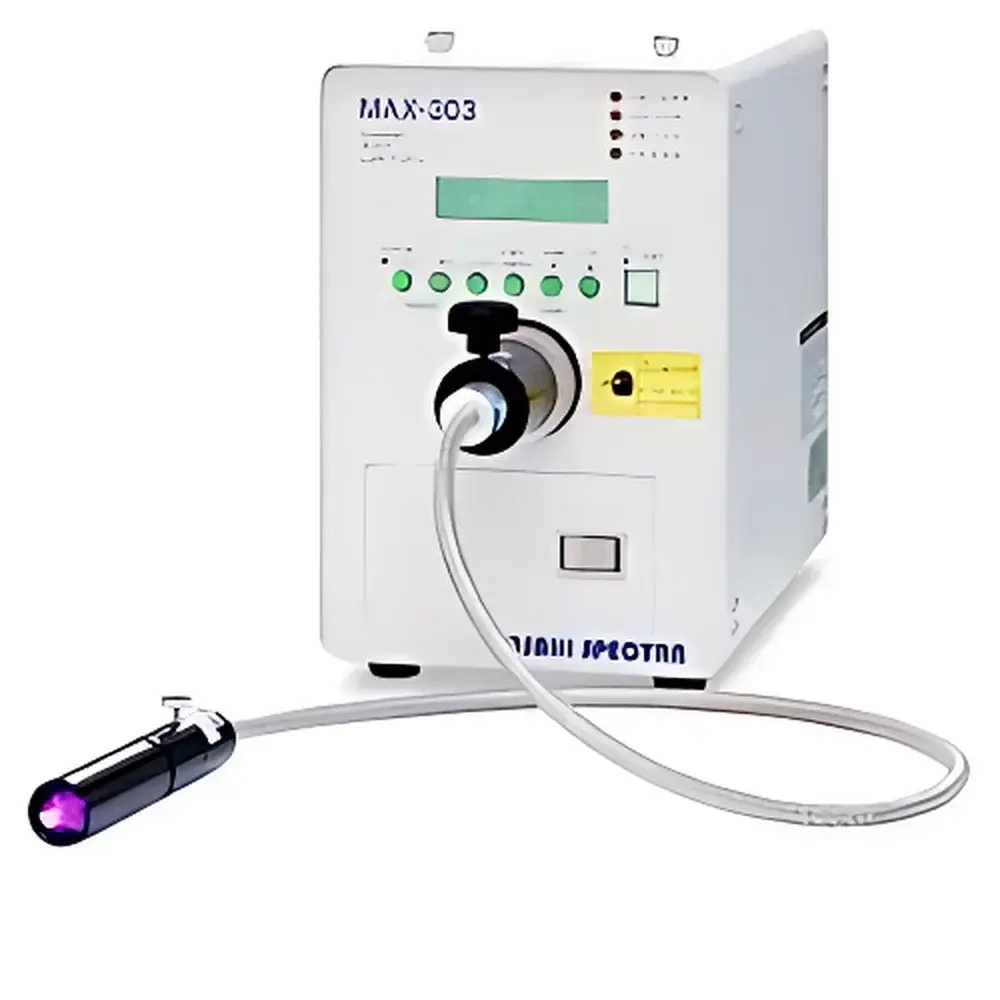
Asahi Spectra MAX-303 300W Cold-Beam Xenon Light Source with Integrated Filter Wheel and Mirror-Based IR Rejection
| Brand | Asahi Spectra |
|---|---|
| Origin | Japan |
| Model | MAX-303 |
| Light Source Type | 300W Compact Xenon Arc Lamp |
| Illumination Method | External Fiber-Coupled Illumination |
| Spectral Output Range | 235–1050 nm (dependent on mirror module and filter selection) |
| Mirror Modules Available | UV (250–385 nm), UV-VIS (300–600 nm), VIS (385–740 nm), IR (750–1050 nm) |
| Filter Wheel | 8-position, accepts 25 mm diameter × 6 mm thick filters |
| Light Intensity Control | Continuous ND-type attenuation, ±5% stability |
| Shutter | Pulse-motor-driven, exposure time 0.5–99999.9 s |
| Cooling | Forced-air convection |
| Power Supply | Switching-mode, AC 100–240 V, 50/60 Hz |
| Max Power Consumption | ≤530 VA (100 V/60 Hz), ≤520 VA (240 V/50 Hz) |
| Lamp Lifetime | ~500 h (to 50% initial radiant flux) |
| Operating Environment | 10–35 °C, 20–80% RH (non-condensing) |
| Dimensions (W×D×H) | 196 × 345 × 302 mm |
| Weight | 12.9 kg |
| Remote Interface | RS232C (cable length ≤3 m) |
Overview
The Asahi Spectra MAX-303 is a high-stability, fiber-coupled 300W xenon arc light source engineered for precision optical experiments requiring spectrally selective, low-thermal-load illumination. Unlike conventional broadband sources, the MAX-303 employs a proprietary mirror-based cold-beam architecture that physically separates infrared (IR) radiation from the usable optical path—eliminating >95% of radiative heat before it reaches the output port. This design enables true “cold-light” delivery essential for thermally sensitive samples, including photochromic molecules, biological tissues, and catalytic thin films. The system integrates a motorized 8-position filter wheel, continuously variable neutral density (ND) attenuation, and a precision pulse-motor shutter—all controlled via front-panel interface or RS232C serial command set. Its spectral coverage spans 235–1050 nm, with effective bandpass determined by the combination of interchangeable mirror modules (UV, UV-VIS, VIS, IR) and user-selected bandpass filters. The MAX-303 does not rely on monochromators or tunable lasers; instead, it delivers high-brightness quasi-monochromatic output through optimized optical filtering—achieving irradiance levels significantly exceeding those of grating-based monochromators at equivalent bandwidths.
Key Features
- Mirror-based IR rejection architecture: eliminates thermal load at the source, enabling direct coupling to temperature-sensitive optics and samples without active cooling.
- Four interchangeable mirror modules: UV (250–385 nm), UV-VIS (300–600 nm), VIS (385–740 nm), and IR (750–1050 nm)—each optimized for reflectivity and stray-light suppression within its designated range.
- Motorized 8-position filter wheel: accommodates standard 25 mm Ø × 6 mm thick interference filters; supports rapid spectral reconfiguration during kinetic experiments.
- Continuous light intensity control: analog ND attenuation with ±5% repeatability across full dynamic range—critical for dose-controlled photolysis or quantum yield measurements.
- Precision timed shutter: pulse-motor actuation ensures accurate exposure durations from 0.5 s to 99,999.9 s, traceable to internal quartz oscillator (±100 ppm).
- Fiber-optic output interface: standardized SMA 905 connector enables flexible integration with microscopes, spectrographs, flow cells, and custom optical benches—no collimation or alignment required.
- Robust thermal management: intelligent forced-air cooling maintains lamp envelope temperature within specification across ambient conditions (10–35 °C), extending arc tube lifetime and spectral stability.
Sample Compatibility & Compliance
The MAX-303 is routinely deployed in GLP-compliant laboratories conducting photostability testing per ICH Q1B and ISO 10977 (photobiological safety). Its stable, filter-defined irradiance profiles support quantitative irradiance calibration traceable to NIST-traceable reference detectors (e.g., calibrated photodiodes or thermopiles). The absence of convective heating at the sample plane satisfies requirements for ISO 11664-3 (colorimetry) and ASTM E2917 (spectral irradiance measurement) where thermal drift must be minimized. When paired with Asahi Spectra’s certified bandpass filters—each supplied with individual spectral transmittance curves and OD₆ blocking specifications—the system meets criteria for UV disinfection validation (UVC 254 nm), photocatalytic activity assessment (ISO 22197-1), and fluorescence excitation profiling under controlled photon flux. All electrical components comply with IEC 61010-1 (Safety Requirements for Electrical Equipment for Measurement, Control, and Laboratory Use), and the RS232 interface supports audit-trail-capable instrument control in environments adhering to FDA 21 CFR Part 11.
Software & Data Management
While the MAX-303 operates as a stand-alone instrument via its embedded controller, full remote orchestration is supported through ASCII-based RS232C protocol. Command sets include lamp enable/disable, shutter open/close, exposure duration setting, filter position selection, ND attenuation level, and real-time status polling (lamp hours, temperature, error flags). Integration with LabVIEW, Python (pySerial), or MATLAB is straightforward using documented SCPI-like syntax. For automated long-term experiments—such as time-resolved photochemical kinetics or multi-wavelength photostability ramps—users may log timestamped control events alongside external sensor data (e.g., spectrometer readings, temperature probes) to generate ISO/IEC 17025-compliant experiment records. Firmware updates are delivered via serial upload and retain all user calibration offsets and configuration presets.
Applications
- Photochromism & photopharmacology: precise UV/visible dosing for reversible molecular switching without thermal artifact.
- Heterogeneous photocatalysis: standardized irradiance delivery for comparative evaluation of TiO₂, g-C₃N₄, or MOF-based catalysts under AM1.5G-simulated or narrowband conditions.
- Fluorescence excitation mapping: high-S/N excitation at defined λₑₓ to characterize Stokes shifts, FRET efficiency, or environmental quenching effects.
- Optogenetics & photobiomodulation research: reproducible visible/NIR illumination for in vitro neuronal activation or mitochondrial response studies.
- UV curing process development: controlled 365 nm or 254 nm irradiance for polymer crosslinking kinetics and depth-of-cure profiling.
- Spectroscopic light-source calibration: stable broadband or filtered output for wavelength accuracy verification of CCD- or CMOS-based spectrometers.
- Art conservation science: non-invasive pigment analysis via reflectance UV-Vis spectroscopy under cold illumination.
FAQ
What is the typical spectral irradiance output at 365 nm using the UV mirror module and a 10 nm FWHM bandpass filter?
Output depends on filter transmission and fiber coupling efficiency, but typical values range from 15–25 mW/cm² at the fiber output face (measured with calibrated silicon photodiode). Absolute values require in-situ calibration.
Can the MAX-303 be synchronized with pulsed detection systems (e.g., gated ICCD or TCSPC)?
Yes—the RS232 interface supports TTL-compatible external trigger input for shutter synchronization, and the internal shutter jitter is <±50 µs.
Is lamp replacement a user-serviceable procedure?
Lamp replacement requires alignment of the arc image onto the mirror module entrance; Asahi Spectra recommends factory service or certified field technician support to maintain specified beam homogeneity and thermal rejection performance.
Does the system support USB or Ethernet connectivity?
No—only RS232C serial interface is provided. USB-to-serial adapters (FTDI-based) are widely compatible and validated for lab use.
How is radiometric calibration maintained over lamp lifetime?
Lamp aging affects absolute output; users are advised to perform periodic relative calibration using a stable reference detector. Asahi Spectra provides optional NIST-traceable calibration services at time of purchase or renewal intervals.




