
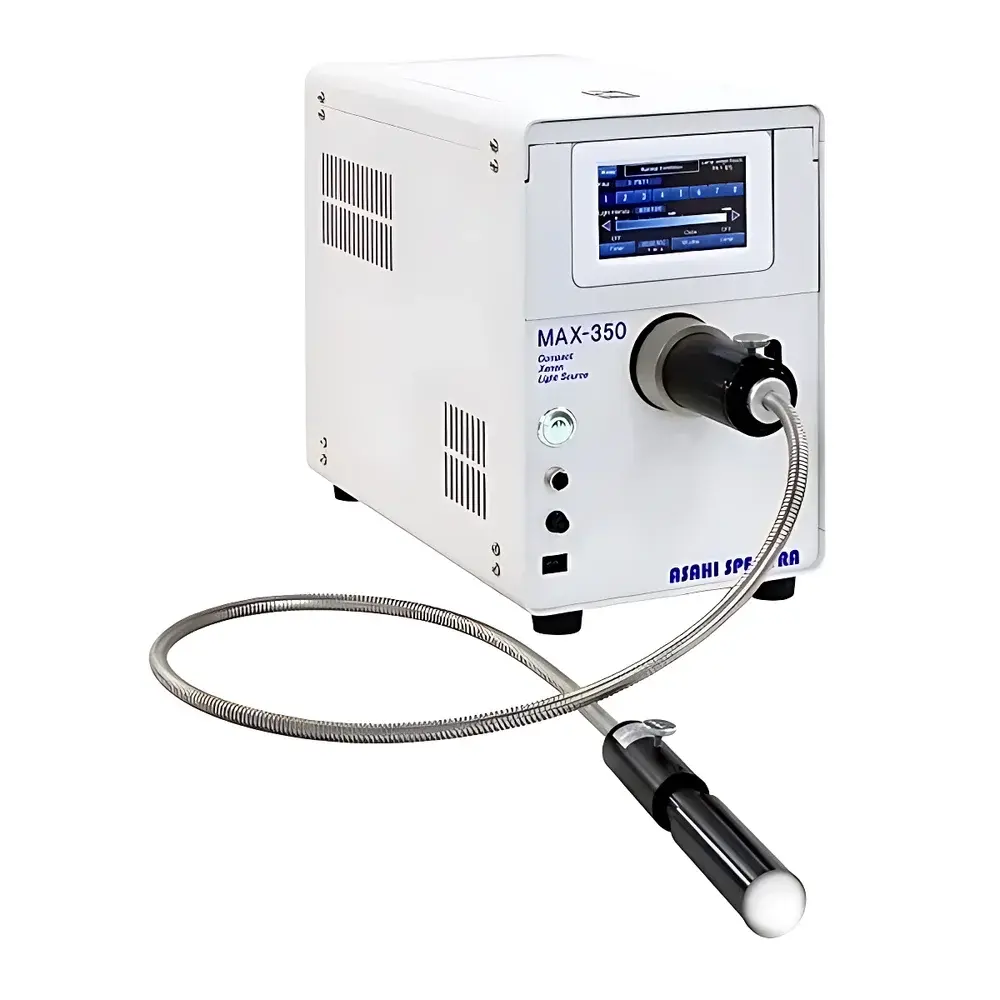
Asahi Spectra MAX-350 300W Air-Cooled Xenon Light Source for Photocatalysis and Monochromatic Photochemistry
| Brand | Asahi Spectra |
|---|---|
| Origin | Japan |
| Model | MAX-350 |
| Light Source Type | 300W Cermax Xenon Lamp |
| Illumination Mode | External Irradiation |
| Output Wavelength Range | 250–1050 nm (dependent on mirror module) |
| Mirror Modules | UV (250–385 nm), UV-VIS (300–600 nm), VIS (385–740 nm), IR (750–1050 nm) |
| Filter Wheel | 8-position, accepts 25 mm Ø × <6 mm filters |
| Light Intensity Control | 1000–50 steps (continuously variable ND attenuation) |
| Shutter | Pulsed motor-driven, exposure time 0.5 s – 24 h |
| Cooling | Forced-air |
| Power Input | AC 100–240 V, 50/60 Hz |
| Apparent Power | <540 VA (100 V/50 Hz), <520 VA (240 V/50 Hz) |
| Lamp Lifetime | ≥500 h (guaranteed within 1 year of delivery) |
| Optical Alignment | Cartridge-type, alignment-free design |
| Dimensions | 196 × 330 × 302 mm (W×D×H) |
| Weight | 12.2 kg |
| Operating Environment | 10–35 °C, 20–80% RH (non-condensing) |
| Safety Interlocks | Xenon lamp fault detection, cooling fan monitoring, thermal anomaly protection |
| Remote Interface | RS-485 |
| Controller | Integrated touchscreen panel |
Overview
The Asahi Spectra MAX-350 is a high-intensity, air-cooled 300W xenon arc light source engineered specifically for precision photochemical and photocatalytic research where spectral selectivity, thermal management, and operational reproducibility are critical. Unlike conventional broad-spectrum illumination systems, the MAX-350 integrates a proprietary mirror module architecture with an eight-position motorized filter wheel to deliver stable, collimated monochromatic or quasi-monochromatic output across the ultraviolet, visible, and near-infrared spectrum (250–1050 nm). Its core optical design eliminates the need for manual beam alignment—achieved via cartridge-based lamp and optics modules—ensuring consistent irradiance geometry between experiments. The system employs a Cermax® xenon short-arc lamp, known for its high radiance, excellent spatial stability, and superior color temperature (~6000 K), making it ideal for applications requiring photon flux density without significant infrared (IR) thermal load. Integrated IR-reflective mirror modules selectively suppress heat-generating wavelengths while preserving usable photon flux in target bands—enabling true “cold-light” irradiation essential for thermally sensitive photoreactions, such as photochromism, photocatalytic degradation kinetics, and artificial photosynthesis studies.
Key Features
- Alignment-free optical cartridge system ensures repeatable beam positioning and eliminates user-dependent setup variability.
- Four interchangeable mirror modules (UV, UV-VIS, VIS, IR) provide wavelength-selective spectral shaping at the source—reducing reliance on downstream filtering and improving overall photon throughput.
- Motorized 8-channel filter wheel accommodates standard 25 mm diameter optical filters (thickness <6 mm), enabling rapid, programmable spectral switching during kinetic experiments.
- Continuously variable neutral density (ND) attenuation (1000–50 steps) allows precise, non-binary control of irradiance without altering spectral distribution.
- Pulsed motor-driven shutter with programmable exposure timing (0.5 s to 24 h) supports time-resolved photochemical protocols, including pulsed irradiation and dark-period cycling.
- Integrated touchscreen controller with real-time status monitoring (lamp voltage/current, fan RPM, housing temperature) and RS-485 interface for LabVIEW, Python, or custom SCADA integration.
- Forced-air cooling system maintains thermal stability under continuous operation; safety interlocks automatically disable output upon fan failure, lamp arc instability, or thermal excursion.
Sample Compatibility & Compliance
The MAX-350 is compatible with standard photochemical reactors—including top-irradiated slurry reactors, quartz immersion well cells, flow-through cuvettes, and custom-built reaction chambers—when coupled with optional fiber-optic light guides or collimating lens assemblies. Its external irradiation configuration avoids internal heating of reaction vessels, supporting ISO 10678:2010 (photocatalytic activity measurement) and ASTM E2739 (standard practice for solar simulator calibration) methodologies. While not certified as a medical device, its stable, traceable irradiance output supports GLP-compliant experimental documentation when used with optional feedback unit FBU-10 (intensity stabilization ±2% over 8 h). All electrical components comply with IEC 61010-1 for laboratory equipment safety; CE marking applies to the full system per EU Directive 2014/30/EU (EMC) and 2014/35/EU (LVD).
Software & Data Management
The built-in controller provides local parameter configuration, real-time diagnostics, and event logging (lamp ignition count, total operating hours, error codes). For automated workflows, the RS-485 serial interface enables bidirectional communication with third-party software environments. Users may script irradiation sequences—including multi-wavelength time-series, intensity ramping, and shutter synchronization—with timestamps logged to external databases. When paired with the optional FBU-10 feedback unit, closed-loop irradiance stabilization is achieved via analog 0–5 V output to external PID controllers. Data export is supported in CSV format for post-acquisition analysis in MATLAB, Origin, or Python-based photokinetic modeling tools. Audit trails meet basic requirements for ISO/IEC 17025 traceability when combined with calibrated reference photodiodes (e.g., NIST-traceable Si or GaP sensors).
Applications
- Photocatalysis: Quantitative evaluation of wavelength-dependent quantum yields in TiO₂, g-C₃N₄, MOFs, and perovskite-based catalysts under controlled monochromatic excitation.
- Photochromism & Photoswitching: Kinetic profiling of spiropyran, diarylethene, and azobenzene derivatives using low-thermal-load UV/VIS irradiation.
- Artificial Photosynthesis: Driving water oxidation or CO₂ reduction half-reactions with spectrally defined photons to decouple charge-transfer efficiency from thermal artifacts.
- UV Disinfection Research: Dose-response studies using narrowband UV-C (254 nm) or UV-B (302 nm) outputs generated via combination of UV mirror module and bandpass filters.
- Fluorescence Excitation Mapping: Rapid screening of fluorophore excitation spectra without laser sources—particularly useful for widefield fluorescence microscopy sample validation.
- Accelerated Photostability Testing: Compliant with ICH Q1B guidelines for forced degradation studies under controlled spectral stress conditions.
FAQ
What is the typical spectral irradiance output at 365 nm using the UV mirror module and a 10 nm bandpass filter?
Output depends on filter transmission, distance, and collimation; typical values range from 15–25 mW/cm² at 10 cm working distance with a 25 mm filter and standard collimator. Calibration certificates are available upon request.
Can the MAX-350 be integrated into a glovebox environment?
Yes—its air-cooled design and compact footprint allow installation inside nitrogen-purged gloveboxes; external power and RS-485 cables pass through standard feedthroughs. Optional quartz viewport adapters are available.
Is lamp replacement a user-serviceable procedure?
Yes—the cartridge-based lamp assembly is designed for field replacement without optical realignment; replacement lamps (Cermax LX300) are supplied with factory alignment verification data.
Does the system support compliance with FDA 21 CFR Part 11 for electronic records?
The base controller does not include Part 11 features (e.g., electronic signatures, audit trail encryption); however, when interfaced with validated LIMS or ELN platforms via RS-485, raw irradiation logs can be captured in compliant environments.
What accessories are recommended for uniform illumination of a 5 cm² reactor surface?
We recommend the CL-300 collimating lens kit paired with a 3 mm core silica fiber bundle (custom lengths available); uniformity better than ±5% over 5 cm² is achievable at 15 cm working distance.



