
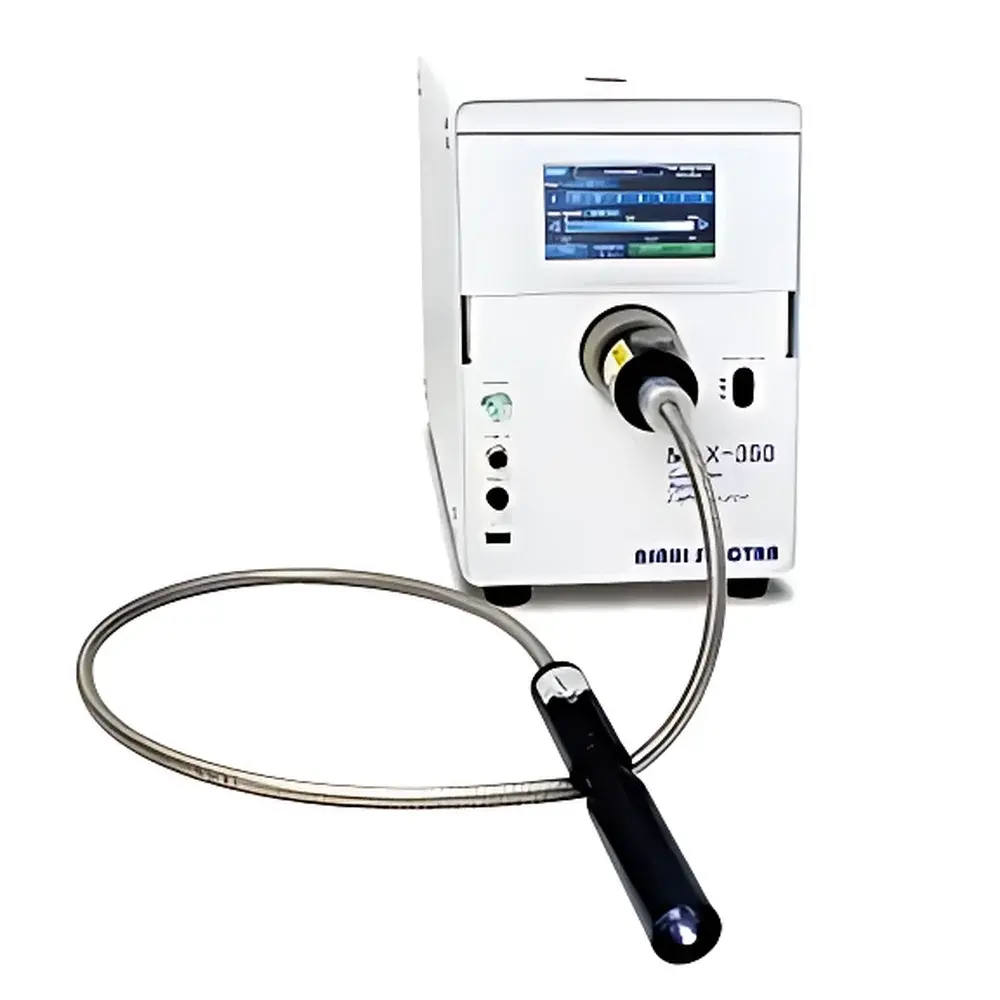
Asahi Spectra MAX-350 300W Xenon Arc Light Source for Solar Simulation and Monochromatic Illumination
| Brand | Asahi Spectra |
|---|---|
| Origin | Japan |
| Model | MAX-350 |
| Output Wavelength Range | 250–1050 nm (dependent on mirror module) |
| Light Output Intensity | 0–900 mW/cm² (spectrally dependent, continuously adjustable) |
| Light Source | Cermax® 300W xenon arc lamp |
| Lamp Lifetime | ≥500 h |
| Cooling Method | Forced-air cooling |
| Shutter Type | Pulsed motor-driven, exposure time 0.5 s – 24 h |
| ND Attenuation | 1000–50 steps (continuous) |
| Filter Wheel | 8-position, accepts 25 mm diameter × <6 mm thick filters |
| Mirror Modules | UV (250–385 nm), UV-VIS (300–600 nm), VIS (385–740 nm), IR (750–1050 nm) |
| Control Interface | Built-in touchscreen + RS-485 remote control |
| Safety Features | Lamp fault detection, fan failure monitoring, thermal overheat protection |
| Operating Environment | 10–35 °C, 20–80% RH (non-condensing) |
| Dimensions | 196 × 330 × 302 mm (W×D×H) |
| Weight | 12.2 kg |
| Power Input | AC 100–240 V, 50/60 Hz |
| Max Power Consumption | <540 VA (100 V/50 Hz), <520 VA (240 V/50 Hz) |
| Beam Alignment | Alignment-free (integrated optical housing) |
Overview
The Asahi Spectra MAX-350 is a high-stability, 300W short-arc xenon light source engineered for precision photonic applications requiring broadband spectral coverage and high radiance in the 250–1050 nm range. Unlike conventional continuous-wave xenon lamps with uncontrolled thermal load and spectral drift, the MAX-350 integrates a thermally optimized optical architecture—featuring proprietary mirror modules and an infrared-attenuating cold mirror design—to deliver spectrally tailored, low-heat irradiance. Its core operating principle relies on stable plasma discharge within a Cermax® xenon arc lamp, coupled with reflective optics that preserve étendue while minimizing IR-induced sample heating. This makes the MAX-350 particularly suitable for solar simulation (Class AAA spectral match achievable with appropriate filtering and calibration), photochemical kinetics, UV-curable material testing, and fluorescence excitation where thermal artifacts must be excluded. The system operates in steady-state mode only, ensuring constant photon flux during extended exposures—critical for quantitative actinometry, quantum yield determination, and ISO 9001-compliant process validation.
Key Features
- Alignment-free optical housing: Pre-aligned collimated output eliminates manual beam centering, reducing setup time and operator-dependent variability.
- Integrated 8-position motorized filter wheel: Accepts standard 25 mm round filters up to 6 mm thickness; enables rapid switching between bandpass, longpass, and neutral density filters without realignment.
- Selectable mirror modules: UV (250–385 nm), UV-VIS (300–600 nm), VIS (385–740 nm), and IR (750–1050 nm) configurations allow spectral shaping at the source—reducing reliance on downstream monochromators and improving throughput.
- High-intensity narrowband output: When paired with certified 5 nm FWHM bandpass filters, the MAX-350 delivers >10× higher irradiance than equivalent grating-based monochromators at selected wavelengths—ideal for replacing multiple laser lines in multi-wavelength photoactivation studies.
- Digital intensity control: 1000–50 step ND attenuation provides continuous, repeatable irradiance adjustment across four decades of optical density, traceable via internal calibration log.
- RS-485 interface with SCPI-compatible command set: Enables integration into automated test benches, GLP-compliant data acquisition systems, and synchronized multi-instrument protocols per IEEE 488.2 standards.
- Active thermal management: Dual-stage forced-air cooling maintains lamp envelope temperature below 85 °C during continuous operation, extending lamp life and stabilizing spectral output per IEC 62471 photobiological safety guidelines.
Sample Compatibility & Compliance
The MAX-350 supports irradiation of solid, liquid, and thin-film samples in environmental chambers, gloveboxes, or open-bench configurations. Its low-IR output minimizes thermal degradation of photosensitive polymers, perovskite thin films, and biological specimens—making it compatible with ASTM E927-22 (Standard Specification for Solar Simulation for Photovoltaic Testing) when used with appropriate reference cells and spectral mismatch correction. The system’s electrical safety conforms to IEC 61010-1:2010 for laboratory equipment; its UV emission profile satisfies EN 62471 requirements for risk group classification. For regulated environments, audit trails from RS-485 commands and internal event logging (lamp ignition count, thermal alerts, shutter actuation timestamps) support FDA 21 CFR Part 11 compliance when integrated with validated LIMS or ELN platforms.
Software & Data Management
No proprietary software installation is required—the MAX-350 operates autonomously via its embedded 4.3-inch resistive touchscreen GUI, which displays real-time lamp hours, fan RPM, case temperature, and filter position. For system-level integration, the RS-485 port supports ASCII-based SCPI commands (e.g., :SHUTTER:OPEN, :ATTEN:SET 420, :FILTER:POS? ) compatible with LabVIEW, Python (pySerial), MATLAB, and custom C++ DAQ frameworks. All operational parameters—including exposure duration, ND step, and filter selection—are timestamped and stored in non-volatile memory for post-experiment reconstruction. Optional firmware updates are delivered via USB-C port and include enhanced thermal derating algorithms aligned with ISO/IEC 17025 calibration traceability requirements.
Applications
- Solar cell characterization: Class AAA-equivalent illumination for J-V curve measurement, EQE mapping, and light-soaking stability tests under AM1.5G spectrum (with UV-VIS mirror + custom filter stack).
- Photocatalytic reaction screening: Uniform, IR-filtered irradiation of TiO₂, g-C₃N₄, or MOF-based catalysts in batch reactors—enabling quantification of H₂ evolution or CO₂ reduction rates per ISO 25357.
- UV disinfection validation: High-fluence UVC (254 nm) or broadband UVB/UVA delivery for log-reduction studies on SARS-CoV-2 surrogates, adhering to EPA UV Disinfection Guidance Manual protocols.
- Fluorescence microscopy excitation: Bright, stable 365 nm or 470 nm output replaces mercury/xenon arc lamps in widefield systems—reducing photobleaching through controlled irradiance and absence of IR heating.
- Photochromic material testing: Accelerated aging and kinetic response analysis under programmable irradiance profiles (e.g., 0.5 s pulse trains repeated over 24 h), compliant with ISO 21348 space environment simulation standards.
FAQ
What is the typical spectral irradiance uniformity across the output aperture?
The MAX-350 achieves ±5% spatial uniformity over a 20 mm Ø area at 100 mm working distance when used with the VIS mirror module and no additional homogenizers. Uniformity degrades to ±12% at 50 mm distance due to inherent divergence; optional Köhler illumination adapters are available for critical applications.
Can the MAX-350 be used for accelerated weathering tests per ISO 4892-2?
Yes—when configured with the UV mirror module and calibrated 313 nm bandpass filter, the system meets spectral power distribution requirements for xenon-arc exposure testing, provided irradiance is validated using a NIST-traceable UV radiometer.
Is lamp replacement user-serviceable?
Lamp replacement requires factory recalibration of the optical alignment and thermal feedback loop; Asahi Spectra recommends authorized service centers to maintain specification compliance and warranty validity.
Does the system support external TTL triggering?
No—shutter and filter wheel control is limited to RS-485 or touchscreen commands. For pulsed illumination synchronized to external events, users must implement a hardware interlock via the RS-485 bus using time-stamped command queuing.
How is spectral calibration performed for quantitative applications?
Asahi Spectra provides optional NIST-traceable spectral irradiance calibration certificates (per CIE S 026/E:2019) measured at the output port using a calibrated spectroradiometer. Users must revalidate after filter/mirror changes or every 200 lamp hours for GMP-grade workflows.






