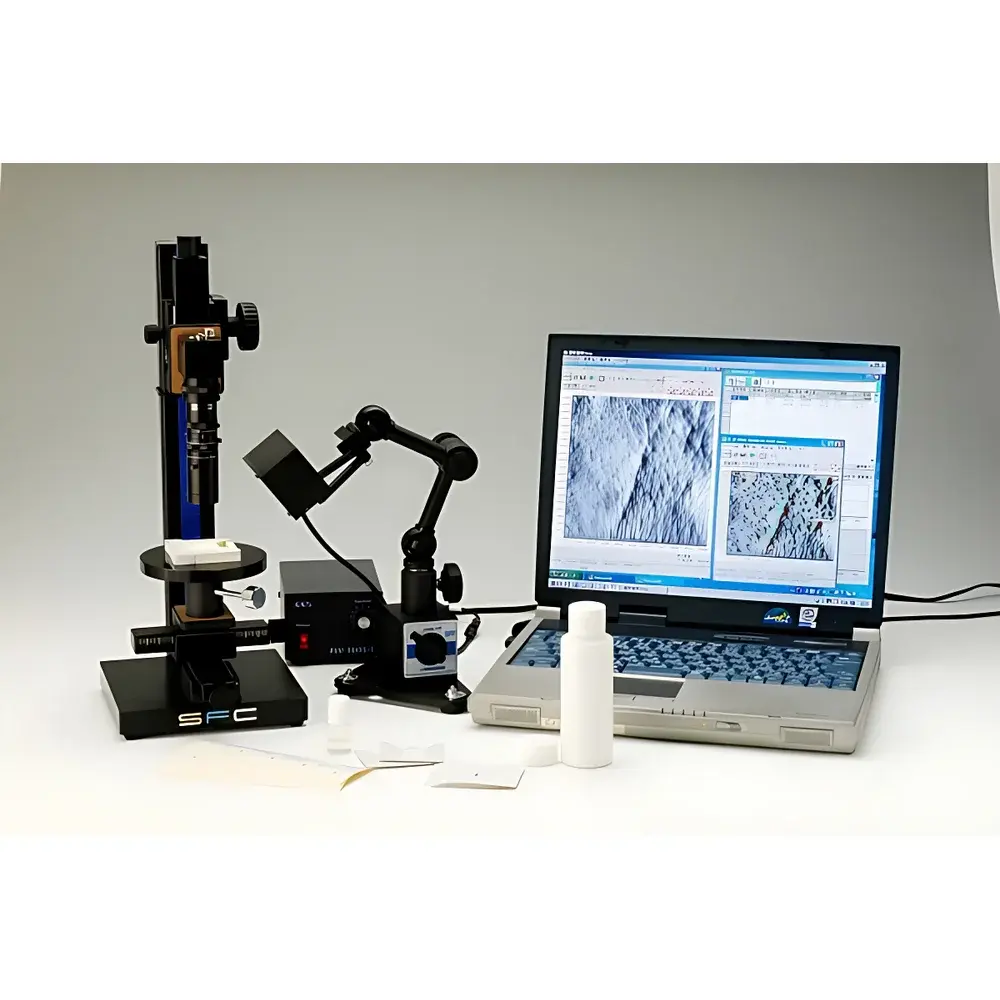
ASCH ASA-03RXD Anti-Wrinkle Efficacy Evaluation System
| Brand | ASCH |
|---|---|
| Origin | Japan |
| Model | ASA-03RXD |
| Imaging Principle | CCD-based 30° parallel-light profilometry |
| Sample Type | Silicone replica |
| Quantitative Output | Wrinkle count, volume (triangular cross-section model), depth, width, area ratio, texture parameters (Rz, Rt), 3D surface visualization |
| Compliance | JSCA Guideline for Evaluation of Anti-Wrinkle Products |
| Software Platform | Windows 10 native application with calibration, edge enhancement, and XY/depth conversion modules |
| Optional Modules | Sebum measurement kit (ASS-001 SEBU patch + absorbance analysis software) |
Overview
The ASCH ASA-03RXD Anti-Wrinkle Efficacy Evaluation System is a dedicated non-invasive metrology platform engineered for objective, quantitative assessment of cutaneous wrinkle and skin texture modulation in cosmetic and dermatological research. It operates on the principle of high-resolution optical profilometry: a monochromatic CCD camera captures grayscale images of silicone replicas under controlled 30° parallel-light illumination, eliminating interference from epidermal pigmentation, hair, sebum, or surface reflectivity. The system reconstructs topographic features by converting shadow length—generated by light occlusion across replica ridges and valleys—into calibrated depth values via proprietary photometric calibration. Wrinkles and texture elements are segmented using multi-stage digital filtering and binary thresholding, then modeled as isosceles triangular cross-sections for volumetric calculation (volume = Σ[width × depth × 0.5]). This physics-based geometric approximation ensures traceable, repeatable quantification aligned with regulatory expectations for clinical endpoint validation.
Key Features
- Optimized silicone replica imaging: Integrated parallel-light source and precision-aligned CCD sensor minimize parallax and specular artifacts, enabling sub-micron lateral resolution in replica surface mapping.
- Automated morphometric segmentation: Adaptive thresholding and multi-scale morphological operators distinguish wrinkles from background texture without manual intervention; outputs include count, spatial distribution, and hierarchical grouping (e.g., “major” vs. “fine” wrinkles).
- Traceable depth calibration: Built-in XY stage and shadow-length-to-depth conversion module supports NIST-traceable calibration using certified step-height standards; calibration data embedded in every analysis report.
- Dual-domain analytical engine: Simultaneous computation of ISO 4287-compliant roughness parameters (Rz, Rt) and wrinkle-specific metrics (total volume, max depth/width, area ratio) within a single workflow.
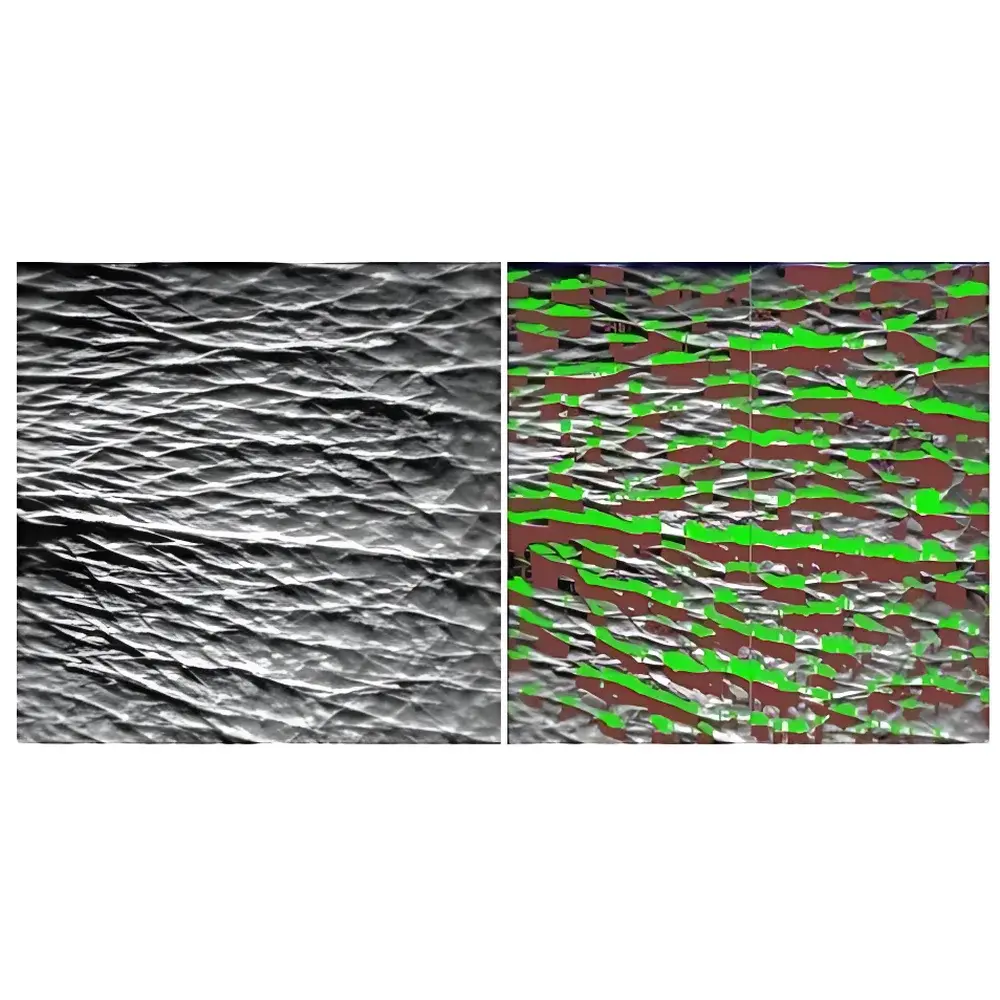
- 3D surface reconstruction: Real-time rendering of replica topography with adjustable lighting angles, false-color depth mapping (brown = depth, green = width), and exportable STL/PLY mesh files for third-party biomechanical modeling.
Sample Compatibility & Compliance
The ASA-03RXD accepts standard medical-grade silicone impression materials (e.g., President MicroSystem, Reprosil) cured to Shore A 10–15 hardness. Its optical design accommodates replica thicknesses from 1.5 mm to 4.0 mm and planar deviations up to ±0.3 mm without refocusing. All analytical algorithms comply with the Japanese Society of Cosmetic Chemists (JSCA) “Guideline for Evaluation of Anti-Wrinkle Products” (2021 edition), including mandatory reporting of intra-replica coefficient of variation (CV < 8% for volume metrics) and inter-operator reproducibility thresholds. Data output formats meet GLP documentation requirements: timestamped audit logs, user ID tagging, version-controlled software binaries, and immutable PDF reports with embedded metadata (exposure time, lens aperture, calibration date).
Software & Data Management
The native Windows 10 application provides FDA 21 CFR Part 11–ready functionality: electronic signatures, role-based access control (admin/operator/reader), and full audit trail of all processing steps—including filter parameter adjustments, ROI redefinition, and calibration updates. Raw image stacks (.tiff), processed binary masks (.png), and quantitative datasets (.csv/.xlsx) are stored in a hierarchical project structure with SHA-256 hash verification. Batch analysis mode supports longitudinal tracking across multiple timepoints per subject; statistical modules compute paired t-tests, ANOVA, and effect size (Cohen’s d) directly within the interface. Export options include DICOM-SR for PACS integration and XML schemas compatible with CDISC SEND standards for regulatory submissions.
Applications
- Clinical trial endpoints: Primary efficacy assessment in Phase II/III anti-aging studies per JSCA, COLIPA, or ICH E9 frameworks.
- Formulation development: Dose-response characterization of retinoids, peptides, or botanical actives on dermal remodeling biomarkers.
- In vitro correlation: Validation of 3D skin equivalent models against human replica data for mechanistic studies.
- Regulatory dossier support: Generation of ISO/IEC 17025-aligned measurement uncertainty budgets for wrinkle volume (k=2, U ≈ ±4.2% at 95% confidence).
- Academic dermatopharmacology: High-throughput screening of topical delivery systems using texture anisotropy indices (e.g., directionality ratio derived from FFT analysis).
FAQ
Does the ASA-03RXD require daily recalibration?
No—calibration is performed during initial setup and after any hardware maintenance. The system stores calibration coefficients in non-volatile memory and validates them automatically at startup using internal reference targets.
Can it analyze dynamic wrinkles (e.g., crow’s feet during facial expression)?
No—the system is designed exclusively for static silicone replicas. Dynamic wrinkle assessment requires synchronized high-speed videography coupled with motion-tracking algorithms, which fall outside its scope.
Is the triangular volume model validated against confocal microscopy?
Yes—peer-reviewed comparative studies (J Cosmet Dermatol. 2022;21:1123–1131) demonstrate r² = 0.94 between ASA-03RXD volume outputs and vertical sectioning measurements from confocal laser scanning microscopy (CLSM) on identical replicas.
What file formats does the software export for statistical analysis?
CSV (UTF-8 encoded, tab-delimited), XLSX (with worksheet-level metadata), and JSON-LD (schema.org-compliant for FAIR data principles).
Is remote software update supported?
Yes—updates are delivered via encrypted HTTPS channel with SHA-512 signature verification; rollback capability preserves previous version binaries for audit continuity.
Related Products