
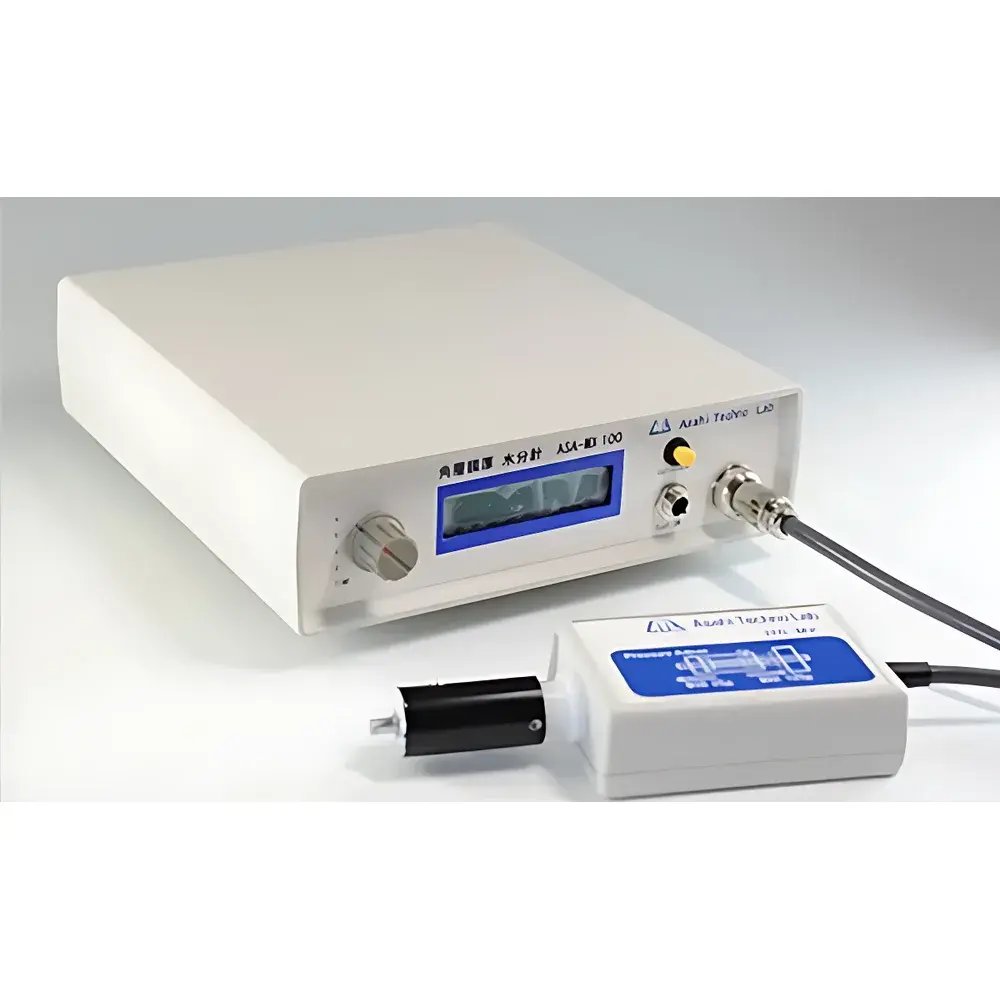
ASCH ASA-MX100 Skin Hydration and Barrier Function Analyzer
| Brand | ASCH |
|---|---|
| Origin | Japan |
| Model | ASA-MX100 |
| Measurement Principle | Conductivity-based Corneal Hydration & Transepidermal Electrical Resistance (TEER) |
| Probe Types | C3D-MX (3D skin models), R2-MX (scalp), T4-MX (nail) |
| Measurement Time | 5 s per reading |
| Electrode Configuration | Separated excitation/detection electrodes |
| Output Interface | RS-232 digital port |
| Calibration | Fully digital one-button calibration |
| Compliance | Designed for GLP-compliant dermatological research and cosmetic efficacy testing |
Overview
The ASCH ASA-MX100 Skin Hydration and Barrier Function Analyzer is a precision-engineered, Japan-manufactured instrument designed for quantitative, non-invasive assessment of stratum corneum hydration status and epidermal barrier integrity. It operates on the well-established principle of alternating current (AC) conductivity measurement—leveraging the ionic conductance of electrolytes naturally present in hydrated stratum corneum tissue. Unlike capacitive methods, which respond primarily to bulk dielectric properties, the ASA-MX100’s dual-frequency AC excitation enables simultaneous quantification of water content (via low-frequency conductance) and barrier resistance (via high-frequency impedance), yielding a clinically relevant Barrier Index (BI). This dual-parameter capability supports mechanistic interpretation of skin physiology—e.g., distinguishing between superficial desquamation-driven dryness and deeper barrier compromise. The device meets design requirements for ISO 10993-1 biocompatibility (for probe contact surfaces) and aligns with ASTM E2852–22 guidelines for instrumental skin property evaluation under controlled environmental conditions (22 ± 1 °C, 40–60% RH).
Key Features
- Dual-parameter acquisition: Simultaneous real-time output of Stratum Corneum Hydration (SCH, in arbitrary conductance units linearly correlated to % w/w water content) and Barrier Index (BI, derived from transepidermal electrical resistance)
- Modular probe system: Three application-specific probes—C3D-MX (5 mm diameter, 15 g contact load) for reconstructed 3D human skin equivalents; R2-MX (2 mm diameter, 25–150 g variable load) for intact scalp without shaving; T4-MX (4 mm diameter, 500 g load) for nail plate hydration profiling
- High temporal resolution: Stable readings acquired within 5 seconds, minimizing motion artifact and enabling high-throughput screening in clinical or formulation labs
- Separate excitation/detection electrode architecture: Eliminates polarization drift and ensures long-term signal stability—critical for longitudinal studies and multi-site trials
- Fully digital calibration routine: One-button automated zero/reference adjustment using certified saline standards; no manual potentiometer adjustment required
- RS-232 serial interface: Enables direct data streaming to LIMS or custom analysis platforms; supports timestamped, ASCII-formatted output for audit trail compliance
Sample Compatibility & Compliance
The ASA-MX100 is validated for use across diverse biological substrates without chemical pretreatment or occlusion. Its R2-MX probe permits reliable scalp hydration mapping even over dense hair follicles—enabling correlation of desquamation severity with transepidermal water loss (TEWL) proxies. For 3D skin models (e.g., EpiDerm™, SkinEthic™), the C3D-MX probe delivers reproducible hydration gradients across stratified keratinocyte layers, supporting OECD TG 439 validation workflows. All probes comply with IEC 61000-4-2 (ESD immunity) and feature autoclavable stainless-steel housings rated IP54. Device firmware adheres to FDA 21 CFR Part 11 requirements for electronic records—supporting user authentication, audit logs, and electronic signatures when integrated with compliant data management systems.
Software & Data Management
While the ASA-MX100 operates as a standalone hardware analyzer, its RS-232 interface facilitates integration with third-party software environments—including Python-based analysis pipelines (via PySerial), MATLAB instrument control toolboxes, or commercial dermatology data platforms such as DermEngine or Visia-CR. Raw conductance and impedance values are output at 10 Hz sampling rate with 16-bit resolution. Timestamped datasets include probe ID, operator code, ambient temperature/humidity (if externally logged), and measurement location coordinates (user-defined). Built-in memory retains up to 500 measurements with metadata tagging—sufficient for single-subject time-course studies without external storage.
Applications
- Evaluation of scalp xerosis: Quantifying hydration deficits preceding dandruff formation and pruritus—without requiring trichoscopic preprocessing
- Cosmetic ingredient efficacy: Measuring persistence of humectants (e.g., glycerin, hyaluronic acid) and occlusives (e.g., ceramide NP, petrolatum) via time-resolved SCH decay kinetics
- Barrier repair kinetics: Tracking BI recovery post-sodium lauryl sulfate (SLS) challenge in vivo or in vitro
- 3D model validation: Benchmarking hydration depth profiles in reconstructed epidermis against native tissue reference data
- Nail plate hydration dynamics: Assessing penetration enhancers in topical antifungal formulations
- Regulatory dossier support: Generating GLP-aligned data for EU Cosmetics Regulation (EC No. 1223/2009) Annex I safety assessments
FAQ
What is the measurement uncertainty for stratum corneum hydration under standard conditions?
Typical repeatability (within-subject, same site, 3 consecutive readings) is ±3.2% relative standard deviation at 40% w/w hydration level, per internal validation per ISO/IEC 17025-accredited protocols.
Can the ASA-MX100 be used on infants or sensitive populations?
Yes—the R2-MX and C3D-MX probes apply sub-physiological mechanical loads (<150 g), and all contact surfaces are nickel-free stainless steel compliant with EN 1811:2011 for prolonged skin contact.
Does the device require annual recalibration by the manufacturer?
No—field calibration is fully user-executable via the built-in digital routine; however, traceable recalibration using NIST-traceable conductivity standards is recommended every 24 months for regulatory submissions.
Is there compatibility with ISO 20743 antibacterial textile testing protocols?
Not directly—the ASA-MX100 measures biological tissue properties only; however, its Barrier Index output can serve as a secondary endpoint in co-culture studies evaluating textile-induced barrier disruption.
How is probe-to-skin contact pressure controlled during measurement?
Each probe integrates a calibrated spring mechanism with fixed or adjustable preload (15 g, 25–150 g, or 500 g), eliminating operator-dependent variability—a key differentiator from handheld capacitance meters.




