
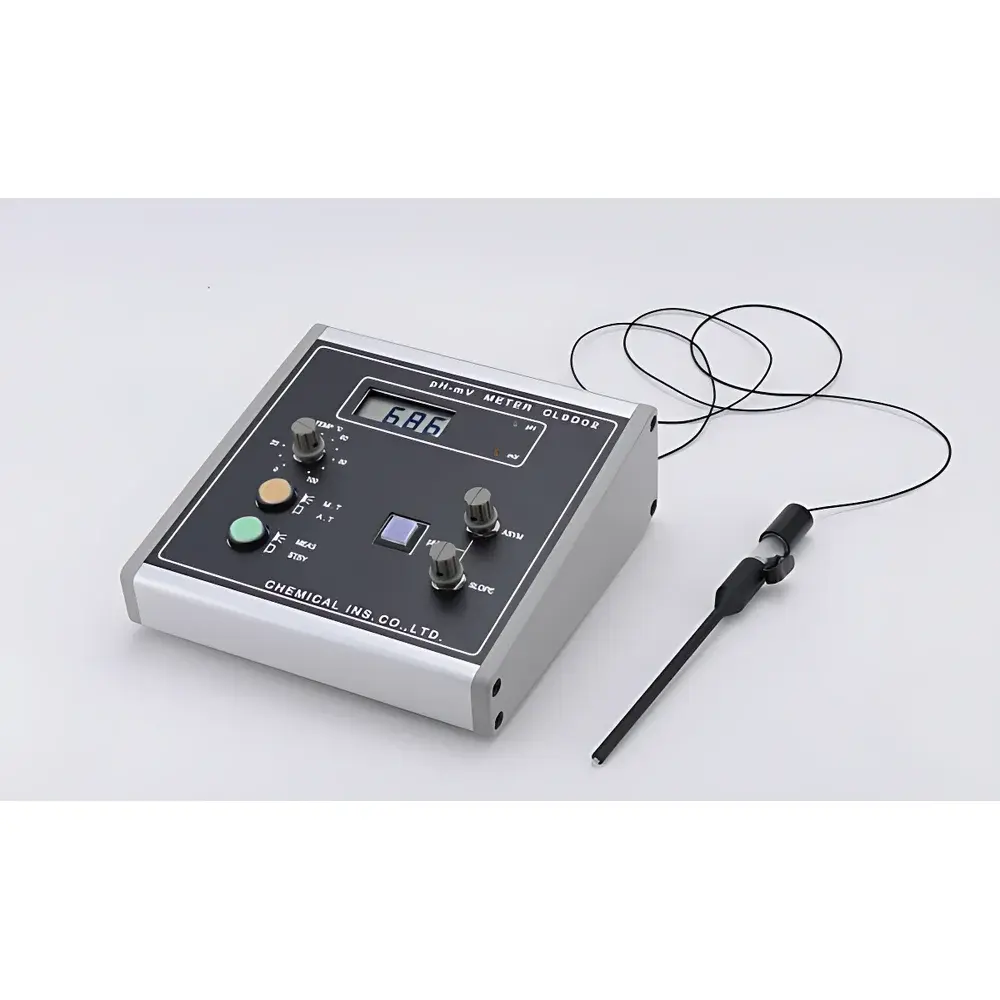
ASCH CMSN-141 Solid-Sample pH Probe System with CL-9D02 Digital pH/mV Meter
| Brand | ASCH |
|---|---|
| Origin | Japan |
| Model | CMSN-141 |
| Instrument Type | Benchtop |
| Parameters Measured | pH and mV |
| Measurement Accuracy | ±0.01 pH |
| pH Range | 4.0–9.0 |
| Resolution | 0.01 pH |
| Calibration Buffers | pH 4.01 and 6.86 |
| Electrode Tip Diameter | 0.65 mm |
| Sensing Element | Antimony |
| Operating Temperature | 0–60 °C |
| Reference Electrode | CMR-545 (BNC, stainless steel body) |
| Salt Bridge | SB-010 |
| Cable Length | 1.0 m |
| Liquid Junction | None |
Overview
The ASCH CMSN-141 Solid-Sample pH Probe System is a specialized benchtop electrochemical measurement platform engineered for direct in-situ pH determination in non-fluid, semi-solid, and heterogeneous matrices—such as dairy products (e.g., cheese, yogurt), gels, pastes, food emulsions, pharmaceutical ointments, and soil aggregates. Unlike conventional glass-electrode-based pH meters designed for aqueous solutions, this system employs a needle-type antimony pH sensor (CMSN-141) with a 0.65 mm diameter rigid probe tip, enabling mechanical penetration into the sample without requiring homogenization or extraction. The antimony sensing element operates on the principle of reversible redox potential development at the metal–sample interface, generating a stable, Nernstian-like response proportional to hydrogen ion activity under defined hydration and contact conditions. When paired with the CL-9D02 digital pH/mV meter and CMR-545 reference electrode—optionally via SB-010 salt bridge—the system satisfies dual-parameter (pH + mV) measurement requirements while maintaining compliance with fundamental electrochemical measurement protocols for solid-phase analysis.
Key Features
- Needle-type antimony pH electrode (CMSN-141) with 0.65 mm stainless-steel probe tip, optimized for low-invasive insertion into soft solids and semi-solids
- No internal electrolyte or liquid junction—eliminates clogging, leakage, and maintenance issues common in gel-filled or ceramic-junction electrodes
- Integrated BNC-compatible interface supporting interoperability with standard laboratory pH meters and data acquisition systems
- Operating temperature range of 0–60 °C ensures stability during routine QC testing and ambient-condition process monitoring
- High-resolution digital readout (0.01 pH) with ±0.01 pH accuracy, traceable to NIST-certified calibration buffers (pH 4.01 and 6.86)
- Modular architecture: compatible with optional salt bridge (SB-010) for ultra-low-volume or high-resistance samples where direct reference contact is impractical
Sample Compatibility & Compliance
The CMSN-141 system is validated for use with samples exhibiting limited free moisture, high viscosity (>10⁴ cP), or structural heterogeneity—conditions that preclude reliable measurement using conventional immersion electrodes. It complies with ASTM D1293 (Standard Test Method for pH of Water) principles adapted for solid-phase applications, and supports method development aligned with ISO 2952:2021 (Soil quality — Determination of pH) and USP (pH Measurement) guidelines where direct matrix interrogation is required. For regulated environments—including food safety labs, pharmaceutical formulation units, and contract research organizations—the CL-9D02 meter supports user-accessible calibration logs and manual entry of buffer values, facilitating GLP-aligned recordkeeping. While not inherently 21 CFR Part 11 compliant (lacking electronic signature or audit trail functions), the system may be deployed within validated workflows when paired with external LIMS-integrated data capture.
Software & Data Management
The CL-9D02 digital pH/mV meter operates independently without proprietary software, delivering real-time readings via a high-contrast LCD display with backlighting. All calibration and measurement data are manually recorded; no onboard memory or USB/Bluetooth connectivity is provided. This design prioritizes operational simplicity, electromagnetic interference resistance, and long-term reliability in industrial or field-deployed settings. For laboratories requiring automated data handling, the BNC output allows analog signal routing to external DAQ systems (e.g., National Instruments or LabVIEW platforms) or programmable logic controllers (PLCs) for integration into continuous monitoring schemes. Calibration verification can be performed using standard two-point protocol with certified buffers, and deviation logs must be retained per internal SOPs to satisfy ISO/IEC 17025 documentation requirements.
Applications
- Quality control of fermented dairy products (e.g., curd pH profiling during cheese ripening)
- In-process pH mapping of topical pharmaceutical gels and ointments during batch release
- Soil and sediment pH assessment in environmental monitoring without slurry preparation
- R&D of hydrocolloid-based food systems (e.g., pectin gels, starch pastes) where phase separation prohibits bulk solution sampling
- Corrosion studies involving pH-sensitive coatings or embedded sensors in polymer composites
- Academic research in biophysics and soft matter science requiring minimally disruptive interfacial proton activity measurement
FAQ
Can the CMSN-141 electrode measure pH in dry powders or highly viscous resins?
No—direct measurement requires sufficient interfacial hydration to establish electrochemical equilibrium. Samples must exhibit measurable surface moisture or plasticity to ensure stable antimony oxide layer formation and charge transfer.
Is the CMSN-141 compatible with automatic titrators or potentiometric analyzers?
Yes, provided the instrument accepts BNC-input high-impedance pH electrodes and supports manual calibration routines. However, auto-detection of electrode type or buffer recognition is not supported.
Why is a salt bridge (SB-010) recommended for some samples?
When sample volume is insufficient for simultaneous contact by both measuring and reference electrodes—or when electrical resistance exceeds ~1 MΩ—a salt bridge provides a stable, low-noise ionic pathway while isolating the reference element from matrix interference.
Does the antimony electrode require periodic reconditioning or polishing?
Yes—surface oxidation and organic fouling may occur after repeated use. Gentle abrasion with 1200-grit alumina slurry followed by rinsing in deionized water restores reproducibility. Avoid acidic or abrasive cleaning agents.
How does accuracy compare to glass electrodes in aqueous standards?
In standardized buffer solutions (pH 4.01/6.86), CMSN-141 achieves ±0.01 pH agreement with traceable glass references. In solid matrices, accuracy is method-dependent and should be verified against extract-based reference methods per application-specific validation protocols.



