
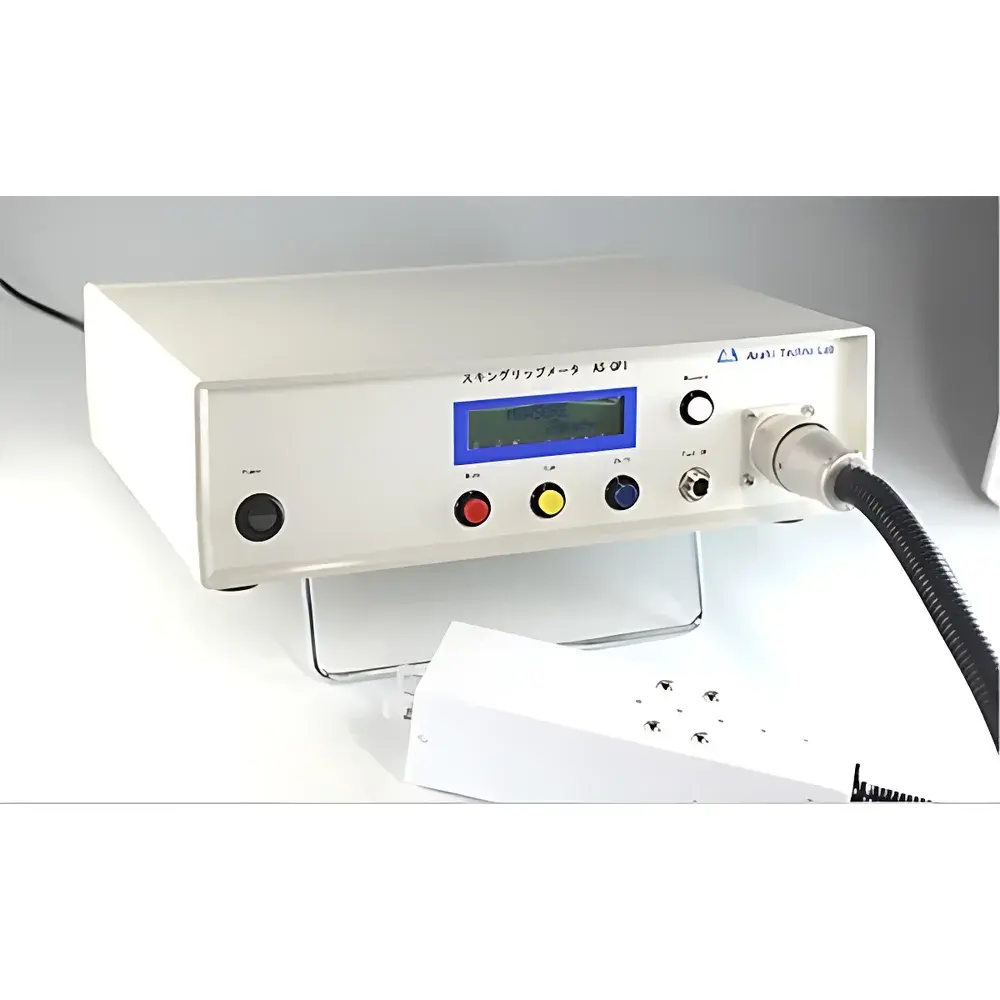
ASCH AS-GP1 Cutaneous Elastometry System
| Brand | ASCH |
|---|---|
| Origin | Japan |
| Model | AS-GP1 |
| Measurement Principle | Dual-finger-type quasi-static compression with real-time viscoelastic force feedback |
| Sensor Type | Lightweight, bidirectional tactile probes with adjustable clamping displacement and dwell time |
| Output Parameters | Maximum Stress (kPa), Skin Hardness Index, Elastic Recoil Ratio (%), Viscoelastic Relaxation Time Constant (s), Collagen Aging Index (unitless derived metric), Initial Rebound Velocity (mm/s), Sagging Index (normalized strain recovery deficit) |
| Compliance | Designed for GLP-aligned dermatological research workflows |
| Software Interface | PC-based acquisition with waveform visualization, timestamped data export (CSV, PNG), and multi-point protocol storage |
Overview
The ASCH AS-GP1 Cutaneous Elastometry System is a precision-engineered instrument designed for quantitative, non-invasive assessment of cutaneous and scalp viscoelastic properties. Unlike conventional suction-based elastometers—which induce uniaxial negative pressure and fail to replicate physiological mechanical loading—this system employs a dual-finger-type quasi-static compression methodology. Two independently actuated, lightweight tactile probes mimic manual pinching motion with controlled displacement, dwell duration, and release kinetics. During probe convergence, the system captures high-resolution force-time response curves as the skin deforms and recoils under defined mechanical boundary conditions. This approach enables direct quantification of biomechanical parameters linked to extracellular matrix integrity, particularly collagen fiber network organization and cross-linking density. The AS-GP1 is calibrated for reproducible measurements across anatomically complex regions—including periorbital zones, nasolabial folds, and plantar surfaces—where curvature, thickness variation, and directional anisotropy challenge conventional modalities.
Key Features
- Dual tactile probes with sub-millimeter positioning resolution and programmable clamping displacement (0.1–3.0 mm range, adjustable in 0.1-mm increments)
- Real-time force transduction at ≥1 kHz sampling rate, enabling accurate capture of initial rebound velocity and relaxation dynamics
- Modular probe orientation capability: probes rotate ±90° relative to each other, permitting measurement along wrinkle directionality or tissue grain
- Multi-stage protocol configuration: independent setting of pre-contact offset, compression speed, hold duration (0.1–10.0 s), and release profile
- Integrated thermal drift compensation and zero-force auto-calibration prior to each measurement cycle
- Compact probe head mass <25 g, minimizing gravitational artifact during angled or inverted surface measurements (e.g., forehead, scalp, heel)
Sample Compatibility & Compliance
The AS-GP1 accommodates human subjects (adult and pediatric cohorts), ex vivo tissue specimens, and 3D reconstructed epidermal/dermal models (e.g., EpiDerm™, SkinEthic™). Probe geometry supports indentation-free contact on concave contours such as the medial canthus and retroauricular fold. All hardware and firmware comply with IEC 61000-4 electromagnetic compatibility standards. Data acquisition protocols align with ISO 13802:2022 (mechanical testing of soft biological tissues) and support audit-ready documentation required under GLP-compliant dermatological efficacy studies. While not FDA-cleared as a diagnostic device, the system meets technical criteria referenced in ASTM E2983-21 (Standard Guide for Evaluating Mechanical Properties of Human Skin In Vivo).
Software & Data Management
The AS-GP1 Control Suite (v3.2+) runs on Windows 10/11 x64 platforms and provides synchronized visualization of force-displacement waveforms, derivative recoil velocity plots, and parameter heatmaps across multi-site trials. Each session generates a timestamped .csv file containing raw sensor output plus calculated metrics: Maximum Stress (kPa), Elastic Recoil Ratio (defined as % recovery of initial deformation at 1.0 s post-release), Relaxation Time Constant τ (fitted from exponential decay model), and Collagen Aging Index (a composite score derived from recoil hysteresis area and early-phase damping ratio). Audit trails record operator ID, calibration timestamps, probe serial numbers, and environmental temperature/humidity metadata. Export formats include CSV (for statistical analysis in R or Python), PNG (publication-ready waveform overlays), and XML (LIMS integration via HL7-compatible wrappers). Software adheres to ALCOA+ principles and supports 21 CFR Part 11-compliant electronic signatures when deployed with validated domain authentication.
Applications
- Quantitative evaluation of UV-induced collagen fragmentation via longitudinal tracking of Elastic Recoil Ratio decline in photodamaged forearm skin
- Biomechanical profiling of scalp elasticity in androgenetic alopecia trials, correlating sagging index with follicular miniaturization scores
- Validation of anti-glycation agents in 3D dermal equivalents by monitoring relaxation time constant stabilization over 28-day culture
- Assessment of stratum corneum barrier repair kinetics through hardness index recovery post-tape stripping
- Comparative analysis of plantar skin stiffening in diabetic neuropathy cohorts versus age-matched controls
- Preclinical screening of topical retinoid formulations using periorbital recoil velocity as a surrogate endpoint
FAQ
What distinguishes the AS-GP1 from suction-based skin elasticity devices?
The AS-GP1 applies controlled biaxial compression mimicking manual pinch mechanics, whereas suction devices generate non-physiological tensile strain that poorly correlates with collagen network behavior under natural loading.
Can the AS-GP1 measure on highly curved or mobile anatomical sites?
Yes—the low-mass probes and rotational joint design allow stable coupling on dynamic surfaces such as the lateral canthus during blink cycles or the flexor crease of the finger joint.
Is calibration traceable to national metrology institutes?
Force transducers are factory-calibrated against NIST-traceable deadweight standards; end-user verification kits include certified reference springs with ±0.5% uncertainty.
How is data integrity ensured during multi-center clinical studies?
Each unit logs firmware version, sensor serial number, and environmental conditions into every dataset; encrypted project containers prevent post-acquisition modification.
Does the system support automated batch processing of repeated measurements?
Yes—protocol templates enable sequential site mapping (e.g., 9-point facial grid) with auto-incremented filenames, geotagged coordinates, and integrated quality flags for outlier rejection.




