
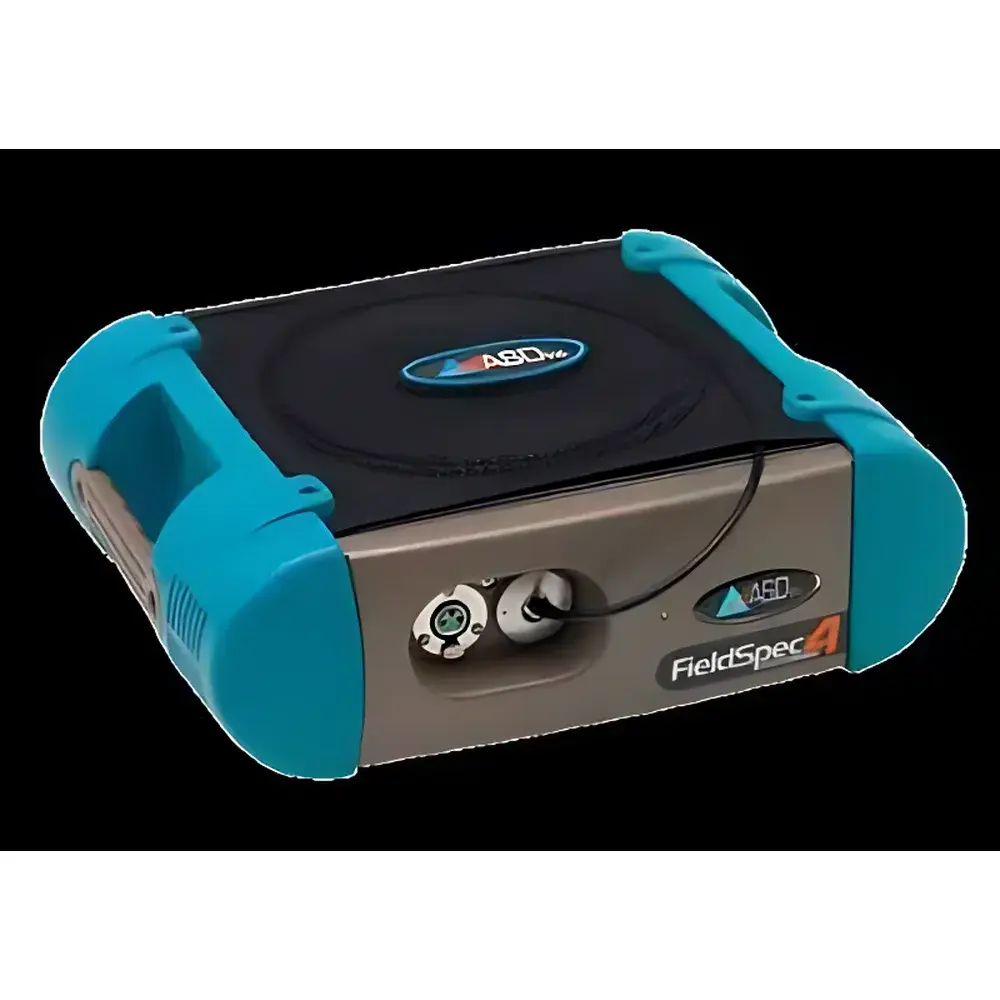
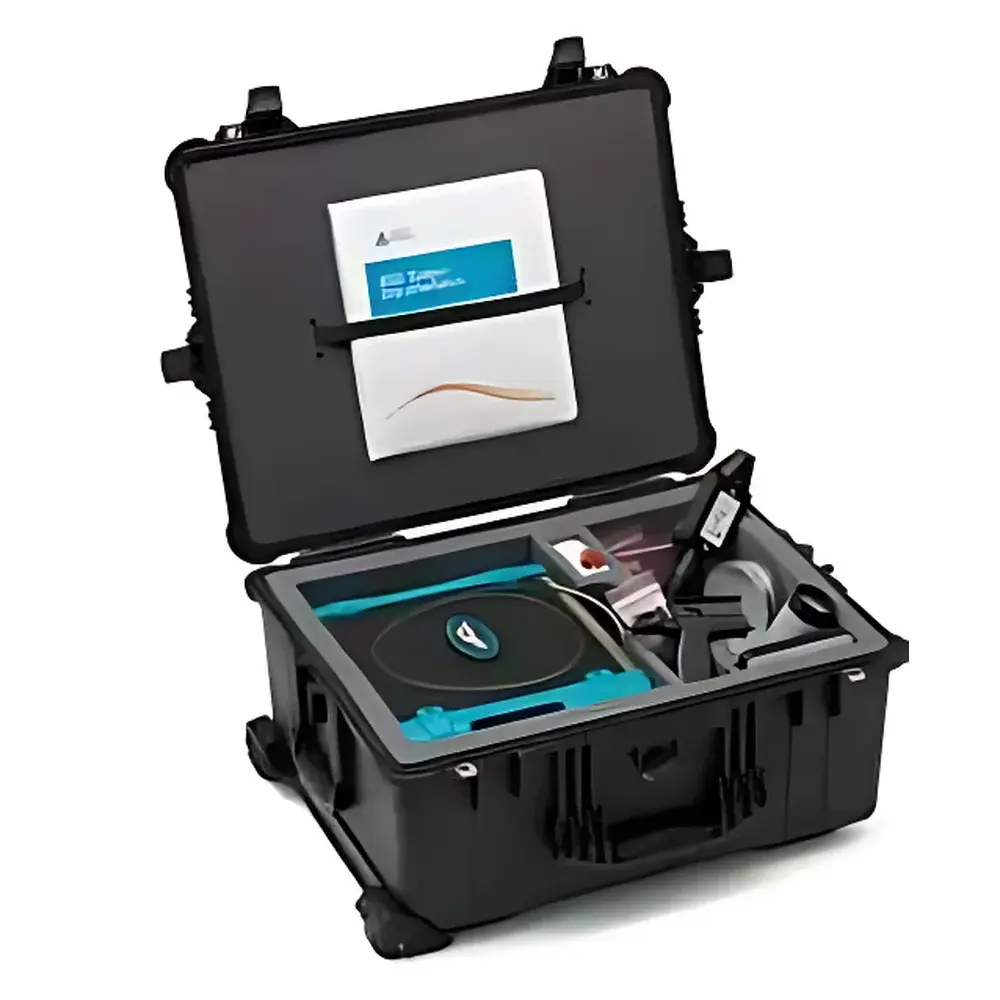
ASD FieldSpec® 4 HI-RES Fiber Optic Spectrometer
| Brand | ASD |
|---|---|
| Origin | USA |
| Model | FieldSpec® 4 HI-RES |
| Detector Type | PDA |
| Wavelength Range | 300–2500 nm |
| Spectral Resolution | 3 nm @ 700 nm, 8 nm @ 1400/2100 nm |
| Scan Time | 100 ms |
| SNR | VNIR: 1.0 × 10⁻⁹ W/cm²/nm/sr @ 700 nm, SWIR1: 1.4 × 10⁻⁹ W/cm²/nm/sr @ 1400 nm, SWIR2: 2.2 × 10⁻⁹ W/cm²/nm/sr @ 2100 nm |
| Stray Light | VNIR: 0.02%, SWIR1/2: 0.01% |
| Wavelength Accuracy | ±0.5 nm |
| Wavelength Repeatability | ±0.1 nm |
| Number of Channels | 2151 |
| Communication | 10/100 Base-T Ethernet, IEEE 802.11g Wi-Fi |
| Dimensions (H×W×D) | 12.7 × 36.8 × 29.2 cm |
| Weight | 5.44 kg (battery included: +1.2 kg) |
| Battery Life | 6 h (NiMH, 12 V, 9 Ah) |
| Operating Temperature | 0–40 °C |
| Storage Temperature | −15–45 °C |
| Power Input | 90–240 VAC, 50/60 Hz or 12 VDC, 5 A |
| Certifications | CE (EN61010-1:2001), EU Directives 2006/95/EC & 2004/108/EC, NIST-traceable calibration, WEEE compliant |
Overview
The ASD FieldSpec® 4 HI-RES Fiber Optic Spectrometer is a field-deployable, high-fidelity spectroradiometer engineered for quantitative spectral measurement across the ultraviolet-visible-near-infrared (UV-VNIR-SWIR) range from 300 to 2500 nm. Built upon the legacy of Analytical Spectral Devices (now part of Malvern Panalytical), this instrument employs a dual-detector architecture—comprising a 512-element silicon photodiode array (PDA) for the VNIR region and two thermoelectrically cooled InGaAs detectors for SWIR bands—to deliver calibrated radiance, reflectance, transmittance, and CIE colorimetric data under ambient field conditions. Its optical design follows rigorous radiometric principles grounded in absolute calibration traceability to the U.S. National Institute of Standards and Technology (NIST), ensuring metrological integrity for applications requiring regulatory-grade data reproducibility. The system operates as a complete spectral measurement platform—not merely a detector—but integrates calibrated optics, temperature-stabilized detection electronics, real-time onboard processing, and traceable factory calibration delivered with each unit.
Key Features
- Triple-spectral-range coverage (300–2500 nm) with seamless stitching and radiometric continuity between VNIR and SWIR channels
- High spectral resolution: ≤3 nm FWHM at 700 nm; ≤8 nm FWHM at 1400 nm and 2100 nm—optimized for fine spectral feature discrimination in vegetation pigments, mineral absorption features, and atmospheric water vapor bands
- Real-time spectral visualization: Simultaneous display of radiance, reflectance (requiring reference panel input), transmittance, and derived indices (e.g., NDVI, PRI, NDWI)
- Robust field architecture: Magnesium alloy housing rated for IP54-equivalent environmental resilience; operational within 0–40 °C without active cooling
- Integrated dual-mode connectivity: Gigabit-capable 10/100 Base-T Ethernet and IEEE 802.11g wireless interface for remote instrument control and live data streaming
- Battery-powered operation: 6-hour continuous acquisition using rechargeable NiMH pack (12 V, 9 Ah); auxiliary 12 VDC output supports co-located sensors (e.g., GPS, PAR, thermal imagers)
- Modular optical interface: SMA 905-compatible fiber port with optional wide-field-of-view fore-optics, cosine-corrected diffusers, leaf clip probes, integrating spheres, and lens-based field-of-view adapters (1° to 25°)
Sample Compatibility & Compliance
The FieldSpec® 4 HI-RES is designed for non-contact, non-destructive spectral characterization of heterogeneous natural and engineered surfaces—including vegetation canopies, soil profiles, geological outcrops, painted coatings, LED luminaires, and aquatic surface layers. Its measurement geometry conforms to ASTM E308-22 (Standard Practice for Computing the Colors of Objects by Using the CIE System) and ISO/CIE 11664-4:2019 (Colorimetry — Part 4: CIE 1976 L*a*b* Colour Space). Radiometric calibration adheres to NIST-traceable protocols per ISO/IEC 17025:2017 requirements for testing laboratories. All factory calibrations include full uncertainty budgets, spectral responsivity curves, and dark current characterization. The instrument meets CE marking requirements under EN61010-1:2001 (safety) and EN61326-1:2013 (EMC), and complies with EU directives 2006/95/EC (Low Voltage Directive) and 2004/108/EC (EMC Directive). It is fully compatible with GLP-compliant workflows when paired with RS3™ software’s audit-trail-enabled acquisition logs.
Software & Data Management
Data acquisition is managed via RS3™ Spectral Acquisition Software, which provides real-time spectral preview, automated exposure control, batch measurement scripting, and on-the-fly index computation. All raw and processed spectra are saved in industry-standard ENVI-compatible BIL format (.hdr/.sli), enabling direct ingestion into ENVI®, Python (spectral, scikit-learn), R (hyperSpec), and MATLAB environments. Post-processing is supported by ASD ViewSpec™ Pro, offering advanced tools for spectral smoothing, derivative analysis, continuum removal, endmember extraction, and spectral angle mapper (SAM) classification. Optional Indico® Pro enables multivariate calibration development (PLS, PCR) for quantitative prediction models—validated against reference laboratory assays per ASTM D7467-21. All software modules support metadata embedding (GPS coordinates, time stamps, operator ID, instrument serial number) and export to CSV, ASCII, or HDF5 for LIMS integration.
Applications
- Remote sensing validation: Ground-truthing satellite and UAV-borne hyperspectral imagery (e.g., Sentinel-2, PRISMA, AVIRIS-NG)
- Agricultural phenotyping: Quantifying chlorophyll content, nitrogen status, water stress, and disease onset via narrowband vegetation indices
- Mineral identification: Detecting diagnostic absorption features of clays, carbonates, sulfates, and hydroxides in exploration geochemistry
- Environmental monitoring: Measuring phytoplankton absorption, CDOM, and suspended sediment load in coastal and inland waters
- Material science: Characterizing spectral reflectance of solar absorbers, architectural coatings, and photovoltaic materials per ASTM E903 and ISO 9050
- Lighting metrology: Evaluating spectral power distribution (SPD), CCT, CRI, and TM-30 metrics for LEDs and OLEDs in compliance with IES LM-79 and CIE S 025/E:2015
FAQ
Is the FieldSpec® 4 HI-RES suitable for laboratory use as well as field deployment?
Yes—the instrument maintains its NIST-traceable calibration stability across both controlled lab environments and variable outdoor conditions. Its thermal management and sealed optical path ensure consistent performance during long-duration benchtop measurements.
Does the system support automated calibration routines in the field?
It does not perform self-calibration, but includes rapid, user-executed reference panel measurements (e.g., Spectralon® white standard) to compute real-time reflectance. Factory calibration remains valid for 12 months under normal use, with optional annual recalibration services available.
Can the FieldSpec® 4 HI-RES be synchronized with GPS or other external sensors?
Yes—via TTL trigger input and serial NMEA 0183 output. Optional integrated GPS modules provide geotagged spectral records with sub-meter positional accuracy when post-processed with differential correction.
What spectral data formats are natively supported for export?
All acquisitions are stored in ENVI BIL format with embedded header metadata. Export options include CSV (wavelength/intensity pairs), ASCII, and HDF5—enabling interoperability with FAIR data principles and institutional repositories.
Is FDA 21 CFR Part 11 compliance supported?
While the base RS3™ software does not include electronic signature or audit-trail modules required for Part 11, validated configurations with third-party LIMS integration (e.g., Thermo Fisher SampleManager, LabVantage) can meet regulated environment requirements when deployed under documented SOPs.






