
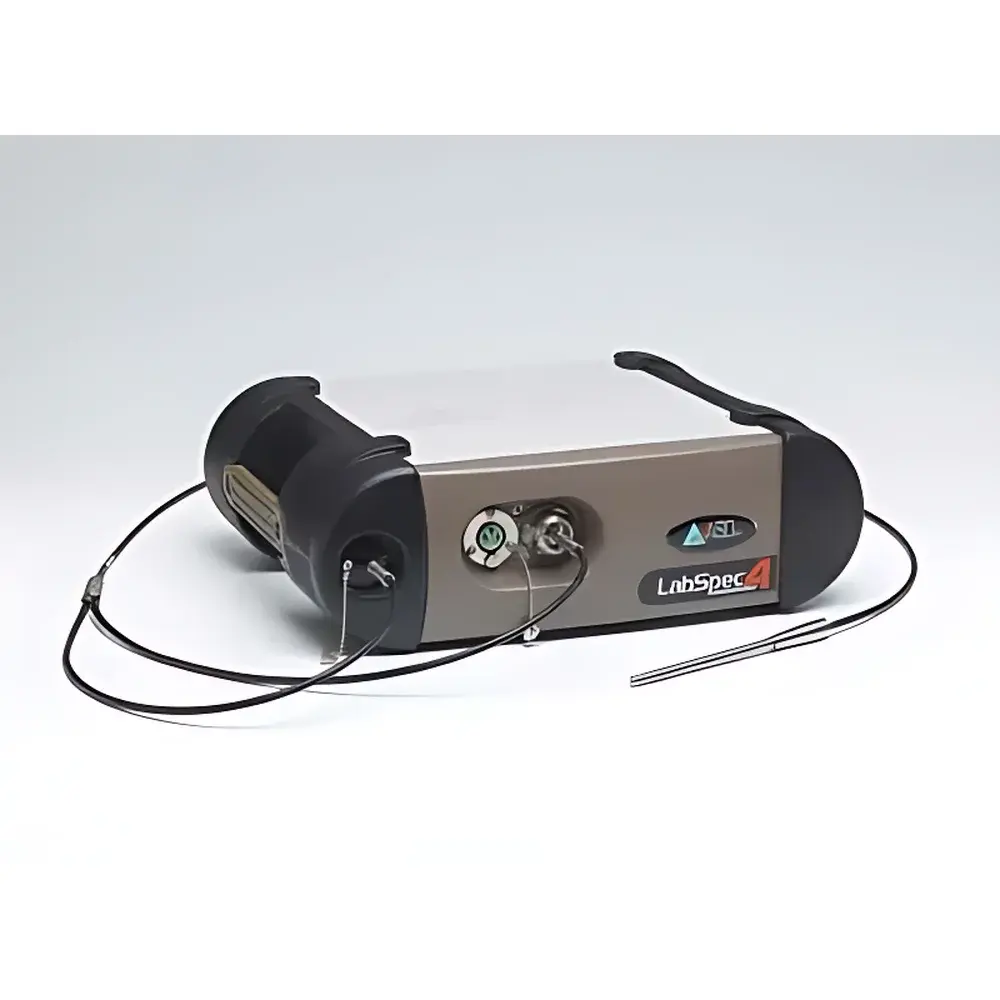
ASD LabSpec 4 Hi-Res Fiber Optic Spectrometer
| Brand | ASD |
|---|---|
| Origin | USA |
| Model | LabSpec 4 Hi-Res |
| Wavelength Range | 350–2500 nm |
| Spectral Resolution | 6 nm @ 1400/2100 nm (Hi-Res) / 10 nm @ 1400/2100 nm (Standard) |
| Scan Time | 100 ms |
| SNR | VNIR 9000:1 @ 700 nm, SWIR1 9000:1 @ 1400 nm, SWIR2 4000:1 @ 2100 nm |
| Detector Configuration | 512-pixel Si array (350–1000 nm) + dual TE-cooled InGaAs arrays (1000–1800 nm & 1800–2500 nm) |
| Certifications | CE (EN 61010-1:2001), EU Directive 2006/95/EC & 2004/108/EC, NIST-traceable calibration |
| Software Compatibility | Indico® Pro, GRAMS (Thermo Scientific), The Unscrambler® (Camo) |
| Connectivity | 10/100Base-T Ethernet, IEEE 802.11g Wi-Fi (up to 300 m line-of-sight) |
| Power | 12 VDC NiMH battery (6 h typical operation), AC/DC adapter (90–240 VAC, 50/60 Hz) |
| Dimensions | 12.7 × 35.6 × 29.2 cm |
| Weight | 5.2 kg (with battery) |
Overview
The ASD LabSpec 4 Hi-Res Fiber Optic Spectrometer is a laboratory-grade, full-range UV-VIS-NIR-SWIR spectrometer engineered for quantitative and qualitative spectral analysis of solid, liquid, and semi-solid samples. Operating on the principle of diffraction grating-based optical dispersion coupled with high-stability photodetector arrays, the instrument delivers calibrated radiometric and reflectance measurements across a continuous spectral range from 350 nm to 2500 nm. Its dual-detector architecture—comprising a 512-pixel silicon CCD for the VNIR region (350–1000 nm) and two thermoelectrically cooled InGaAs linear arrays for SWIR sub-bands (1000–1800 nm and 1800–2500 nm)—ensures low-noise, high-dynamic-range acquisition under ambient or controlled lab conditions. Designed for reproducible benchtop deployment, the LabSpec 4 Hi-Res integrates NIST-traceable factory calibration and supports compliance-critical workflows in regulated environments.
Key Features
- High-resolution spectral acquisition: 6 nm full-width-at-half-maximum (FWHM) resolution at 1400 nm and 2100 nm—optimized for resolving narrow absorption features in petrochemicals, pharmaceutical actives, and polymer additives.
- Sub-100 ms spectral scan time enables rapid data collection for high-throughput screening and kinetic studies.
- Dual TE-cooled InGaAs detectors maintain thermal stability over extended measurement sessions, minimizing dark current drift and ensuring long-term wavelength fidelity (±0.1 nm repeatability, ±0.5 nm absolute accuracy).
- Integrated Wi-Fi 802.11g interface allows remote instrument control and real-time spectral streaming up to 300 meters—ideal for hazardous or spatially constrained lab setups.
- Optional built-in 10 VDC, 50 W quartz-tungsten-halogen (QTH) light source facilitates consistent illumination for transmission, absorbance, and diffuse reflectance measurements of liquids, slurries, and opaque solids.
- Radiometric capability with solar-scaled irradiance ranges: up to 2× solar in VNIR and 10× solar in SWIR—supporting field-lab correlation studies and BRDF characterization.
Sample Compatibility & Compliance
The LabSpec 4 Hi-Res accommodates diverse sample geometries—including Petri dishes, cuvettes (1–10 mm pathlength), powder cells, and custom sample holders—via standardized SMA 905 fiber-optic coupling. Its optical design supports ASTM E1777 (standard practice for near-infrared reflectance analysis), ISO 14771 (spectral reflectance measurement), and USP <1119> (near-infrared spectroscopy for pharmaceutical raw material identification). When configured with audit-trail-enabled software (e.g., Indico® Pro with 21 CFR Part 11-compliant user authentication and electronic signature modules), the system meets GLP and GMP documentation requirements for QC laboratories. CE marking per EN 61010-1:2001 confirms conformance to electrical safety standards for laboratory instrumentation.
Software & Data Management
The spectrometer operates natively with Indico® Pro—ASD’s proprietary chemometric platform offering PLS, PCA, SVM, and cluster analysis tools with model validation (cross-validation, RMSEP, R²). It also interfaces seamlessly with third-party spectroscopy suites: GRAMS (Thermo Scientific) for advanced spectral preprocessing and library search, and The Unscrambler® (Camo) for multivariate calibration development and PAT deployment. All software packages support direct import of ASD’s native .asd binary format, metadata-rich spectral files containing embedded calibration coefficients, detector temperature logs, and integration time stamps. Raw data export options include CSV, ASCII, and JCAMP-DX formats to ensure interoperability with LIMS and ELN systems.
Applications
- Pharmaceutical: Identification and assay of active pharmaceutical ingredients (APIs) and excipients using NIR-SWIR fingerprinting; blend uniformity assessment via real-time spectral mapping.
- Agriculture & Food: Quantification of moisture, protein, starch, and oil content in grains, feed, and processed foods—validated against AOAC and ICC reference methods.
- Petrochemical: Discrimination of hydrocarbon classes (paraffins, olefins, aromatics) and detection of oxidation products in fuels and lubricants.
- Materials Science: Characterization of polymer crystallinity, filler dispersion, and degradation markers via SWIR overtone and combination band analysis.
- Environmental: Soil organic carbon estimation, clay mineral identification, and heavy metal proxy modeling using VNIR-SWIR spectral indices.
FAQ
What spectral resolution options are available for the LabSpec 4 platform?
The LabSpec 4 offers two fixed-resolution configurations: Standard-Res (10 nm FWHM at 1400/2100 nm) and Hi-Res (6 nm FWHM at 1400/2100 nm), both maintaining identical wavelength coverage (350–2500 nm) and detector architecture.
Is the instrument suitable for Good Manufacturing Practice (GMP) environments?
Yes—when paired with 21 CFR Part 11-compliant software modules (e.g., Indico® Pro with electronic signatures and audit trail), the LabSpec 4 supports validated analytical procedures and regulatory submissions.
Can the LabSpec 4 perform absolute radiometric measurements?
Yes—it delivers NIST-traceable radiometric calibration across all spectral bands, enabling absolute irradiance, radiance, and reflectance quantification when used with calibrated reference standards.
Does the system require external cooling or climate control?
No—TE cooling of SWIR detectors is fully internal and self-regulating; operational temperature range is 0–40 °C, with no requirement for chilled water or external chillers.
How is spectral data synchronized with auxiliary sensors (e.g., temperature, humidity)?
The LabSpec 4 provides a programmable auxiliary I/O port (+12 VDC, 27 W max) for triggering and timestamp synchronization with external environmental sensors via TTL or analog inputs—enabling correlative multimodal data acquisition.
Related Products





