
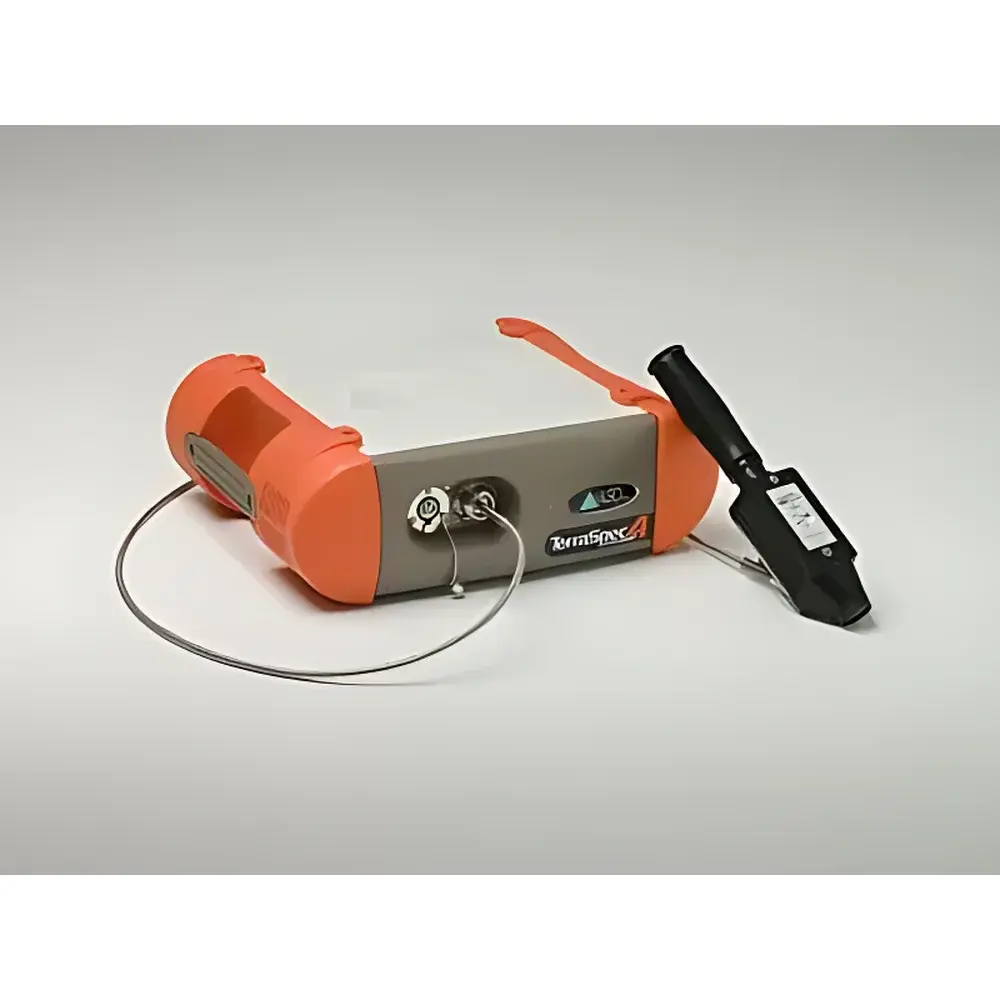
ASD TerraSpec 4 Hi-Res Fiber Optic Spectrometer
| Brand | ASD |
|---|---|
| Origin | USA |
| Model | TerraSpec 4 Hi-Res |
| Wavelength Range | 350–2500 nm |
| Spectral Resolution | 3 nm @ 700 nm, 6 nm @ 1400/2100 nm |
| Scan Speed | 100 ms |
| SNR | VNIR 9000:1 @ 700 nm, SWIR1 9000:1 @ 1400 nm, SWIR2 4000:1 @ 2100 nm |
| Stray Light | VNIR 5000:1 (0.02%), NIR 10000:1 (0.01%) |
| Wavelength Repeatability | ±0.1 nm |
| Wavelength Accuracy | ±0.5 nm |
| Detector | 512-pixel Si array (350–1000 nm), TE-cooled InGaAs gradient-index arrays (1001–1800 nm & 1801–2500 nm) |
| Interface | 10/100 Base-T Ethernet, 802.11g Wi-Fi |
| Dimensions (H×W×D) | 12.7 × 36.8 × 29.2 cm |
| Weight | 5.44 kg (instrument), +1.2 kg (battery) |
| Battery Life | ~6 h (standalone) |
| Operating Temperature | 0–40 °C |
| Storage Temperature | −15–45 °C |
| Power Input | 90–240 VAC / 50–60 Hz or 12 VDC / 60 W |
Overview
The ASD TerraSpec 4 Hi-Res Fiber Optic Spectrometer is a field-deployable, high-fidelity reflectance spectrometer engineered for quantitative mineral identification and mapping in geological exploration. Operating across the full solar-reflective spectrum—from visible-near infrared (VNIR: 350–1000 nm) through two shortwave infrared (SWIR1: 1001–1800 nm; SWIR2: 1801–2500 nm) regions—the instrument leverages dual InGaAs detector arrays with thermoelectric (TE) cooling to deliver stable, low-noise spectral acquisition under variable ambient conditions. Its optical architecture is based on a fixed-grating, fiber-coupled design optimized for high throughput and minimal polarization sensitivity, enabling robust measurement of low-reflectance, iron-rich minerals—including serpentine, chlorite, and other hydroxyl-bearing phyllosilicates—that exhibit weak spectral contrast in conventional systems. The 3 nm resolution at 700 nm and 6 nm at key SWIR absorption features (e.g., Al–OH at ~2200 nm, Mg–OH at ~2320 nm) ensures resolvable diagnostic absorption minima critical for lithological discrimination and alteration zoning.
Key Features
- High-resolution spectral acquisition across 350–2500 nm with 2151 data channels and <±0.5 nm wavelength accuracy
- Dual TE-cooled InGaAs detector arrays for SWIR1 and SWIR2, minimizing thermal drift and enhancing signal stability during extended field operation
- 100 ms full-spectrum scan speed—enabling rapid point-and-shoot measurements without motion-induced artifacts
- Integrated 802.11g Wi-Fi module and Ethernet interface for real-time remote control, metadata tagging, and networked data streaming to ruggedized Windows® laptops or tablet-based acquisition platforms
- Field-optimized mechanical design: magnesium alloy housing, IP54-rated ingress protection, shock-absorbing transport case, and ergonomic backpack system rated for multi-day survey deployments
- Low-stray-light optical path (<0.01% in NIR) ensuring fidelity in dark-sample analysis where spectral slope and subtle absorption depth are quantitatively significant
Sample Compatibility & Compliance
The TerraSpec 4 Hi-Res is designed for non-destructive, contact or standoff reflectance measurements of unprepared geological materials—including drill cuttings, core samples, outcrop surfaces, and soil profiles—without sample homogenization or pelletization. Its calibrated spectral response adheres to ASTM E1777 (Standard Practice for Reflectance Spectroscopy of Geologic Materials) and supports traceable calibration via NIST-traceable ceramic standards (e.g., Spectralon®). Data acquisition workflows comply with GLP-aligned documentation requirements, including embedded GPS timestamping, operator ID tagging, illumination geometry logging (e.g., 0°/45° or diffuse), and raw DN-to-radiance conversion metadata. While not FDA 21 CFR Part 11 certified out-of-the-box, audit trails generated by RS3™ software—including user login logs, parameter change history, and raw file checksums—can be integrated into validated laboratory information management systems (LIMS) supporting GMP-regulated mineral resource estimation.
Software & Data Management
Acquisition is managed via RS3™ Spectral Acquisition Software, which provides real-time spectral preview, automated dark/current reference capture, and batch-mode measurement scripting. Raw spectra are stored in ENVI-compatible BIL format with embedded header metadata (wavelength grid, integration time, detector temperature, GPS coordinates). Post-processing is supported by ViewSpecPro™, offering continuum removal, spectral angle mapper (SAM), and spectral feature fitting (e.g., Gaussian deconvolution of OH/H₂O bands). Third-party interoperability includes direct import into ENVI, ArcGIS (via Python GDAL bindings), and The Spectral Geologist (TSG) for lithological classification and alteration mapping. Optional Indico® Pro enables partial least squares (PLS) and support vector machine (SVM) modeling for semi-quantitative mineral abundance estimation—validated against XRD and EPMA reference datasets per ISO 18115-2:2017.
Applications
- Mineral exploration targeting hydrothermal alteration assemblages (e.g., kaolinite–smectite–illite zoning)
- Core logging and drill-cuttings screening for rapid lithostratigraphic correlation
- Open-pit and underground mine face mapping using handheld or vehicle-mounted configurations
- Regolith and laterite profile characterization for bauxite or nickel exploration
- Early-stage reconnaissance surveys integrating with drone-based hyperspectral platforms for ground-truthing
- Geotechnical assessment of clay mineralogy influencing slope stability and tailings behavior
FAQ
What spectral calibration standards are recommended for routine field validation?
NIST-traceable white reference panels (e.g., Spectralon® 99% reflectance) and dark current references should be measured before and after each survey session. ASD provides factory-calibrated lamp-based irradiance standards for absolute reflectance correction.
Can the TerraSpec 4 Hi-Res be operated from a moving platform such as an ATV or UAV?
Yes—its 100 ms scan speed and internal inertial stabilization (via optional IMU add-on) enable georeferenced spectral collection at vehicle speeds up to 20 km/h. UAV integration requires external GNSS-IMU synchronization and custom mounting to minimize vibration coupling.
Is TE cooling active during battery-powered operation?
Yes—the detector cooling subsystem draws power from the sealed lead-acid battery and maintains stable operating temperature (−5 °C to +5 °C) for ≥6 hours, preserving SNR performance across SWIR2 without AC dependency.
How does the instrument handle spectral degradation due to moisture or dust exposure in tropical environments?
The optical bench is sealed with O-ring gaskets and desiccant ports; the front lens assembly features hydrophobic anti-smudge coating. Field maintenance protocols include nitrogen purging and periodic spectral verification using onboard dark reference.
Does RS3™ support automated spectral library matching against USGS or JPL spectral databases?
Yes—RS3™ includes built-in spectral matching against the USGS Digital Spectral Library (Version 7) and JPL’s RELAB database using spectral angle, Euclidean distance, and derivative-based correlation algorithms—with customizable match thresholds and confidence scoring.





