
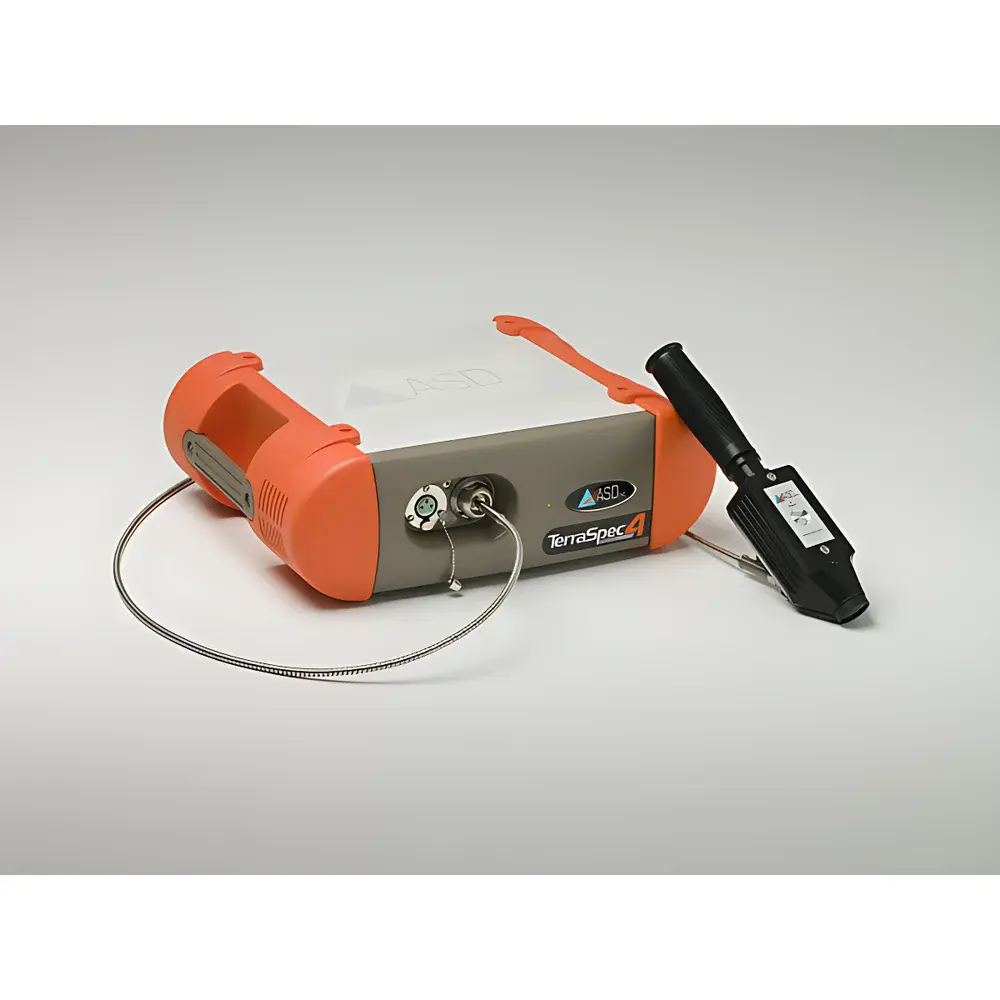
ASD TerraSpec 4 Hi-Res Portable Field Spectrometer
| Brand | ASD |
|---|---|
| Origin | USA |
| Model | TerraSpec 4 Hi-Res |
| Spectral Range | 350–2500 nm |
| Detector | InGaAs |
| Resolution | 3 nm @ 700 nm |
| Sensitivity | 75 photons/count |
| SNR | VNIR 9000:1 @ 700 nm |
| SWIR1 9000 | 1 @ 1400 nm |
| SWIR2 4000 | 1 @ 2100 nm |
| Dynamic Range | 7.5×10⁹ |
| Stray Light | VNIR 5000:1 (0.02%) |
| NIR 10000 | 1 (0.01%) |
Overview
The ASD TerraSpec 4 Hi-Res Portable Field Spectrometer is a rigorously engineered, field-deployable spectroradiometer designed for quantitative mineralogical characterization in geological exploration and resource assessment. Operating on the principle of reflectance spectroscopy across the visible-near-infrared (VNIR) and shortwave infrared (SWIR) spectral domains (350–2500 nm), it captures diagnostic absorption features arising from electronic transitions (e.g., Fe²⁺/Fe³⁺, Cr³⁺) and vibrational overtones (e.g., OH, Al–OH, Mg–OH, CO₃, H₂O) in crystalline and hydrous minerals. Its high-fidelity spectral response enables unambiguous identification of alteration assemblages—including phyllosilicates (kaolinite, smectite, illite, chlorite), sulfates (gypsum, jarosite), carbonates (calcite, dolomite), and iron oxides/hydroxides—critical for vectoring toward hydrothermal ore systems. The instrument’s ruggedized architecture, integrated GPS synchronization, and real-time spectral preview support GLP-aligned field workflows without laboratory dependency.
Key Features
- High-resolution spectral sampling: 3 nm FWHM at 700 nm, 6 nm at 1400 nm and 2100 nm—optimized to resolve narrow OH–H₂O combination bands essential for distinguishing dioctahedral vs. trioctahedral clay species and subtle compositional zoning.
- Dual InGaAs detector array with thermoelectric cooling ensures stable radiometric performance across SWIR1 (1000–1800 nm) and SWIR2 (1800–2500 nm) regions, delivering 2× improved signal fidelity for low-reflectance, Fe-rich minerals (e.g., serpentine, chlorite, goethite).
- Enhanced optical throughput and reduced stray light (<0.01% in NIR, <0.02% in VNIR) enable reliable detection of weak absorption features under variable illumination and surface conditions—critical for reconnaissance-scale mapping of subtle alteration halos.
- Integrated 802.11g Wi-Fi and lightweight ergonomic backpack design facilitate wireless data streaming, remote instrument control, and rapid site-to-site deployment in rugged terrain without compromising measurement repeatability.
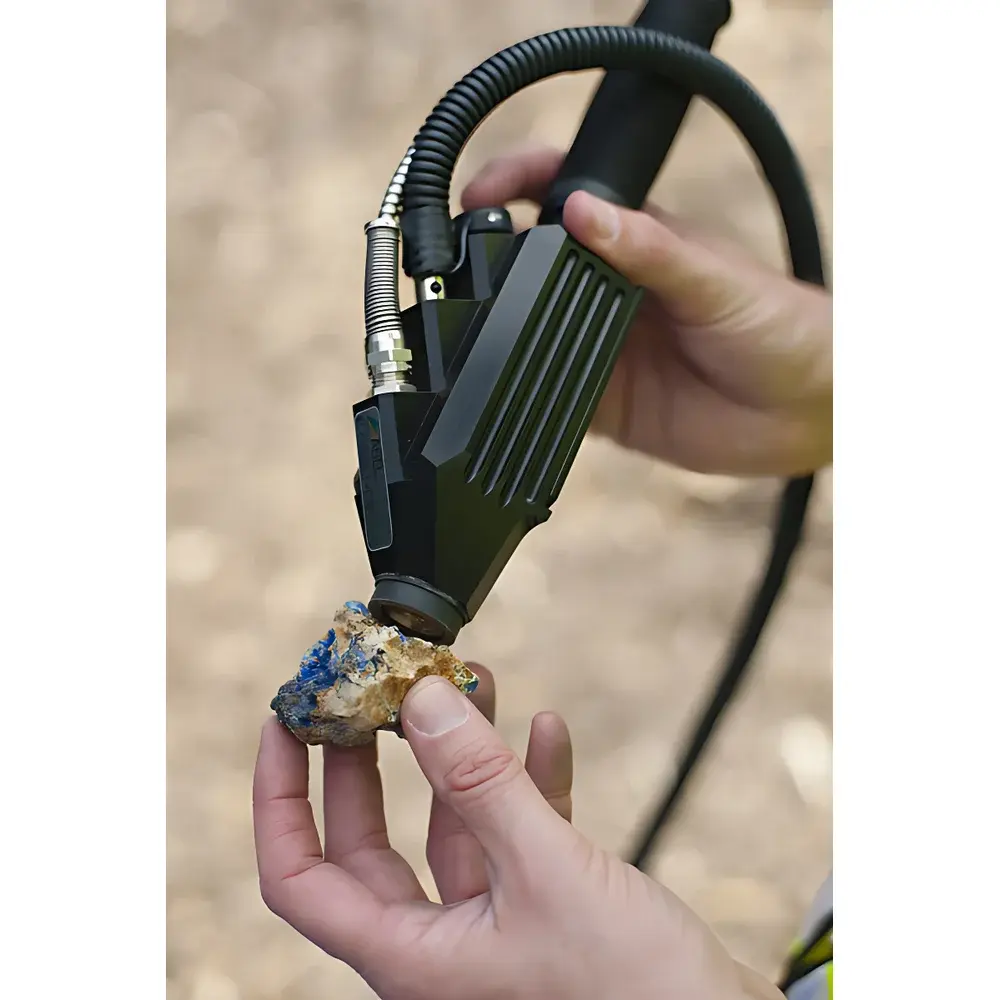
- Non-destructive, contactless measurement protocol supports high-throughput field acquisition (≤2 s per spectrum), enabling systematic scanning of drill cuttings, core trays, outcrops, and stockpiles while preserving sample integrity for downstream geochemical validation.
Sample Compatibility & Compliance
The TerraSpec 4 Hi-Res is validated for direct reflectance analysis of dry, uncoated, or minimally weathered solid samples including rock chips, drill cuttings, soil horizons, and pulverized powders. Surface preparation follows ASTM D7682–19 (Standard Practice for Field Spectroscopic Characterization of Geologic Materials). Spectral data acquisition complies with ISO 18563-1:2015 (Non-destructive testing — Guidelines for spectral calibration traceability) and supports audit-ready metadata logging (GPS coordinates, UTC timestamp, irradiance reference, instrument temperature, integration time). Instrument firmware and spectral libraries are compatible with FDA 21 CFR Part 11–compliant data management platforms when deployed in regulated QA/QC environments (e.g., metallurgical process control).
Software & Data Management
Bundled with ASD’s ViewSpec Pro v6.x software, the system provides calibrated radiance-to-reflectance conversion, atmospheric correction (empirical line method), spectral library matching (USGS, JPL, CSIRO mineral databases), and derivative analysis (first/second derivative, continuum removal) for feature depth quantification. All raw spectra (.asd format) and processed outputs (.csv, .txt) are stored with embedded EXIF-style metadata, supporting FAIR (Findable, Accessible, Interoperable, Reusable) data principles. Exported datasets integrate natively with GIS platforms (ArcGIS Pro, QGIS), geostatistical modeling tools (Isatis, Leapfrog Geo), and machine learning pipelines (Python scikit-learn, TensorFlow) for automated mineral classification and spatial trend analysis.
Applications
- Exploration Geology: Lithostratigraphic mapping, alteration zonation modeling (propylitic, phyllic, argillic, potassic), indicator mineral targeting (e.g., muscovite Al-content as pressure proxy), and drill-core lithological logging.
- Laboratory Support: Acid consumption estimation (carbonate reactivity), swell potential assessment of clays (smectite content), gangue mineral quantification (quartz/feldspar ratio), blast fragment characterization, and hyperspectral core scanning at 1 cm resolution.
- Mining & Metallurgy: Real-time ore sorting feed control, blended ore grade reconciliation, heap leach monitoring (clay coating effects on cyanide diffusion), flotation circuit optimization (sulfide vs. oxide ratio), and block model grade interpolation using spectral endmember constraints.
FAQ
What spectral calibration standards are supported?
NIST-traceable ceramic reflectance standards (e.g., Spectralon® 99% and 50%) are recommended for daily radiometric calibration; ASD provides factory-certified calibration certificates compliant with ISO/IEC 17025.
Can the TerraSpec 4 Hi-Res operate under direct sunlight without spectral distortion?
Yes—the instrument’s dual-beam optical design and real-time dark-current subtraction compensate for ambient irradiance fluctuations; however, use of a shaded measurement hood is advised for optimal SNR in high-dynamic-range scenarios.
Is spectral data export compatible with third-party chemometric software?
All native .asd files include full wavelength, radiance, and metadata headers; ASCII exports (.csv) preserve calibrated reflectance values and are directly ingestible by Unscrambler®, Pirouette®, and MATLAB-based PLS regression toolboxes.
How does the TerraSpec 4 Hi-Res handle spectral degradation due to detector drift?
Thermoelectric cooling maintains detector temperature within ±0.1°C; onboard dark-reference acquisition before each sample scan corrects for thermal offset, ensuring long-term measurement stability across multi-day field campaigns.
Does the system support automated mineral identification via onboard processing?
No—the TerraSpec 4 Hi-Res functions as a high-fidelity data acquisition platform; mineral identification requires post-processing in ViewSpec Pro or external spectral unmixing engines (e.g., MCR-ALS, SAM, NFINDR) using validated endmember libraries.







