
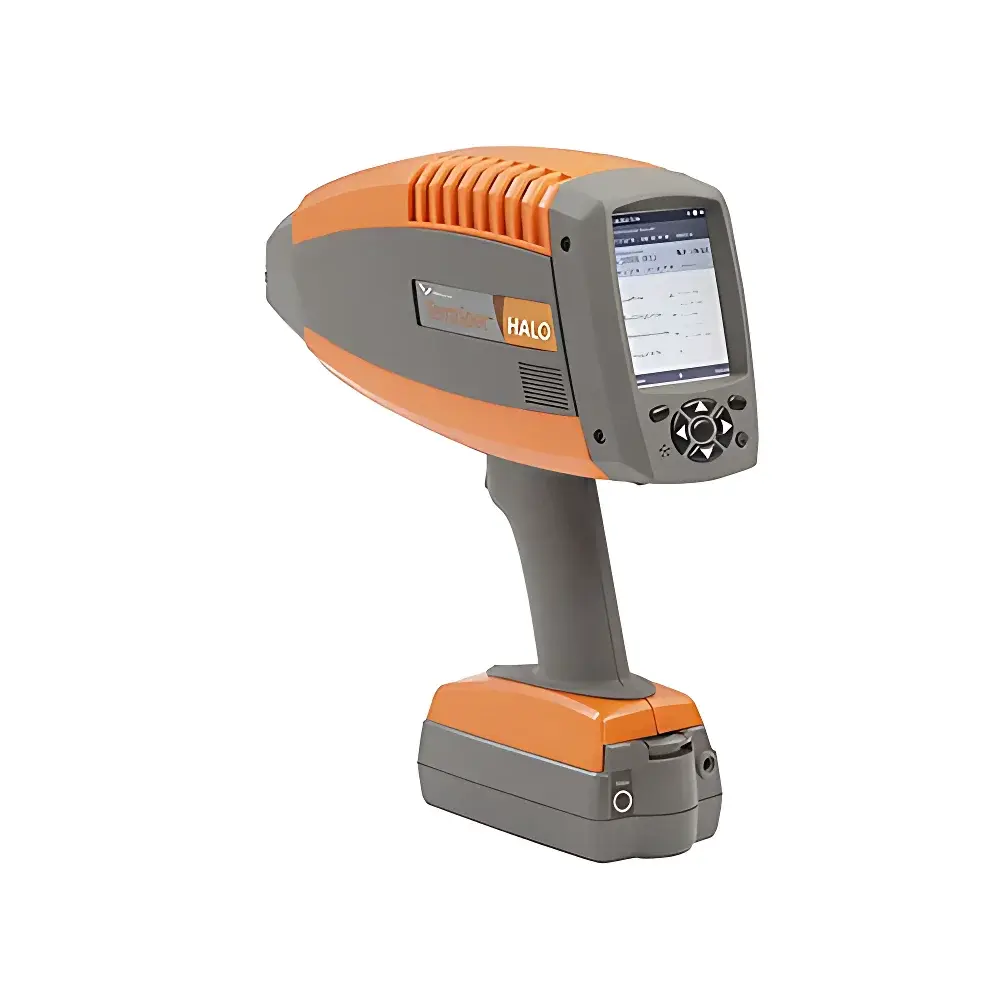
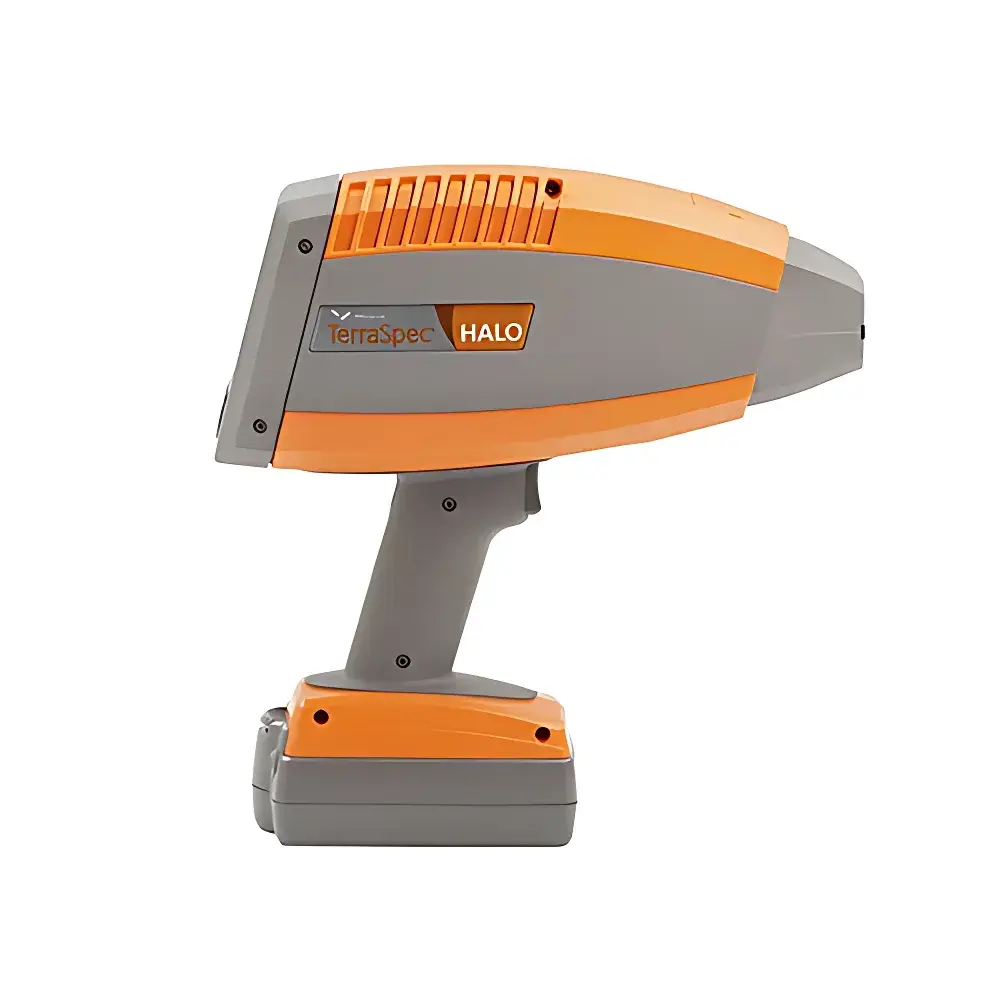
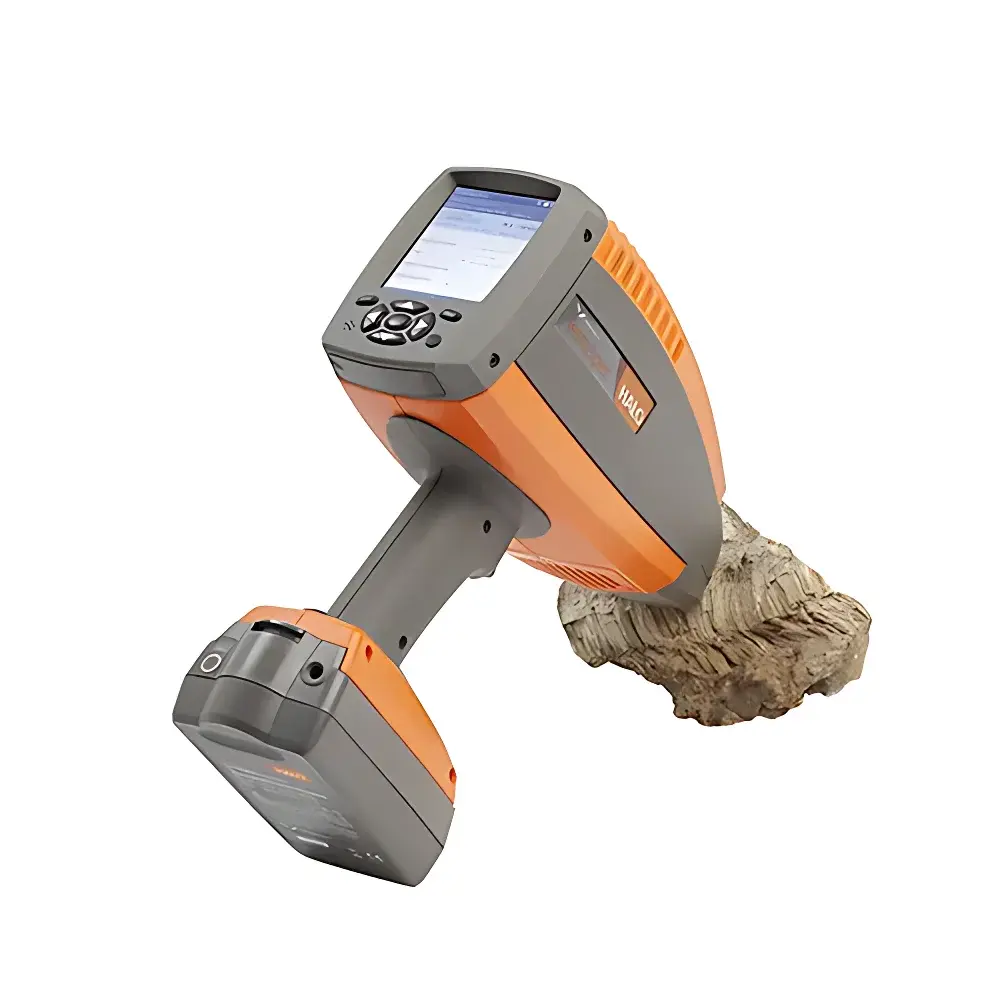
ASD TerraSpec Halo Handheld Mineral Spectrometer
| Brand | ASD |
|---|---|
| Origin | USA |
| Manufacturer Type | Authorized Distributor |
| Origin Category | Imported |
| Model | Halo |
| Instrument Type | Portable |
| Application Field | General (Universities, Research Institutes) |
| Operating Principle | Grating-Based Array Detector (Non-Scanning) |
| Wavelength Range | 350–2500 nm |
| Scan Speed | 10 spectra/sec |
| Spectral Sampling Interval | 1 nm |
| Measurement Mode | Diffuse Reflectance |
| Chemometrics Software | ASD Halo Manager |
| Spectral Resolution | 3 nm @ 700 nm, 9.8 nm @ 1400 nm, 8.1 nm @ 2100 nm |
| Dimensions (L×W×H) | 775 × 250 × 750 mm |
| Weight (with battery) | 2.5 kg (5.5 lbs) |
| Weight (without battery) | 2.0 kg (4.3 lbs) |
| Supported Languages | English, Spanish, Chinese |
Overview
The ASD TerraSpec Halo Handheld Mineral Spectrometer is an engineering-integrated, field-deployable near-infrared (NIR) spectrometer designed for rapid, non-destructive mineral identification and characterization in geological exploration, mining operations, academic research, and environmental site assessment. Built upon a fixed grating optical architecture with a high-sensitivity silicon/InGaAs linear array detector, the Halo operates across a continuous spectral range of 350–2500 nm—spanning the visible (VIS), near-infrared (NIR), and short-wave infrared (SWIR) regions. Unlike scanning monochromator-based systems, its non-scanning design enables acquisition of full-range spectra in under 100 ms per measurement, delivering high temporal stability and minimal motion artifact during handheld operation. The instrument implements diffuse reflectance spectroscopy to capture diagnostic absorption features arising from fundamental vibrational overtones and combination bands—particularly those associated with OH⁻, CO₃²⁻, H₂O, Al–OH, Mg–OH, and Fe³⁺/Fe²⁺ electronic transitions—enabling robust discrimination among clay minerals, carbonates, sulfates, hydroxides, and alteration assemblages.
Key Features
- True all-in-one handheld architecture: Integrated optics, detector, battery, GPS, microphone, and touchscreen interface—no external cables, PDA, or tethered computing required.
- Ruggedized industrial enclosure rated for field use (IP54 equivalent), with ergonomic grip and balanced center-of-mass for extended single-hand operation.
- Real-time spectral acquisition at 10 Hz, with 1 nm spectral sampling interval and factory-calibrated wavelength accuracy traceable to NIST standards.
- On-device mineral identification using embedded spectral matching algorithms and user-configurable decision thresholds.
- Integrated dual-band GNSS receiver (GPS + GLONASS) with sub-5 m horizontal positional accuracy (autonomous mode), time-stamped and georeferenced with each spectrum.
- Voice annotation capability: Record up to 60 seconds of field notes per measurement; synchronized playback within Halo Manager software.
- Preloaded spectral libraries including USGS Digital Spectral Library Version 7, TerraSpec Reference Mineral Library, and customizable user-defined libraries.
Sample Compatibility & Compliance
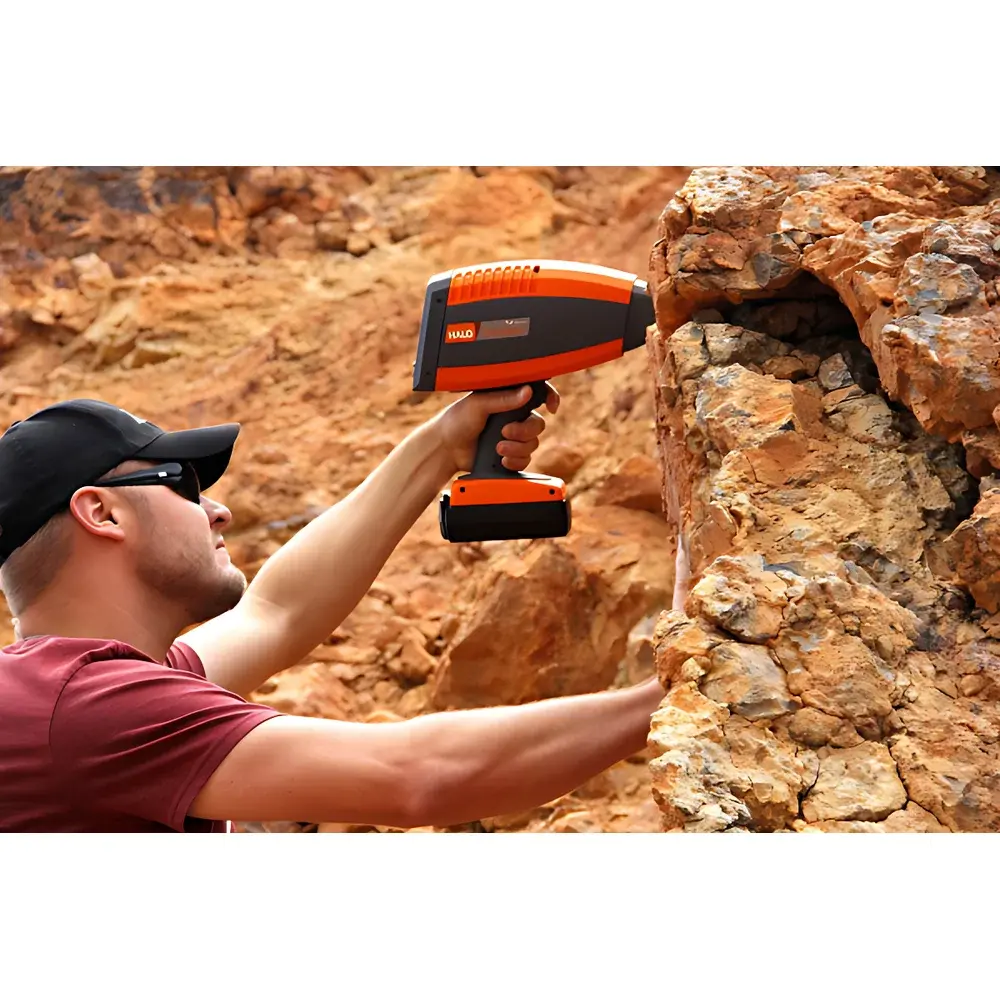
The Halo is optimized for solid, opaque, or semi-opaque geological samples—including outcrops, drill cores, chip trays, soil profiles, and mine face exposures. It requires no sample preparation beyond surface cleaning (e.g., removal of dust, oxidation layers, or organic coatings). While highly effective for phyllosilicates (kaolinite, smectite, illite), carbonates (calcite, dolomite), sulfates (gypsum, jarosite), and iron oxides/hydroxides (hematite, goethite), it exhibits reduced sensitivity toward cubic-system minerals lacking strong IR-active vibrational modes (e.g., quartz, fluorite, galena, sphalerite, pyrite). The system complies with IEC 61326-1:2013 for electromagnetic compatibility and meets MIL-STD-810G environmental test criteria for shock, vibration, and thermal cycling. Data acquisition workflows support ALTA (Analytical Laboratory Technical Association) best practices and are compatible with GLP/GMP-aligned documentation requirements when used with Halo Manager’s audit-trail-enabled export logs.
Software & Data Management
Halo Manager is a Windows-native desktop application that provides comprehensive spectral curation, visualization, batch processing, and reporting tools. It supports direct USB-C transfer of raw and processed spectra (.asd format), preserves full metadata (GPS coordinates, timestamp, operator ID, instrument settings, voice annotations), and enables spectral normalization (e.g., continuum removal, vector normalization, SNV). Chemometric analysis modules include spectral library search (spectral angle mapper, Euclidean distance, correlation coefficient), endmember extraction, and supervised classification (PLS-DA, SVM). Export options include CSV, ENVI .hdr/.img, ASCII, and PDF reports compliant with ISO/IEC 17025 documentation guidelines. Halo Manager also facilitates seamless integration with industry-standard geospatial platforms—including Leapfrog Geo™, Seequent TSG®, QGIS, and ArcGIS Pro—via standardized spectral metadata schemas (Spectral Data Exchange Format, SDEX).
Applications
- Real-time lithological mapping and alteration zoning in greenfield exploration campaigns.
- Drill core logging and grade control in open-pit and underground mining operations.
- Soil mineralogy assessment for acid rock drainage (ARD) prediction and remediation planning.
- Teaching and field-based instruction in structural geology, economic geology, and planetary analog studies.
- Archaeological provenance analysis of ceramics and pigments using NIR spectral fingerprinting.
- Environmental monitoring of mine waste dumps and tailings storage facilities for secondary mineral formation.
FAQ
Does the Halo require annual recalibration?
No—its fixed-grating optical design and thermally stabilized detector eliminate the need for routine wavelength recalibration. However, users are advised to perform daily dark-current and white-reference measurements before field deployment.
Can Halo data be used for quantitative mineral abundance estimation?
Yes—when coupled with site-specific calibration models built from laboratory XRD/XRF-validated reference samples, Halo spectra support semi-quantitative abundance modeling via partial least squares regression (PLSR) or support vector regression (SVR).
Is the Halo compliant with FDA 21 CFR Part 11 for regulated environments?
While Halo Manager does not provide full electronic signature functionality out-of-the-box, its audit-log export module generates tamper-evident CSV records containing user actions, timestamps, and spectral hash values—serving as foundational evidence for Part 11 compliance when implemented within validated IT infrastructure.
What spectral resolution specifications apply across the full range?
Resolution is wavelength-dependent: ≤3 nm FWHM at 700 nm, ≤9.8 nm at 1400 nm, and ≤8.1 nm at 2100 nm, measured per ASTM E1421-19 Annex A1.
How does the Halo handle low-reflectance dark rocks?
The instrument employs dynamic exposure control and signal-averaging (up to 64 scans per measurement) to maintain signal-to-noise ratio >1000:1 even on graphite-rich shales or magnetite-bearing basalts.






