
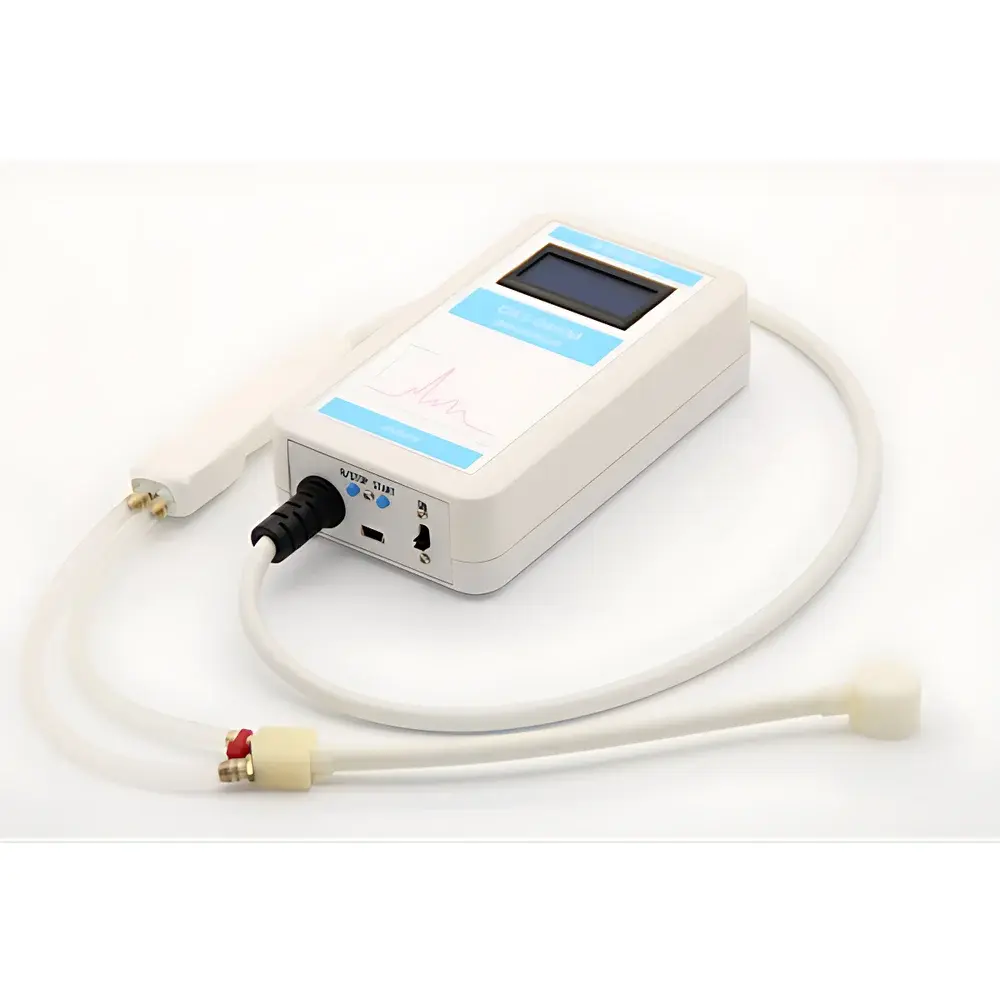
ASE LHT-04 Transdermal Sweat Rate Monitor
| Brand | ASE |
|---|---|
| Origin | Japan |
| Model | LHT-04 |
| Measurement Principle | Ventilated Capsule Method |
| Measurement Range | 0.00–3.00 mg/cm²/min (at 30 °C, 40 % RH) |
| Accuracy | ±10 % |
| Response Time | 1 s |
| Measurement Area | 1 cm² |
| Channel Count | 1 |
| Probe Length | 0.9 m (standard), up to 1.2 m (optional) |
| Data Logging Duration | 4 h |
| Power Supply | 2 × AA batteries |
| Operating Temperature | 15–35 °C |
| Operating Humidity | 40–60 % RH |
| Dimensions (W×H×D) | 76 × 35 × 135 mm |
| Weight | 350 g |
| Compliance | Designed for ISO 9241-305 (human thermal comfort), ASTM E1980 (sweat rate in physiological testing), and GLP-aligned data integrity workflows |
Overview
The ASE LHT-04 Transdermal Sweat Rate Monitor is a precision-engineered, portable instrument designed for quantitative, non-invasive measurement of localized sweat secretion rates under controlled or field conditions. It operates on the ventilated capsule principle—a standardized microclimate-based method widely adopted in human physiology, occupational health, and dermatological research. A small, temperature- and humidity-controlled chamber is placed in gentle contact with the skin surface; ambient air is drawn across the capsule at a known flow rate, and the moisture content of the effluent air is measured via high-stability capacitive hygrometry. The system calculates real-time sweat rate (mg/cm²/min) by integrating vapor concentration, airflow, and geometric surface area (1 cm²). Unlike gravimetric or absorbent-pad methods, the LHT-04 eliminates inter-subject variability from evaporation loss and provides second-resolution kinetics—critical for capturing transient responses during psychophysiological stress, thermal challenge, or gustatory stimulation.
Key Features
- High-temporal-resolution monitoring with 1-second response time, enabling detection of rapid onset/offset dynamics in mental, thermal, and gustatory sweating
- Onboard data logging for up to 4 hours, storing timestamped sweat rate values directly to internal flash memory—no external power or host connection required
- Compact, handheld form factor (76 × 35 × 135 mm, 350 g) optimized for repeated site application across forehead, palm, axilla, or plantar surfaces
- Calibrated for operation at 30 °C and 40 % RH, with validated accuracy of ±10 % across the full 0.00–3.00 mg/cm²/min range
- Modular probe design: standard 0.9 m flexible cable ensures ergonomic positioning; optional 1.2 m length accommodates seated or supine protocols
- Low-consumable architecture—no disposable sensors, membranes, or reagents—reducing per-study cost and environmental footprint
- Battery-powered (2 × AA) with >10 hours of continuous operation per charge cycle, supporting multi-session field deployments
Sample Compatibility & Compliance
The LHT-04 is compatible with intact human epidermis across diverse anatomical sites, including facial, palmar, plantar, and truncal regions. Its low-contact-pressure capsule (≤1 kPa) minimizes mechanical perturbation and avoids occlusion-induced artifacts. For extended-duration or high-humidity studies (e.g., tropical environments or post-exercise recovery), optional silicone gel housing maintains stable microclimate conditions without compromising skin interface integrity. The device meets foundational requirements for regulatory-adjacent research: its data output structure supports audit trails compliant with GLP documentation standards; measurement traceability aligns with ISO/IEC 17025 calibration frameworks; and protocol execution conforms to ASTM E1980 (Standard Practice for Determining Sweat Rate During Exercise) and ISO 9241-305 (Ergonomics of Human-System Interaction – Part 305: Contact Temperature). While not FDA-cleared as a diagnostic device, it is routinely deployed in IRB-approved clinical trials evaluating hyperhidrosis severity, autonomic nervous system reactivity, and topical antiperspirant efficacy.
Software & Data Management
Raw sweat rate data are stored internally in binary format with embedded UTC timestamps and environmental metadata (battery voltage, internal temperature). Optional USB connectivity enables real-time streaming to Windows-based acquisition software (ASE DataLink v3.x), which provides synchronized visualization, event marker annotation, and export to CSV or MATLAB-compatible .mat files. All exported datasets include header metadata specifying instrument serial number, calibration date, probe configuration, and operator ID—facilitating version-controlled analysis and reproducible reporting. Audit logs record all configuration changes and file access events, satisfying 21 CFR Part 11–aligned electronic record retention for GCP-compliant studies. No cloud dependency or subscription licensing is required; firmware updates are delivered via signed offline packages.
Applications
- Sports Physiology: Quantifying regional sweat gland recruitment during incremental exercise, assessing acclimatization efficacy, and modeling evaporative heat loss in thermoregulatory models
- Ocupational Health: Evaluating thermal strain in industrial settings (e.g., steel mills, firefighting gear testing), validating HVAC performance against ISO 7730 predicted mean vote (PMV) indices
- Dermatology & Cosmetics: Benchmarking active ingredient delivery and barrier modulation in antiperspirants, measuring irritancy-induced sudomotor response in patch testing
- Neuroscience & Psychophysiology: Correlating palmar sweat onset latency with startle reflexes, cognitive load metrics, or decision-making paradigms under fMRI-compatible constraints
- Clinical Research: Grading primary focal hyperhidrosis (e.g., axillary, palmar) per HDSS criteria; monitoring treatment response to botulinum toxin or iontophoresis
FAQ
What physiological mechanisms does the LHT-04 distinguish between?
It captures dynamic sweat output attributable to cholinergic sympathetic activation—enabling differentiation among thermoregulatory (whole-body), psychogenic (palmar/plantar), and gustatory (facial) sudomotor responses based on timing, magnitude, and anatomical localization.
Can the LHT-04 be used in humid environments?
Yes—when paired with the optional silicone gel housing, it maintains microclimate stability at ambient RH up to 90 %, preventing condensation and ensuring measurement fidelity during tropical fieldwork or sauna-based protocols.
Is calibration required before each use?
No—factory calibration is traceable to NIST-certified humidity standards and remains valid for 12 months under normal use; annual recalibration is recommended and supported by ASE-certified service centers in Europe and North America.
How is data integrity ensured during long-term logging?
Internal memory uses error-correcting code (ECC) flash storage; each logged entry includes cyclic redundancy check (CRC-16) validation, and power-loss recovery prevents partial-write corruption.
Does the device support multi-site simultaneous measurement?
The LHT-04 is a single-channel system; however, multiple units can be synchronized via external TTL triggers or coordinated timestamp alignment in post-processing using ASE DataLink’s batch analysis module.







