
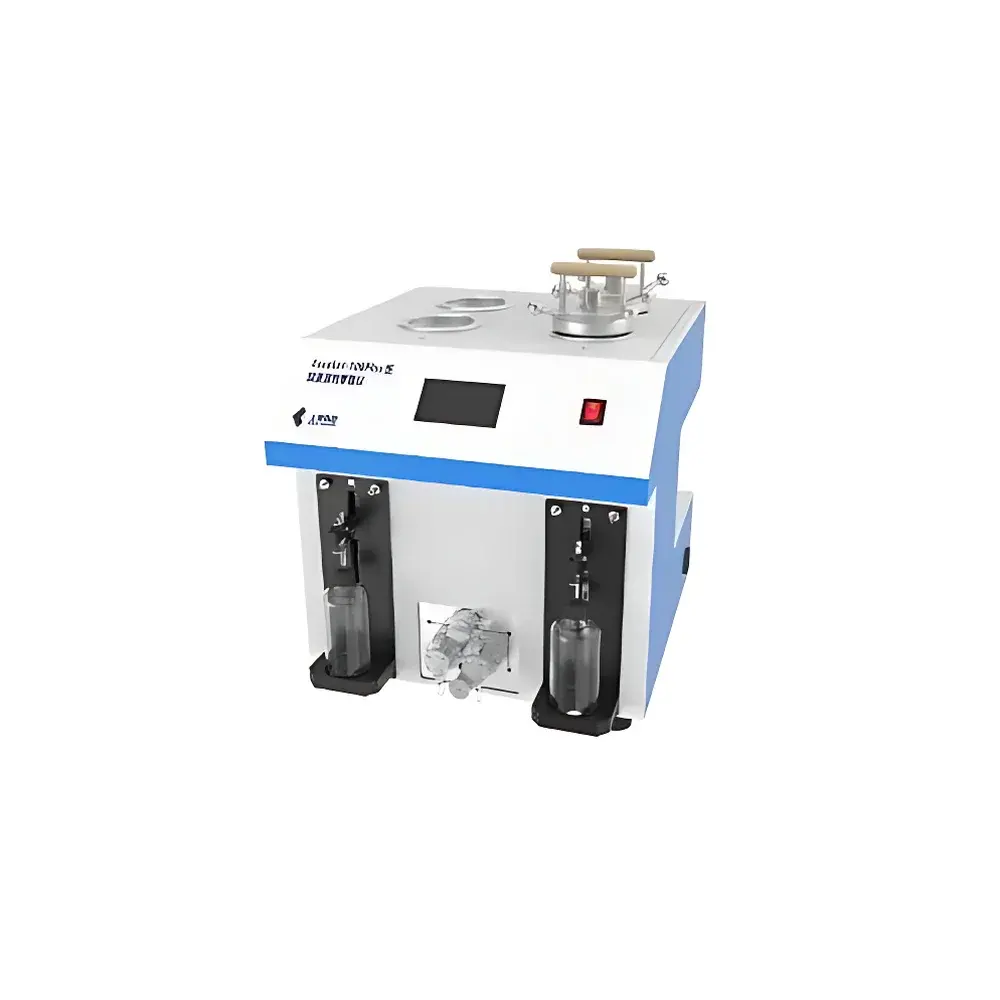
Aseeker-100Plus Accelerated Solvent Extractor
| Brand | KEZHE SHANGHAI |
|---|---|
| Origin | Shanghai, China |
| Manufacturer Type | Direct Manufacturer |
| Country of Origin | China |
| Model | Aseeker-100Plus |
| Instrument Category | Fast Liquid Chromatography System |
| Flow Rate Range | 0.001–10 mL/min |
| Maximum Pressure Rating | 50 MPa |
| Sample Injection Volume | 1–60 µL |
| Injection Vial Capacity | 2 mL |
| Temperature Control Range | 10–50 °C |
| Wavelength Detection Range | 100–700 nm |
| Data Acquisition Frequency | 100 Hz |
| Extraction Temperature Range | Ambient to 200 °C (±1 °C) |
| Pressure Range | 0–20 MPa (±0.3 MPa) |
| Pump Flow Range | 0.1–50 mL/min |
| Standard Extraction Cell Volume | 40 mL (optional: 10 mL / 20 mL) |
| Standard Collection Vial Volume | 250 mL (optional: 60 mL) |
| Solvent Mixing Capability | Up to 4 solvents |
| Typical Extraction Duration | 20–30 min |
| Solvent Consumption | ~10 mL per 10 g sample |
| Required Gas Supply | Nitrogen, 0.4–1 MPa |
| Max Power Consumption | 600 W |
| Electrical Input | 100–240 VAC ±10%, 50–60 Hz |
Overview
The Aseeker-100Plus Accelerated Solvent Extractor is an integrated, benchtop-scale extraction platform engineered for rapid, reproducible, and thermally assisted solvent extraction of solid and semi-solid matrices. It operates on the principle of pressurized liquid extraction (PLE), leveraging elevated temperature (up to 200 °C) and pressure (up to 20 MPa) to enhance solute solubility and mass transfer kinetics while maintaining solvent integrity below its critical point. Unlike conventional Soxhlet or ultrasonic extraction, PLE significantly reduces extraction time—typically completing full-cycle processing in 20–30 minutes—with minimal solvent usage (~10 mL per 10 g sample). The system features dual independent extraction channels, enabling parallel processing of heterogeneous samples under identical or divergent method conditions—a capability essential for comparative studies, method validation, and high-throughput QC workflows in environmental, pharmaceutical, food, and agricultural laboratories.
Key Features
- Dual-channel architecture with fully independent thermal, pressure, and fluidic control per channel—enabling simultaneous optimization of two extraction protocols.
- Robust heating system with ring-type furnace design ensures uniform thermal distribution across extraction cells (±1 °C accuracy from ambient to 200 °C).
- Integrated high-pressure pump delivering precise flow rates from 0.1 to 50 mL/min, compatible with gradient solvent delivery and multi-solvent mixing (up to four solvents).
- Advanced safety architecture including mechanical overpressure relief valves, electronic overtemperature cutoff, real-time solvent leak detection with automatic shutdown, and intelligent liquid-level monitoring in collection vials.
- Chemically inert wetted path constructed from 316/316L stainless steel, PEEK, and borosilicate glass—validated for compatibility with aggressive solvents including dichloromethane, acetone, methanol, and ethyl acetate.
- Automated post-extraction filtration via integrated sintered metal or polymeric frits, eliminating manual filtration steps and reducing analyst exposure.
- High-resolution capacitive touchscreen interface with intuitive workflow navigation, method storage (≥100 user-defined methods), and real-time parameter logging.
- Modular cell and vial configuration: standard 40 mL extraction cells (with optional 10 mL and 20 mL variants) and 250 mL collection vials (60 mL option available) support diverse sample mass and concentration requirements.
Sample Compatibility & Compliance
The Aseeker-100Plus accommodates a broad range of solid and semi-solid matrices—including soils, sediments, plant tissues, animal feed, polymer composites, and pharmaceutical tablets—without requiring pre-grinding beyond standard homogenization. Its sealed extraction environment minimizes volatile organic compound (VOC) emissions, supporting laboratory compliance with OSHA PEL and EPA Method 3545A guidelines for PLE. All firmware and control logic adhere to IEC 61000-6-2/6-4 electromagnetic compatibility standards. While not inherently 21 CFR Part 11 compliant, audit-trail-ready data export (CSV/TXT) and timestamped method logs facilitate integration into GLP/GMP environments when paired with validated LIMS or ELN systems.
Software & Data Management
The embedded control software provides full method definition—including temperature ramping profiles, pressure hold sequences, solvent composition gradients, flush cycles, and collection timing—via a graphical step editor. All operational parameters are logged at 100 Hz resolution and exported in timestamped, comma-delimited format. Raw data files include metadata headers (operator ID, date/time, method name, cell ID, pressure/temperature traces), enabling traceability and retrospective analysis. Optional USB-to-PC connectivity supports remote monitoring and batch report generation. No proprietary drivers or cloud dependencies are required; data handling remains fully local and IT-administrator controllable.
Applications
- Environmental analysis: extraction of PAHs, PCBs, organochlorine pesticides, and petroleum hydrocarbons from soil and sediment per EPA SW-846 Methods 3545A and 3546.
- Food safety testing: recovery of mycotoxins (e.g., aflatoxin B1), fat-soluble vitamins, antioxidants (BHT/BHA), and pesticide residues from cereals, nuts, and dairy powders.
- Pharmaceutical R&D: active pharmaceutical ingredient (API) recovery from excipient blends, dissolution matrix interference removal, and residual solvent quantification in solid dosage forms.
- Materials science: leaching studies of plasticizers, flame retardants (e.g., PBDEs), and stabilizers from polymers and composites.
- Agricultural research: phytochemical profiling (e.g., flavonoids, alkaloids) from dried botanicals and herbal matrices under controlled thermal-solvent conditions.
FAQ
What sample types are compatible with the Aseeker-100Plus?
Solid and semi-solid matrices with particle sizes ≤ 1 mm—such as dried soils, ground plant tissue, powdered pharmaceuticals, and homogenized food products—are routinely processed. Gelatinous or highly viscous samples require dilution or matrix dispersion prior to loading.
Does the system support method transfer from EPA or ISO standard protocols?
Yes—preconfigured method templates for EPA 3545A, ISO 14507, and ASTM D7699 are available upon request and can be loaded directly into the instrument’s method library.
Can extraction cells be cleaned in-place or must they be disassembled?
Cells are designed for rapid manual disassembly and solvent rinsing; however, automated cell rinse cycles using inert gas or low-boiling solvents (e.g., hexane) can be programmed into the method sequence.
Is nitrogen the only acceptable purge gas?
Nitrogen is recommended for inert atmosphere maintenance; argon may also be used. Compressed air is not advised due to moisture and oxygen content that may degrade thermally labile analytes.
How is calibration verified for temperature and pressure sensors?
Temperature calibration is performed using NIST-traceable PT100 reference probes; pressure transducers are factory-calibrated against dead-weight testers and include built-in zero-drift compensation—field verification kits are available as optional accessories.




