
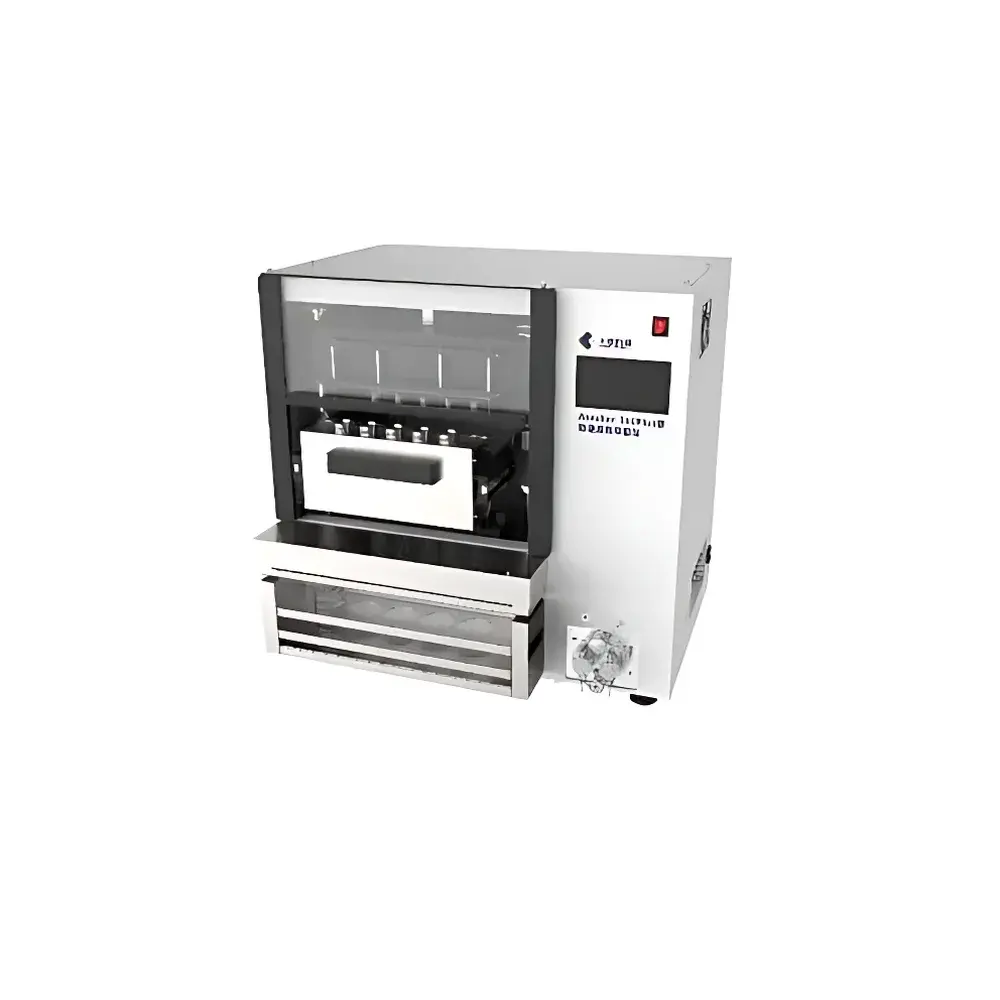
Aseeker-350Plus Accelerated Solvent Extractor
| Brand | KEZHE SHANGHAI |
|---|---|
| Origin | Shanghai, China |
| Manufacturer Type | Direct Manufacturer |
| Model | Aseeker-350Plus |
| Flow Rate Range | 0.001–10 mL/min |
| Maximum Pressure | 50 MPa |
| Sample Injection Volume | 1–60 µL |
| Temperature Control Range | 10–50 °C |
| Wavelength Range | 100–700 nm |
| Data Acquisition Frequency | 100 Hz |
| Extraction Cell Volume (Standard) | 120 mL |
| Pressure Accuracy | ±0.3 MPa |
| Temperature Accuracy | ±0.5 °C |
| Solvent Channels | 4 |
| Simultaneous Extraction Positions | 5 |
| Extraction Time per Batch (5 samples) | ≤20 min |
| Power Consumption | ≤1.7 kW |
| Gas Supply Requirement | N₂, 0.4–1 MPa |
Overview
The Aseeker-350Plus Accelerated Solvent Extractor is a high-throughput, fully automated extraction platform engineered for precision and reproducibility in solid and semi-solid sample preparation. Based on the principle of accelerated solvent extraction (ASE®), it applies elevated temperature and pressure to enhance solubility and mass transfer kinetics—enabling rapid, quantitative recovery of analytes from complex matrices such as soil, sediment, foodstuffs, botanicals, and polymers. Unlike conventional Soxhlet or ultrasonic methods, ASE minimizes solvent consumption while maximizing extraction efficiency and method robustness. The Aseeker-350Plus integrates five independent extraction channels, each with dedicated pressure sensing, dual-valve fluidic control, and real-time thermal monitoring—ensuring parallel processing without cross-contamination and full traceability per sample path.
Key Features
- Five-channel parallel architecture: Enables simultaneous extraction of up to five samples with individual channel diagnostics and fault isolation—no system downtime if one channel requires maintenance.
- Dual-stage safety system: Mechanical overpressure relief valves combined with electronic overtemperature cutoff (±0.5 °C accuracy) comply with IEC 61010-1 requirements for laboratory equipment safety.
- Integrated leak detection and automatic shutdown: Solvent leakage triggers immediate pump stoppage and audible/visual alert—preventing hazardous exposure and instrument damage.
- Four-solvent gradient mixing module: Supports precise, programmable blending of up to four solvents at user-defined ratios—critical for method development in multi-residue analysis.
- On-board filtration: Extracted solution passes through an integrated sintered stainless-steel or PEEK filter (optional glass frit) prior to collection—eliminating manual post-extraction filtration steps.
- Automated rinse cycle: Dedicated wash positions route spent solvent to a separate waste reservoir—reducing carryover risk and simplifying cleaning validation per GLP protocols.
- Chemically inert wetted materials: All fluid-contact surfaces constructed from 316/316L stainless steel, PEEK, and borosilicate glass—compatible with aggressive solvents including dichloromethane, acetone, and acidic methanol.
- Low solvent consumption: Typical usage ranges from 5 to 200 mL per extraction, aligning with green chemistry principles and reducing disposal costs.
- Direct interface capability: Standardized output ports support seamless integration with concentrators (e.g., TurboVap®), SPE manifolds, or LC autosamplers—minimizing sample handling and analyte loss.
Sample Compatibility & Compliance
The Aseeker-350Plus accommodates a broad range of solid and semi-solid matrices—including soils, sludge, plant tissues, animal feed, pharmaceutical powders, polymer pellets, and forensic evidence swabs. Its 120 mL standard extraction cell (with optional 40 mL and 80 mL variants) supports both bulk environmental sampling and high-concentration natural product isolation. The system meets functional equivalency requirements for EPA Methods 3545A and 3546, ASTM D7699, and ISO 14507 for organic contaminant extraction. All firmware logs—including temperature, pressure, flow, valve actuation, and error events—are time-stamped and stored locally with audit trail capability, supporting 21 CFR Part 11 compliance when deployed in regulated QC environments.
Software & Data Management
Controlled via a 10.1-inch industrial-grade capacitive touchscreen, the embedded Linux-based software provides intuitive method programming, real-time parameter visualization, and event-driven alarm management. Each extraction run generates a timestamped .CSV log file containing setpoints, actual values, and diagnostic flags—exportable via USB or Ethernet. Optional PC software enables remote monitoring, batch report generation (PDF/Excel), and integration into LIMS via RESTful API. All data files are digitally signed and immutable once generated—ensuring integrity during regulatory audits under GLP or GMP frameworks.
Applications
- Environmental Analysis: Extraction of PAHs, PCBs, organochlorine pesticides, dioxins, and microplastics from soil, sediment, and air filters per EPA SW-846 protocols.
- Food Safety: Multi-residue screening of pesticides, mycotoxins, and veterinary drug residues in grains, fruits, dairy powders, and processed foods.
- Pharmaceutical & Natural Products: Isolation of alkaloids, flavonoids, terpenes, and glycosides from herbal matrices; residual solvent removal from active pharmaceutical ingredients (APIs).
- Agricultural Research: Lipid profiling in oilseeds, pesticide dissipation studies in crop tissues, and metabolite extraction from root nodules.
- Industrial Chemistry: Polymer additive leaching studies, catalyst residue analysis, and contaminant screening in petrochemical feedstocks.
FAQ
What is the maximum operating temperature and pressure for the Aseeker-350Plus?
The system supports extraction temperatures up to 200 °C and pressures up to 20 MPa (standard configuration); the 50 MPa rating reflects burst pressure tolerance of the fluidic manifold.
Can the instrument be validated for use in regulated laboratories?
Yes—full IQ/OQ documentation packages are available, and the system supports electronic signatures, audit trails, and data integrity controls aligned with FDA 21 CFR Part 11 and EU Annex 11 requirements.
Is method transfer from legacy ASE systems possible?
Method parameters (temperature, pressure, static/dynamic time, flush volume) are directly translatable; the five-channel architecture allows scaling of throughput without re-optimization.
What maintenance intervals are recommended?
Valve seals and filter frits require replacement every 500 extractions or annually; pressure transducers are factory-calibrated and certified for 24 months.
Does the system support unattended overnight operation?
Yes—scheduled runs, auto-shutdown upon completion, and battery-backed real-time clock enable fully autonomous 24/7 operation with no operator intervention required.
Related Products





