
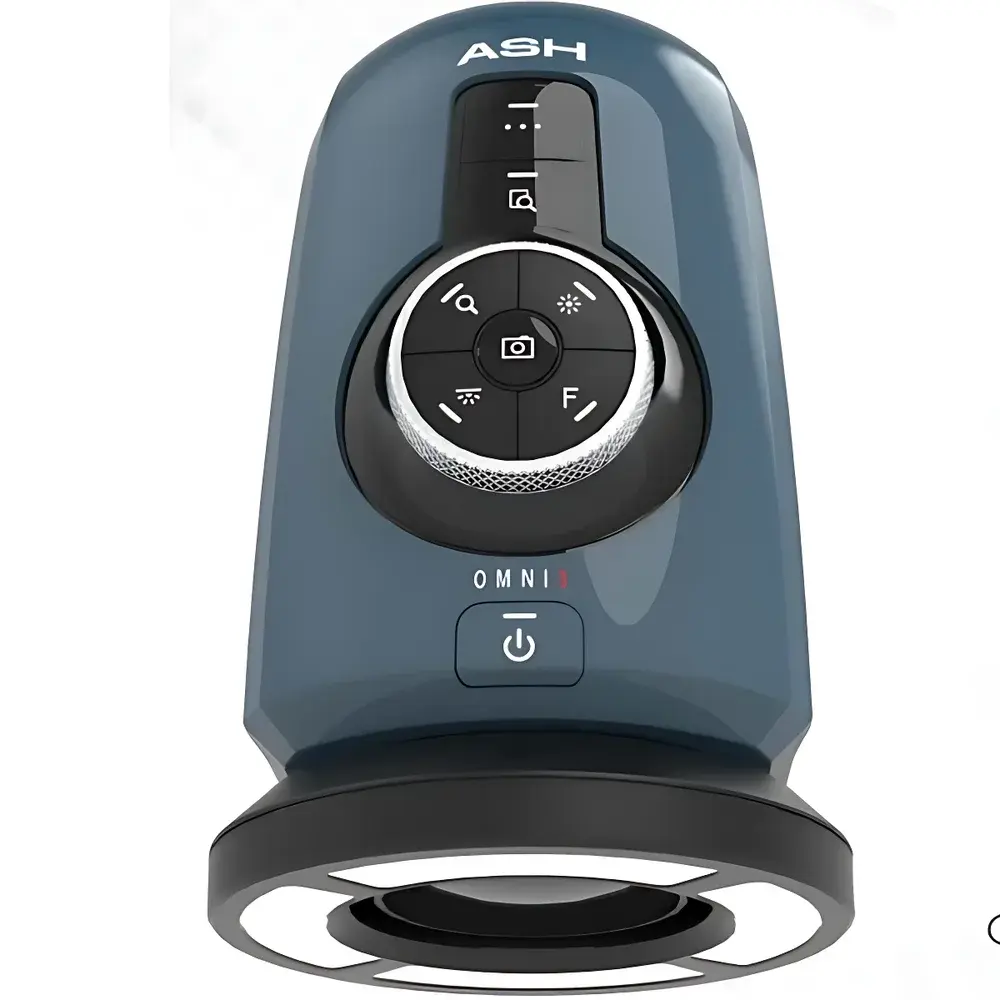
ASH Omni3 Digital Microscope and Measurement System
| Brand | ASH TECHNOLOGIES |
|---|---|
| Origin | Ireland |
| Manufacturer Type | Authorized Distributor |
| Origin Category | Imported |
| Model | Omni3 |
| Price Range | USD 21,500 – 27,000 |
Overview
The ASH Omni3 Digital Microscope and Measurement System is a fully integrated, PC-free optical inspection platform engineered for high-precision 2D/3D metrology, defect analysis, and real-time image-based quality control in regulated manufacturing and laboratory environments. Built upon a coaxial optical architecture with motorized Z-axis actuation and a high-sensitivity CMOS sensor, the Omni3 employs digital imaging metrology principles—leveraging pixel-to-dimension calibration, sub-pixel edge detection algorithms, and real-time distortion-corrected optics—to deliver traceable, repeatable measurements without reliance on external computing hardware. Its embedded Linux-based firmware enables deterministic response times and deterministic I/O latency, making it suitable for inline inspection workflows requiring zero video lag and sub-50 ms focus stabilization. Designed for ISO/IEC 17025-compliant labs and ISO 9001-certified production lines, the system supports audit-ready operation through built-in calibration traceability (AshCal™), real-time lens distortion correction (RTLDC™), and user-access-controlled configuration management.
Key Features
- Embedded real-time operating system: Full image acquisition, measurement, annotation, and reporting executed natively on-device—no host PC required.
- Auto-focus architecture: Dual-mode focusing—ultra-fast global auto-focus (<150 ms) for rapid part placement, and precision point-focus for region-specific depth targeting.
- Z-axis 3D height profiling: Motorized vertical stage with ±5 mm travel and 0.1 µm encoder resolution enables true topographic reconstruction alongside XY planar measurements.
- Advanced optical calibration suite: AshCal™ factory-applied geometric calibration ensures consistent magnification across all objective lenses; RTLDC™ applies per-frame lens distortion correction using pre-characterized polynomial coefficients.
- Multi-spectral illumination compatibility: Interchangeable LED modules—including ring light, hemispherical dome, polarized, and UV-A (365 nm)—enable contrast optimization for diverse material surfaces and defect types.
- Zero-latency imaging pipeline: Proprietary FPGA-accelerated image processing delivers full-HD (1920×1080) video at 60 fps with <1 frame buffer delay between optical input and display output.
- User permission hierarchy: Role-based access control (RBAC) allows administrators to assign granular permissions—e.g., calibration lockout, report export rights, or measurement tool enablement—to individual operator profiles.
Sample Compatibility & Compliance
The Omni3 accommodates flat, curved, reflective, translucent, and textured specimens ranging from semiconductor wafers and PCB assemblies to pharmaceutical tablets and polymer films. Its non-contact optical design eliminates mechanical loading risks, supporting fragile or electrostatic-sensitive samples. The system complies with key international standards for optical metrology equipment: ISO 10110-7 (surface imperfection assessment), ISO 14134 (digital microscope validation), and ASTM E2971 (standard guide for digital microscopy in materials characterization). All calibration artifacts are NIST-traceable, and AshCal™ certificates include uncertainty budgets per ISO/IEC 17025 Annex A.5. For regulated industries, the firmware supports 21 CFR Part 11-compliant electronic signatures, audit trail logging (user actions, parameter changes, image annotations), and GLP/GMP-aligned data retention protocols.
Software & Data Management
The embedded software includes six validated application modules: Color Analysis (CIE L*a*b*, ΔE00, and histogram-based contaminant classification per ISO 11664-4); Particle Counting (threshold-based segmentation with size-class filtering and statistical reporting); Z-Height Mapping (cross-sectional profile extraction with RMS roughness calculation); 2D Metrology (point-to-point, radius, angle, parallel line, and grid-based coordinate referencing); DXF Overlay (import/export of industry-standard CAD geometry for go/no-go comparison); and Image Fusion (focus stacking up to 32 layers + panoramic stitching with sub-pixel registration). All images and reports embed EXIF metadata: timestamp, user ID, magnification, lens ID, illumination mode, and calibration status. Data export supports CSV (measurement logs), PDF/A-2 (compliant reports), TIFF (lossless image), and encrypted ZIP archives with AES-256 encryption for network transfer.
Applications
- Electronics manufacturing: Solder joint inspection, BGA void analysis, solder mask alignment verification, and microvia dimensional validation.
- Medical device QA: Surface defect mapping on catheter shafts, coating uniformity assessment on stents, and particulate contamination screening per USP .
- Automotive Tier-1 suppliers: Surface finish evaluation of injection-molded components, adhesive bond line thickness measurement, and gasket compression profiling.
- Academic materials research: Grain boundary quantification in metallurgical mounts, fiber orientation analysis in composites, and thin-film thickness estimation via interference fringe counting.
- Pharmaceutical QC: Tablet coating thickness homogeneity, capsule shell integrity, and foreign particle identification per ICH Q5A guidelines.
FAQ
Does the Omni3 require periodic recalibration after installation?
No—AshCal™ factory calibration remains valid for 12 months under normal operating conditions. A full recalibration is only required if the objective lens is replaced or the system undergoes physical shock exceeding 25 g.
Can measurement data be exported directly to an ERP or MES system?
Yes—via configurable RESTful API endpoints and scheduled SFTP push jobs. All exported datasets include ISO 17025-compliant metadata headers and support schema mapping to SAP QM, Siemens Opcenter, or Rockwell FactoryTalk.
Is the system compatible with existing ASH legacy accessories?
All ASH-branded objectives (1×–100×), stage adapters, and calibration standards designed for the Omni2 platform are mechanically and optically compatible with the Omni3.
What level of measurement uncertainty does the system achieve?
At 10× magnification, the expanded uncertainty (k=2) for length measurement is ±0.8 µm; at 50×, it is ±0.3 µm—verified per ISO 15530-3 using certified step gauges and documented in the Certificate of Conformance shipped with each unit.




