
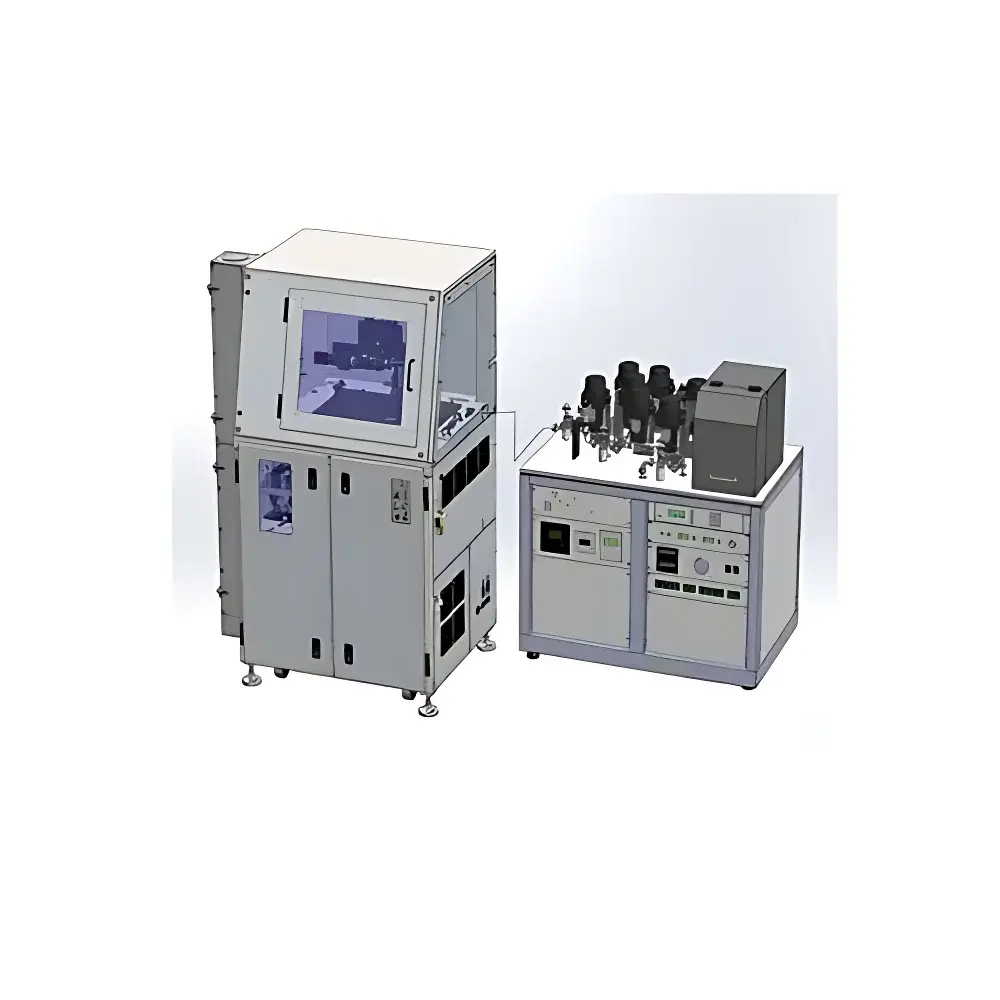
ASI RESOChron U-Th/He In-Situ Dating System
| Brand | ASI |
|---|---|
| Origin | USA |
| Manufacturer Type | Authorized Distributor |
| Origin Category | Imported |
| Model | RESOChron U-Th/He |
| Pricing | Available Upon Request |
Overview
The ASI RESOChron U-Th/He In-Situ Dating System is a fully integrated, computer-controlled microanalytical platform engineered for high-precision, in-situ geochronological and thermochronological analysis of individual mineral grains. It combines a 193 nm excimer laser ablation system (RESOlution) with a high-sensitivity noble gas mass spectrometer and multi-collector ICP-MS detection architecture to simultaneously quantify 4He, U, Th, and Pb isotopes—and associated trace elements—within single crystals such as zircon, apatite, rutile, and monazite. Unlike conventional step-heating or bulk digestion approaches, the RESOChron eliminates the need for alpha-ejection correction by enabling direct, spatially resolved measurement of He diffusion domains at sub-micron scale resolution. Its operational principle rests on laser-induced ablation coupled with real-time noble gas extraction and isotopic ratio measurement under ultra-high vacuum (UHV) conditions, ensuring minimal atmospheric contamination and high reproducibility across heterogeneous grain populations.
Key Features
- Integrated 193 nm RESOlution excimer laser ablation system with Laurin Technic and UHV-compatible sample chambers
- In-situ, single-grain U-Th-Pb-He triple-dating capability without alpha-ejection correction
- Simultaneous acquisition of radiogenic 4He, parent nuclides (238U, 235U, 232Th), and common Pb isotopes
- Trace element mapping via time-resolved ICP-MS signal integration during ablation
- Fully automated stage control and sequence programming for batch analysis of >50 grains per session
- Modular design supporting future upgrades to include He isotopic ratio calibration (e.g., 3He/4He) and low-blank He extraction protocols
Sample Compatibility & Compliance
The RESOChron accommodates polished thin sections, grain mounts, and epoxy-embedded mineral separates. It is optimized for non-conductive and radiation-damaged phases common in geological archives—including metamict zircons, annealed apatites, and REE-rich monazites. All analytical workflows adhere to established community standards for (U-Th)/He dating, including ASTM D7692–22 (Standard Guide for Geochronological Data Reporting) and ISO/IEC 17025:2017 requirements for measurement uncertainty quantification. Data provenance and instrument metadata are recorded in compliance with GLP principles; audit trails support regulatory review for petroleum basin modeling and nuclear waste repository site characterization studies.
Software & Data Management
Control and data reduction are performed using ASI’s proprietary ChronoSuite software suite, which includes modules for laser parameter optimization, real-time background subtraction, isotope ratio deconvolution, and age calculation based on the Farley et al. (1996) and Ketcham et al. (2011) diffusion models. Raw signal files (.raw) and processed age tables (.csv) are exportable in FAIR-compliant format. The system supports secure network deployment and integrates with laboratory LIMS environments via ODBC drivers. Full 21 CFR Part 11 compliance is available through optional electronic signature and user access control modules.
Applications
- Reconstructing paleoclimatic conditions during formation of Fe-rich fluvial placer deposits
- Constraining thermal history of source rocks in sedimentary basins for hydrocarbon generation modeling
- Assessing reservoir quality evolution in petroleum systems through apatite (U-Th)/He cooling histories
- Evaluating convective heat transfer and fluid migration pathways in geothermal prospects
- Quantifying fault slip rates and timing of tectonic events using differential exhumation signals
- Characterizing thermal fluid flow chronology in candidate nuclear waste disposal formations
- Resolving cratonic stability and landscape evolution timelines in diamond exploration targeting
- Deriving time-temperature paths for hydrothermal ore deposit formation
- Calculating denudation and orogenic uplift rates from multi-mineral thermochronometric datasets
FAQ
Does the RESOChron require chemical digestion or grain dissolution prior to analysis?
No—analysis is performed entirely in situ via laser ablation; no acid digestion, HF treatment, or physical grain separation is needed.
Can the system analyze sub-20 µm mineral domains?
Yes—the 193 nm laser enables spot sizes down to 5 µm with stable He signal yield, suitable for analyzing zoned cores and metamict regions.
Is alpha-ejection correction applied during data reduction?
No—alpha-ejection effects are mitigated by spatially resolved He measurement within crystallographically intact domains, eliminating reliance on geometric correction factors.
What certification documentation accompanies the system?
Each unit ships with factory calibration reports, UHV leak-test certificates, laser energy stability logs, and NIST-traceable reference material validation data.
How is long-term reproducibility verified?
Routine analysis of interlaboratory reference materials (e.g., Fish Canyon Tuff zircon, Durango apatite) is supported through built-in QC protocols and drift-correction algorithms.





