
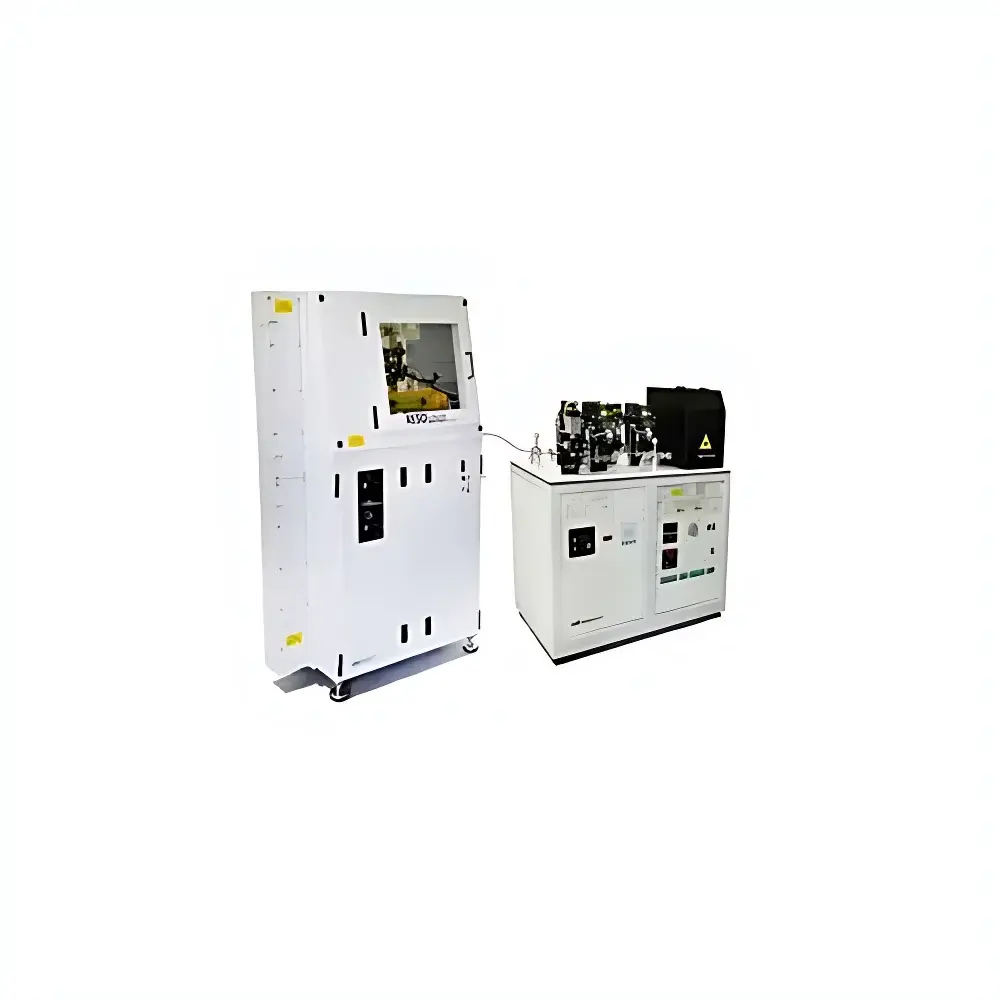
ASI RESOlution-3 Automated Laser Ablation Sampling System
| Brand | ASI |
|---|---|
| Origin | USA |
| Manufacturer Type | Authorized Distributor |
| Origin Category | Imported |
| Model | RESOlution-3 |
| Pricing | Available Upon Request |
Overview
The ASI RESOlution-3 Automated Laser Ablation Sampling System is a high-precision, research-grade laser ablation (LA) interface engineered for seamless integration with inductively coupled plasma mass spectrometry (ICP-MS) and optical emission spectrometry (ICP-OES). It employs a 193 nm excimer laser source—optimized for deep UV photon energy delivery—to achieve stoichiometric ablation of solid conductive and non-conductive materials with minimal thermal fractionation. The system’s core architecture centers on the Laurin Technic sample cell, originally developed by Dr. Mike Shelley (formerly of the Australian National University), and refined over decades of geochemical, metallurgical, and materials science applications. Its dual-volume, constant-volume chamber design ensures rapid aerosol transport to the ICP torch with minimized dispersion and memory effects, enabling high temporal resolution signal stability and reproducible quantification across heterogeneous matrices.
Key Features
- Off-axis high-resolution camera integrated into the ablation optics path, enabling real-time, parallax-free sample imaging and precise feature-based positioning without obstructing the laser beam path;
- GeoStar software suite with remote collaboration capability—supports offline ablation point selection, multi-user project sharing, and audit-trail-enabled method versioning;
- Dual-gas flow control architecture featuring a dedicated N₂ (or other diatomic gas) secondary mass flow controller (MFC), enhancing aerosol carrier efficiency and improving sensitivity for low-abundance isotopes;
- Motorized rotating rectangular slit assembly for dynamic line-scan ablation, enabling high spatial resolution profiling of elongated or anisotropic samples (e.g., mineral growth zones, thin sections, coated substrates);
- Excimer laser platform delivering >10⁹ shots lifetime with stable pulse energy output, reduced optical degradation, and maintenance intervals exceeding 12 months under typical laboratory use;
- Sample cell geometry optimized for >6× greater accessible ablation area compared to legacy M50A designs, while retaining identical sealing integrity, pressure response, and washout kinetics.
Sample Compatibility & Compliance
The RESOlution-3 accommodates standard 1″ and 2″ diameter polished sections, pressed pellets, sputter targets, and mounted particulates. Its vacuum-tight cell design supports operation under controlled He/N₂ carrier gas environments (0.1–1.5 L/min) and is compatible with both single-collector and multi-collector ICP-MS platforms. The system meets mechanical and electrical safety requirements per IEC 61010-1 and laser safety standards per ANSI Z136.1 (Class IV laser product). GeoStar software includes configurable electronic logbooks and optional 21 CFR Part 11 compliance modules—including user authentication, electronic signatures, and immutable audit trails—for GLP/GMP-regulated laboratories engaged in geological reference material certification, nuclear forensics, or clinical trace element mapping.
Software & Data Management
GeoStar v4.x provides instrument control, real-time ablation monitoring, and post-acquisition data annotation. Key capabilities include automated focus calibration via motorized Z-stage feedback, time-resolved signal deconvolution for transient signal correction, and batch processing of multi-point raster or spot analyses. Raw acquisition files are stored in vendor-neutral HDF5 format with embedded metadata (laser fluence, spot size, dwell time, carrier gas composition). Export options include CSV, IAEA-compatible .csv templates, and direct linkage to common data reduction packages (e.g., Iolite, Glitter, U-Pb Isoplot). All software updates are delivered via secure HTTPS repository with SHA-256 checksum verification.
Applications
- High-spatial-resolution U–Pb, Lu–Hf, and Sm–Nd geochronology of zircon, monazite, and apatite;
- In situ trace element mapping of ore minerals, meteoritic phases, and archaeological ceramics;
- Isotopic microanalysis of biological tissues (e.g., Ca, Fe, Zn distribution in bone or plant sections);
- Depth-profiling of thin-film coatings, semiconductor layers, and corrosion products;
- Reference material homogeneity assessment and certified value assignment per ISO/IEC 17025 requirements.
FAQ
What laser wavelength does the RESOlution-3 use, and why is 193 nm preferred for LA-ICP-MS?
The system uses a 193 nm ArF excimer laser, selected for its high photon energy (6.4 eV), strong absorption in silicates and oxides, and minimal wavelength-dependent elemental fractionation compared to IR or 213 nm solid-state sources.
Can the RESOlution-3 be retrofitted to existing ICP-MS instruments?
Yes—it interfaces via standard 1/4″ Swagelok fittings and supports analog/digital trigger synchronization with all major ICP-MS vendors (Thermo Fisher, Agilent, Nu Instruments, Elementar).
Is GeoStar software validated for regulated environments?
GeoStar offers optional 21 CFR Part 11-compliant configuration with role-based access control, electronic signature workflows, and full audit trail generation for FDA, EPA, or ISO 17025 audits.
What maintenance is required for the excimer laser module?
Routine maintenance is limited to quarterly gas replenishment (Ar/F₂/Ne mixture) and annual optical alignment verification; no mirror replacement or cavity cleaning is needed within the first 18 months of operation.
Does the system support helium-only carrier gas operation?
Yes—while N₂-assisted transport improves sensitivity for certain elements, the dual-MFC architecture allows fully independent He-only mode with adjustable flow ramping and stabilization profiles.
Related Products







