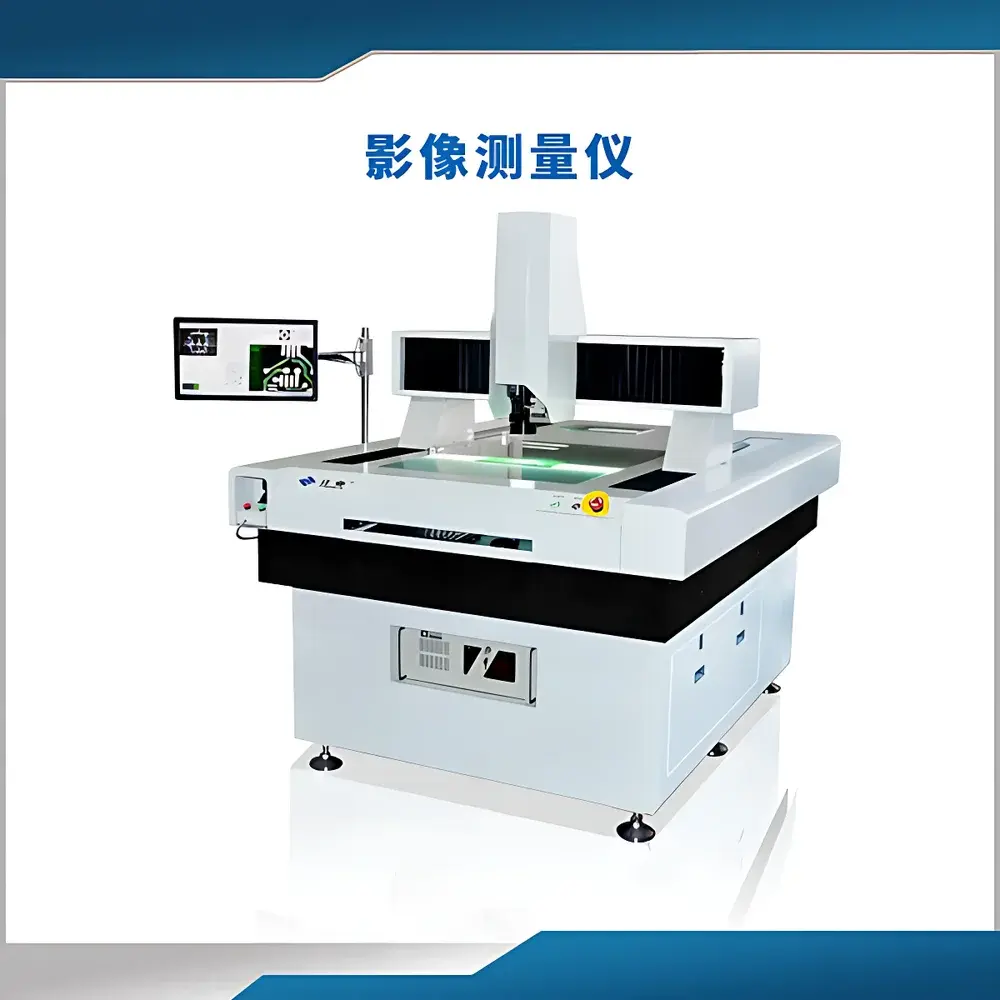
ASIDA 7060 Advanced 2D/3D Vision Measuring System
| Brand | ASIDA |
|---|---|
| Model | 7060 |
| Measurement Range (X×Y×Z) | 700 mm × 600 mm × 200 mm |
| Granite Base Material | Grade 0 Natural Granite |
| Linear Accuracy (X/Y) | ≤ (3 + L/200) µm |
| Repeatability | ≤ ±0.003 mm |
| Optical Magnification | 0.75×–5× Objective + 1× Eyepiece → Total 30×–230× |
| Encoders Resolution | ≤ 0.001 mm |
| Light Source | Ring-shaped LED Cold Illumination |
| Drive System | Panasonic Servo Motors (XYZ) |
| Software | AISDA VMA 3.00.01 (Multi-language: Simplified Chinese, Traditional Chinese, English) |
| Output Formats | DXF, Excel, Word |
| Compliance | Designed for ISO 10360-2, ISO 14253-1, and GB/T 16857.2 metrological traceability frameworks |
| Environmental Requirements | 20 ± 2 °C, 45–75% RH, Vibration < 0.002 g (<15 Hz) |
Overview
The ASIDA 7060 Advanced 2D/3D Vision Measuring System is an opto-mechanical coordinate measurement platform engineered for high-precision geometric metrology in quality control laboratories, R&D facilities, and precision manufacturing environments. It operates on the principle of non-contact optical imaging combined with high-resolution digital image processing and motorized stage positioning. The system captures magnified images of part features through a telecentric optical path, enabling sub-pixel edge detection and deterministic dimensional evaluation of planar geometries—including points, lines, circles, arcs, polygons, and freeform contours. With optional tactile probing (e.g., Renishaw TP20 trigger probe), it extends capability to Z-axis height measurement and basic 3D feature inspection—supporting both 2D profile verification and hybrid 2.5D metrology workflows. Its rigid Grade 0 natural granite frame, air-bearing X/Y guideways, and thermally stable LED illumination collectively ensure long-term mechanical stability and measurement reproducibility under controlled laboratory conditions.
Key Features
- Structural integrity: Monolithic Grade 0 granite base and column provide exceptional thermal inertia and resistance to creep or elastic deformation over time.
- Precision motion system: Air-bearing linear guides on X/Y axes eliminate mechanical friction and wear, maintaining positional fidelity across extended operational cycles.
- Optical performance: High-transmission telecentric objective lens (0.75×–5× magnification range) paired with 1× eyepiece delivers total optical magnification from 30× to 230×; optimized for sharp edge contrast and minimal distortion.
- Thermal management: Uniform ring-type cold LED illumination eliminates heat-induced substrate expansion during prolonged measurement sessions.
- Dynamic control: Panasonic AC servo motors with closed-loop feedback ensure smooth, repeatable stage movement and accurate encoder-based position tracking (≤ 0.001 mm resolution).
- Modular expandability: Designed to integrate certified third-party probes (e.g., Renishaw trigger probes) and laser displacement sensors (e.g., Keyence LJ-V series) for multi-sensor metrology applications.
Sample Compatibility & Compliance
The ASIDA 7060 accommodates parts up to 700 mm × 600 mm footprint and 200 mm height, with maximum load capacity of 30 kg on its reinforced optical glass stage. It supports metallic, ceramic, plastic, and composite components exhibiting reflective, matte, or translucent surface finishes—provided adequate contrast is achievable under adjustable LED lighting angles. The system conforms to fundamental requirements of ISO 10360-2 (acceptance and reverification testing of CMMs), ISO 14253-1 (geometrical product specifications — uncertainty evaluation), and China’s national standard GB/T 16857.2. While not inherently FDA 21 CFR Part 11-compliant out-of-the-box, audit trails, user access controls, and electronic signature functionality can be implemented via validated software configuration when deployed in regulated medical device or pharmaceutical QC settings.
Software & Data Management
AISDA VMA 3.00.01 is a Windows-based metrology software platform supporting tri-lingual UI (Simplified Chinese, Traditional Chinese, English) and compliant with Windows XP Professional minimum system requirements (dual-core CPU, ≥2 GB RAM, ≥320 GB HDD). It provides automated edge detection algorithms, geometric fitting routines (least-squares circle, line, etc.), GD&T evaluation (position, concentricity, parallelism), and batch report generation. Measurement data exports natively to industry-standard formats: DXF for CAD comparison, Excel (.xlsx) for statistical process control (SPC), and Word (.docx) for audit-ready documentation. All measurement records include timestamped operator ID, environmental log metadata (if external sensors are connected), and full traceability of calibration status per ISO/IEC 17025 guidelines.
Applications
This system serves as a primary metrology tool in sectors requiring tight tolerances on flatness, position, and form—such as printed circuit board (PCB) stencil inspection, semiconductor packaging alignment verification, automotive gasket and bracket dimensional validation, precision mold cavity analysis, and orthopedic implant component certification. Typical use cases include first-article inspection (FAI), incoming material verification, in-process SPC sampling, and failure analysis root-cause correlation between design intent (CAD model) and manufactured geometry. Its ability to generate overlay comparisons against nominal CAD profiles makes it especially valuable in reverse engineering and tolerance stack-up studies.
FAQ
What is the maximum part size this system can accommodate?
The ASIDA 7060 accepts parts up to 700 mm in X-direction, 600 mm in Y-direction, and 200 mm in Z-height, with a stage load limit of 30 kg.
Does the system support GD&T evaluation?
Yes—AISDA VMA 3.00.01 includes built-in tools for evaluating position, concentricity, symmetry, parallelism, perpendicularity, and profile of a surface per ASME Y14.5 and ISO 1101 standards.
Can measurement data be integrated into enterprise quality management systems (QMS)?
Yes—via standardized Excel and DXF exports, the system interfaces with common QMS platforms such as ETQ Reliance, MasterControl, and Siemens Teamcenter for automated data ingestion and SPC charting.
Is calibration certification included with purchase?
A factory calibration report traceable to NIM (National Institute of Metrology, China) is provided; users are responsible for periodic re-calibration per ISO/IEC 17025-accredited labs or internal metrology procedures.
What environmental conditions are required for optimal performance?
Operation requires temperature-controlled environment at 20 ± 2 °C, relative humidity 45–75%, and floor vibration below 0.002 g at frequencies under 15 Hz—consistent with ISO 22982 recommendations for high-accuracy vision metrology.