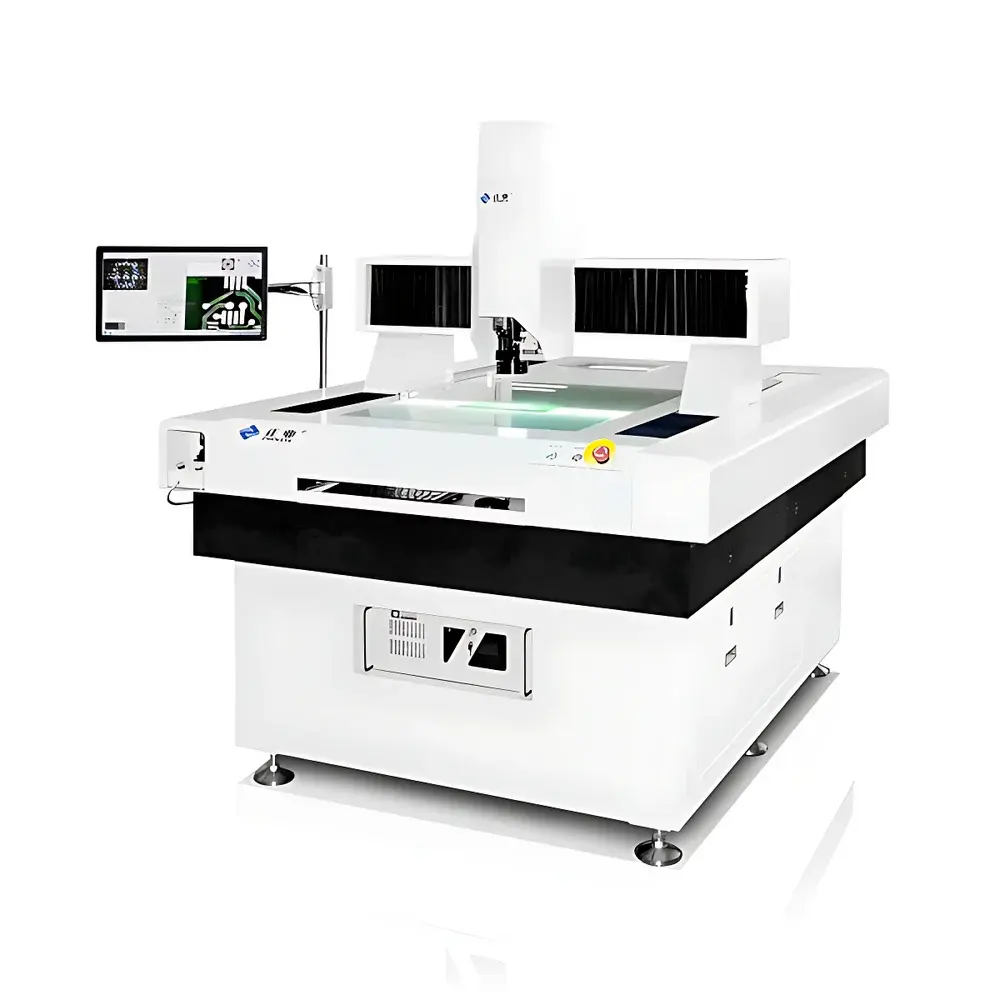
ASIDA 7060 Series龙门式全自动影像测量仪 | High-Precision CNC Video Measuring Machine with 3D Touch-Probe Capability
| Brand | ASIDA |
|---|---|
| Origin | Guangdong, China |
| Manufacturer Type | Authorized Distributor |
| Country of Origin | China |
| Model | 7060 Series |
| Price Range | USD 14,000 – 72,000 (FOB Guangdong) |
| Measurement Range (X×Y×Z) | 700 mm × 600 mm × 200 mm |
| Granite Base Grade | ISO 8540 Grade 00 |
| Encoder Resolution | ≤1 µm |
| XY Axis Linear Accuracy | ±(3 + L/200) µm (L in mm) |
| Repeatability | ≤±3 µm |
| Optical Magnification | 0.75×–5× Objective + 1× Eyepiece → Total 30×–230× |
| Working Distance | 82 mm |
| Stage Load Capacity | 30 kg |
| Software | AISDA VMA 3.00.01 (Multilingual: EN/TC/SC) |
| Compliance | ISO 10360-7, GB/T 16857.7, JJF 1306–2011 |
| Optional Accessories | NAVITAR Telecentric Lens, Renishaw MCR20 Trigger Probe, KEYENCE LJ-V Series Laser Displacement Sensor |
Overview
The ASIDA 7060 Series is a high-stability,龙门-style (gantry-type) CNC video measuring machine engineered for precision geometric metrology in industrial quality control and R&D environments. Based on the principle of digital image correlation and sub-pixel edge detection, it performs non-contact two-dimensional coordinate measurement of planar features—including points, lines, circles, arcs, rectangles, polygons, and freeform contours—while supporting optional tactile probing for Z-axis height acquisition and true 3D feature reconstruction. Its structural architecture integrates a grade-00 granite base and column (per ISO 8540), air-bearing X/Y motion systems with granite guideways, and high-torque Panasonic servo drives—ensuring long-term mechanical stability, thermal homogeneity, and positional fidelity under continuous operation. Designed to meet international dimensional metrology standards, the system delivers traceable, repeatable measurements compliant with ISO 10360-7 (CMM acceptance and reverification) and Chinese national verification regulation JJF 1306–2011.
Key Features
- Gantry-mounted optical head with motorized zoom objective (0.75×–5×) and fixed 1× eyepiece, enabling total optical magnification from 30× to 230× with consistent depth-of-field and minimal chromatic aberration
- Zero-backlash friction drive system for the worktable using polished stainless steel rods and precision-ground polymer bushings—eliminating mechanical hysteresis and wear-induced drift
- Uniform ring-array LED cold illumination (6,500 K CCT) with adjustable intensity and quadrant segmentation, minimizing thermal expansion artifacts during extended measurement cycles
- High-resolution glass scale encoders (≤1 µm resolution) mounted in direct kinematic chain, referenced to granite datum surfaces for minimized Abbe error
- Integrated environmental monitoring interface supporting real-time logging of ambient temperature (20 ±2 °C), relative humidity (45–75 %RH), and floor vibration (<0.002 g, <15 Hz)
- Modular probe mount compatible with Renishaw MCR20 trigger probes or KEYENCE LJ-V laser displacement sensors for hybrid 2.5D/3D metrology workflows
Sample Compatibility & Compliance
The ASIDA 7060 accommodates flat, rigid, and semi-rigid components up to 30 kg and 750 mm × 650 mm footprint. Typical applications include stamped metal parts, PCBs, machined housings, injection-molded plastic components, and precision optics substrates. All measurement data adhere to ISO/IEC 17025 documentation requirements when paired with calibrated reference artifacts (e.g., NIST-traceable step gauges, ball bars, or grid plates). The system supports audit-ready reporting per FDA 21 CFR Part 11 when configured with user authentication, electronic signatures, and immutable measurement log archiving—making it suitable for regulated manufacturing sectors including medical device production and automotive Tier-1 supply chains.
Software & Data Management
AISDA VMA 3.00.01 is a Windows-based metrology platform (Windows XP Pro minimum; recommended: Windows 10 IoT LTSB) featuring multilingual UI (English, Traditional Chinese, Simplified Chinese), GD&T annotation tools (per ISO 1101), and automated report generation in DXF, Excel (.xlsx), and Word (.docx) formats. The software implements statistical process control (SPC) modules with Cp/Cpk calculation, trend charting, and outlier detection based on IEC 62443-3-3 security-aligned data handling. Raw image buffers and coordinate point clouds are stored in vendor-neutral HDF5 containers, ensuring long-term readability independent of software version upgrades. Optional API integration (COM/ActiveX) enables bi-directional data exchange with MES or PLM systems such as Siemens Teamcenter or PTC Windchill.
Applications
- Dimensional verification of automotive brake caliper mounting holes, flange runout, and bracket symmetry tolerances
- PCB solder mask alignment accuracy assessment and fiducial mark position deviation analysis
- Geometric tolerance evaluation of orthopedic implant mating surfaces (flatness, parallelism, profile of a surface)
- Tooling validation for injection molds—cavity depth, gate location, and ejection pin concentricity
- Calibration artifact certification (e.g., linearity checks on gauge blocks, roundness assessment of calibration spheres)
- Reverse engineering support via dense point-cloud export for CAD model reconstruction in SolidWorks or Geomagic Design X
FAQ
What is the maximum permissible part weight and size for the 7060A configuration?
The standard 7060A model supports parts up to 30 kg and 750 mm × 650 mm in footprint. Customized oversized stages (e.g., 800 mm × 700 mm) are available upon request with reinforced granite base and recalibrated error mapping.
Does the system support ISO 15530-3 compliant calibration using calibrated artifacts?
Yes—the VMA software includes dedicated artifact calibration routines aligned with ISO 15530-3 (calibration by comparison with calibrated workpieces) and supports import of certificate data from accredited labs (e.g., A2LA, CNAS).
Can measurement uncertainty budgets be generated per ISO/IEC Guide 98-3 (GUM)?
Uncertainty estimation modules are embedded within advanced license tiers, calculating combined standard uncertainty based on encoder resolution, thermal expansion coefficients, lens distortion maps, and operator repeatability studies.
Is GLP-compliant audit trail functionality included in the base software?
Full audit trail—recording user ID, timestamp, parameter changes, and raw image metadata—is enabled by default and exportable as encrypted PDF or CSV. Electronic signature enforcement requires optional PKI module activation.
What maintenance intervals are recommended for air bearing filtration and optical cleaning?
Air filter elements should be inspected every 250 operating hours and replaced every 1,000 hours. Optical surfaces require cleaning only when particulate accumulation affects edge detection SNR—typically every 6–12 months in ISO Class 8 cleanroom-equivalent environments.