
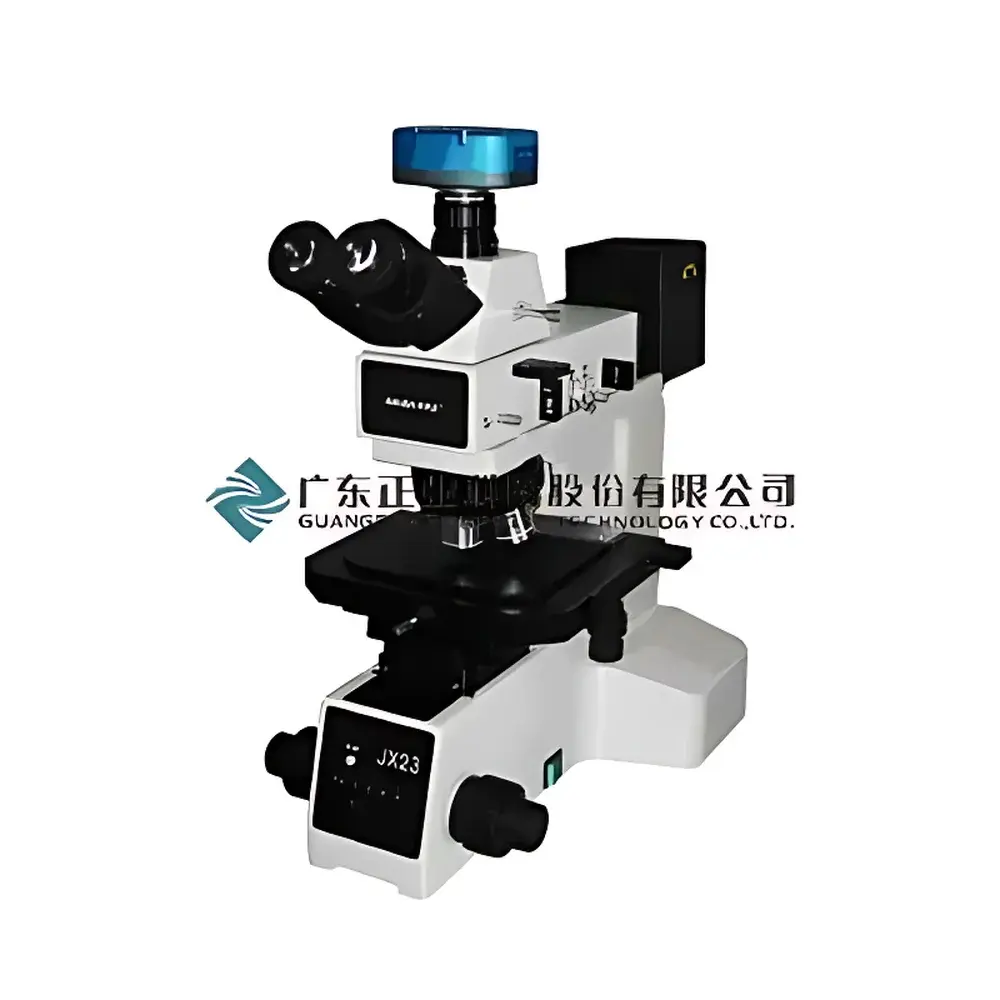
Asida JX22 Metallurgical Microscope
| Brand | Asida |
|---|---|
| Origin | Guangdong, China |
| Manufacturer Type | Authorized Distributor |
| Country of Origin | China |
| Model | JX22 |
| Pricing | Available Upon Request |
| Optical Magnification | 50×–600× |
| Digital Magnification | 90×–1080× |
| Eyepiece | Wide-Field 10× |
| Objective Lenses | Plan Achromatic 5×, 10×, 40×, 60× |
| Illumination | Reflected 6V/20W Halogen Lamp with Adjustable Brightness and Polarizer |
| Camera | DLCW 1.3 MP CCD |
| Measurement Accuracy | ±0.0006 mm |
Overview
The Asida JX22 Metallurgical Microscope is a precision upright optical instrument engineered for high-fidelity microstructural analysis of opaque, reflective specimens—particularly in metallurgy, electronic materials science, and printed circuit board (PCB) failure analysis. Unlike biological microscopes, metallurgical microscopes employ epi-illumination (reflected light) to visualize surface topography, grain boundaries, phase distribution, inclusion morphology, and interfacial defects in polished metallographic sections, solder joints, IC packages, and thin-film coatings. The JX22’s optical architecture integrates plan achromatic objectives and wide-field 10× eyepieces to deliver flat-field, color-corrected imaging across the full field of view—critical for quantitative morphometric measurements and ASTM E3-22 compliant microstructure evaluation. Its rigid mechanical stage, coaxial coarse/fine focusing system, and calibrated micrometer-driven X-Y translation ensure repeatable positioning and long-term dimensional stability during serial sectioning or multi-site comparative analysis.
Key Features
- Upright configuration optimized for vertical sample mounting and routine metallographic specimen handling
- Four-plan achromatic objective turret (5×, 10×, 40×, 60×) providing 50×–600× optical magnification range; digital enhancement extends effective resolution to 1080× via 1.3 MP CCD capture
- Reflected-light Köhler illumination system with 6V/20W halogen source, continuously adjustable intensity control, and integrated polarizer for contrast enhancement of anisotropic phases (e.g., ferrite, martensite, intermetallics)
- Precision mechanical stage with vernier-scaled X-Y movement (0.01 mm resolution) and specimen holder compatible with standard 25 × 75 mm metallographic slides and custom PCB cross-section mounts
- Calibrated measurement platform achieving ±0.0006 mm linear accuracy—traceable to NIST-traceable stage encoders and software-based pixel calibration routines
- Modular software interface supporting ISO/IEC 17025-aligned measurement workflows: point-to-point distance, chord length, radius/diameter of circular features, angular deviation, area fraction analysis, and multi-layer thickness profiling
Sample Compatibility & Compliance
The JX22 accommodates standard metallographic specimens up to 40 mm in height and 75 mm in width—including epoxy-mounted cross-sections of solder bumps, wire bonds, copper traces, and layered semiconductor substrates. Its robust stage design supports both conductive and non-conductive samples without grounding requirements. The system complies with key international standards governing microstructural characterization: ASTM E3-22 (Standard Guide for Preparation of Metallographic Specimens), ASTM E112-21 (Standard Test Methods for Determining Average Grain Size), and ISO 643:2021 (Steels — Micrographic determination of the apparent grain size). Optional documentation packages support GLP/GMP audit readiness, including instrument qualification records (IQ/OQ/PQ), calibration certificates, and software validation summaries aligned with FDA 21 CFR Part 11 data integrity requirements.
Software & Data Management
The bundled imaging and metrology software provides a deterministic, audit-ready environment for quantitative microanalysis. All measurement operations are timestamped and logged with operator ID, microscope configuration state, and calibration parameters. Raw image files are saved in TIFF format with embedded EXIF metadata (magnification, exposure time, lens ID, stage coordinates). The software supports batch export of measurement reports in PDF or CSV formats—fully customizable to match internal QA/QC templates. Version-controlled firmware updates ensure backward compatibility with legacy datasets, while encrypted local storage safeguards intellectual property associated with proprietary material characterization protocols.
Applications
- PCB and IC packaging: Solder joint integrity assessment, void quantification in BGA underfills, intermetallic compound (IMC) layer thickness mapping at Cu–Sn interfaces
- Failure analysis: Crack propagation path identification, fatigue striation spacing measurement, corrosion pit depth profiling in stainless steel or aluminum alloys
- Quality control: Grain size distribution analysis per ASTM E112, inclusion rating per ASTM E45, decarburization depth measurement in heat-treated steels
- Research & development: Phase transformation kinetics studies, coating adhesion evaluation via cross-sectional delamination analysis, thermal barrier coating microcrack density quantification
- Educational laboratories: Structured pedagogical modules for metallography fundamentals, including polishing artifact recognition, etchant selectivity assessment, and stereological sampling strategies
FAQ
What is the maximum specimen height supported by the JX22?
The standard stage permits specimens up to 40 mm in vertical height; optional extended-focus nosepieces or low-profile objective adapters can accommodate taller mounts upon request.
Is the polarizer motorized or manually inserted?
The polarizer is manually rotatable with angular scale markings (0°–360°) and lockable position retention for reproducible extinction angle alignment.
Can the software generate ASTM-compliant grain size reports?
Yes—the software includes automated grain detection algorithms validated against ASTM E112 Annex A1 reference images and outputs both ASTM G-number and mean linear intercept values with statistical confidence intervals.
Does the system support external camera integration beyond the included DLCW unit?
The microscope features a C-mount port compliant with ISO 8036-1, enabling direct coupling of third-party scientific CMOS or sCMOS cameras (e.g., Hamamatsu ORCA-Fusion, Basler ace USB3) via adapter rings.
Is remote operation possible for lab-wide deployment?
The software supports LAN-based client-server architecture, allowing concurrent access from up to eight operator workstations with role-based permissions and centralized log archiving.




