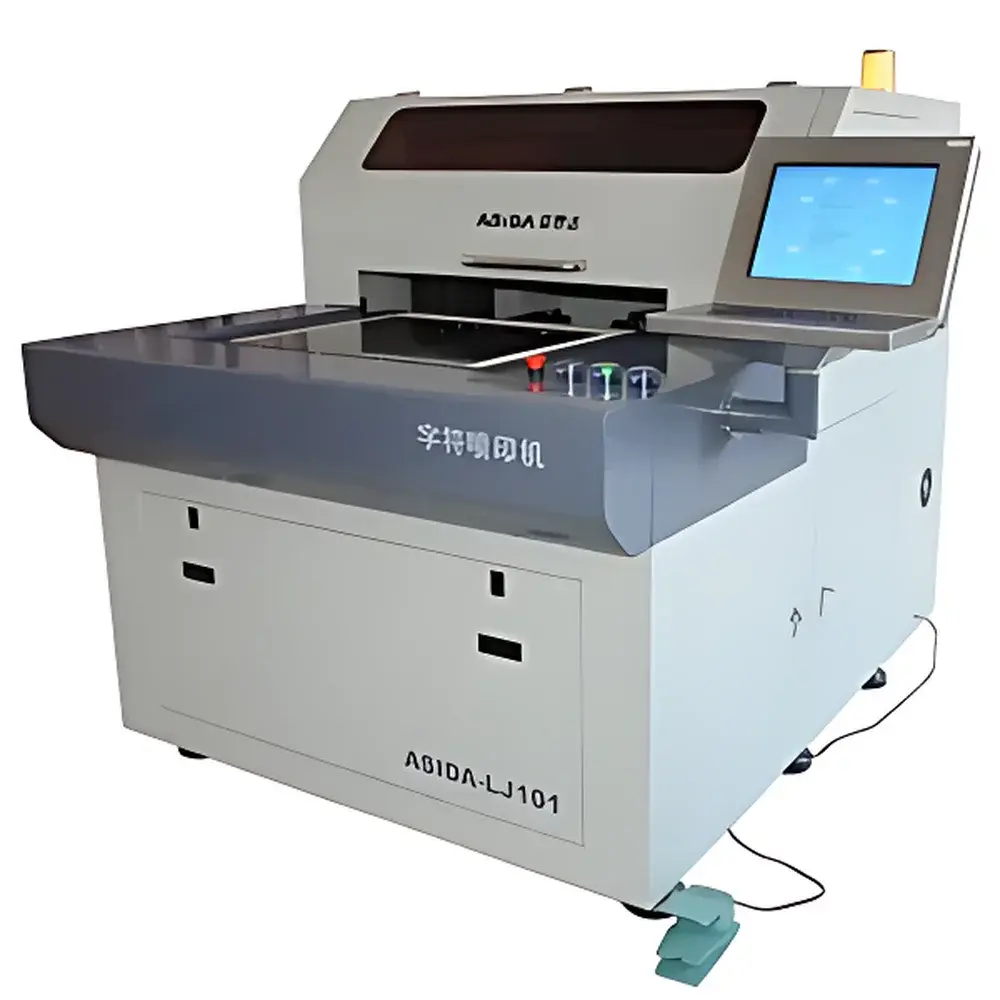
ASIDA LJ101A FPC Character Inkjet Printer
| Brand | ASIDA |
|---|---|
| Model | LJ101A |
| Origin | Guangdong, China |
| Manufacturer Type | Authorized Distributor |
| Country of Origin | PRC |
| Print Resolution | 720 × 720 dpi / 720 × 1440 dpi |
| PCB Size Range | 170 × 220 mm to 660 × 610 mm |
| PCB Thickness Capacity | 0.1–6 mm |
| Minimum Line Width | 70 µm |
| Minimum Character Height | 0.5 mm |
| Printhead | KM1024 (14 pL drop volume) |
| Print Speed | ≤70 s per side (for 24″ × 18″ panel) |
| Registration Method & Accuracy | CCD-based three-point auto-alignment |
| Curing System | UV LED lamp with active cooling |
| Power Supply | AC 380 V, 10 A, 50 Hz |
| Air Supply | Dry compressed air, 0.5–0.8 MPa |
| Dimensions (W×D×H) | 1350 × 1790 × 1500 mm |
| Weight | 1500 kg |
Overview
The ASIDA LJ101A FPC Character Inkjet Printer is a precision-engineered industrial inkjet system designed specifically for permanent, high-fidelity alphanumeric marking and 2D barcode printing on rigid and flexible printed circuit boards (PCBs and FPCs). Unlike traditional screen-printing methods—which require stencils, solvent-based inks, extended drying times, and dedicated ventilation—this system employs non-contact piezoelectric inkjet technology combined with UV-curable ink formulation and real-time vision-guided registration. It operates on the principle of digital drop-on-demand (DOD) ink deposition, where each character or code is rendered pixel-by-pixel at defined resolution, enabling traceability, serialization, and compliance-driven labeling without process interruption. Engineered for semiconductor packaging and advanced PCB assembly lines, the LJ101A supports green manufacturing initiatives by eliminating VOC emissions, reducing ink waste, and minimizing floor space and utility overhead associated with legacy printing infrastructure.
Key Features
- CCD-based three-point automatic registration system ensures repeatable placement accuracy of ≤35 µm across diverse board geometries and surface reflectivity conditions.
- High-precision linear motor-driven gantry with optical encoder feedback delivers stable positioning and consistent dot placement across full-format substrates.
- Proprietary image rendering algorithm optimizes edge sharpness and contrast for characters as small as 0.5 mm in height and line widths down to 70 µm—critical for fine-pitch FPC identification.
- Self-maintaining printhead architecture includes automated nozzle health monitoring, periodic cleaning cycles, and sealed capping station to prevent nozzle clogging during idle periods.
- Fully enclosed ink delivery path with pressure-regulated circulation minimizes ink evaporation, sedimentation, and contamination—ensuring long-term viscosity stability and print consistency.
- Integrated UV-LED curing module with thermal management provides instantaneous cross-linking of acrylic-based ink, eliminating post-print handling delays and enabling immediate downstream processing.
- Intuitive HMI interface with drag-and-drop layout editor, batch serialization tools, and configurable job templates reduces operator training time and minimizes setup errors.
Sample Compatibility & Compliance
The LJ101A accommodates both rigid FR-4 and flexible polyimide (PI)-based substrates—including multilayer HDI, rigid-flex hybrids, and ultra-thin FPCs—with thickness ranging from 0.1 mm to 6.0 mm. Its adaptive Z-axis compensation and dynamic focus control maintain optimal ink droplet trajectory regardless of board warpage or surface topography. The system meets core requirements for electronics manufacturing traceability under IPC-A-600 and IPC-6012 standards. Ink formulations are RoHS 2.0 compliant and halogen-free, supporting IEC 61249-2-21 specifications. Optional audit trail logging and user access control modules align with ISO 9001:2015 documentation integrity protocols and support GLP/GMP-aligned production environments.
Software & Data Management
The embedded control software supports native integration with MES and ERP platforms via OPC UA and Modbus TCP interfaces. All print jobs—including variable data fields such as serial numbers, date/time stamps, QR codes, and custom logos—are stored with timestamped metadata and can be exported in CSV or XML format. Version-controlled firmware updates are delivered through secure HTTPS channels. Optional 21 CFR Part 11-compliant configuration enables electronic signatures, change history tracking, and role-based permissions—facilitating FDA-auditable workflows in regulated semiconductor packaging facilities.
Applications
- Permanent component identification and revision marking on IC substrates and leadframes.
- Lot/batch serialization and UDI encoding for medical-grade PCB assemblies.
- QR code and DataMatrix printing for automated optical inspection (AOI) and pick-and-place traceability.
- Replacement of silkscreen processes in high-mix, low-volume FPC production lines.
- Marking on thermally sensitive flex circuits where conventional thermal transfer or laser etching risks substrate degradation.
- Integration into inline SMT lines for post-reflow marking without rehandling or conveyor stoppages.
FAQ
What types of ink are compatible with the LJ101A?
The system is validated exclusively for use with ASIDA-certified UV-curable acrylic inks formulated for adhesion to solder mask, copper, polyimide, and ENIG surfaces. Third-party inks are not supported and may void warranty.
Can the LJ101A print on warped or uneven PCBs?
Yes—the Z-axis servo compensates dynamically within ±1.5 mm range using real-time height mapping from integrated capacitive sensors, maintaining consistent ink drop focus and curing intensity.
Is offline programming supported?
Yes—job files can be prepared using ASIDA’s standalone LayoutStudio software on Windows PCs and transferred via USB or network share without requiring machine downtime.
What maintenance intervals are recommended?
Daily nozzle check and weekly printhead purge cycle; biannual calibration of CCD alignment and UV irradiance output using NIST-traceable reference targets.
Does the system support Industry 4.0 connectivity?
Standard Ethernet port supports SNMP monitoring, remote diagnostics, and predictive maintenance alerts via ASIDA’s cloud-enabled FleetManager platform (subscription optional).