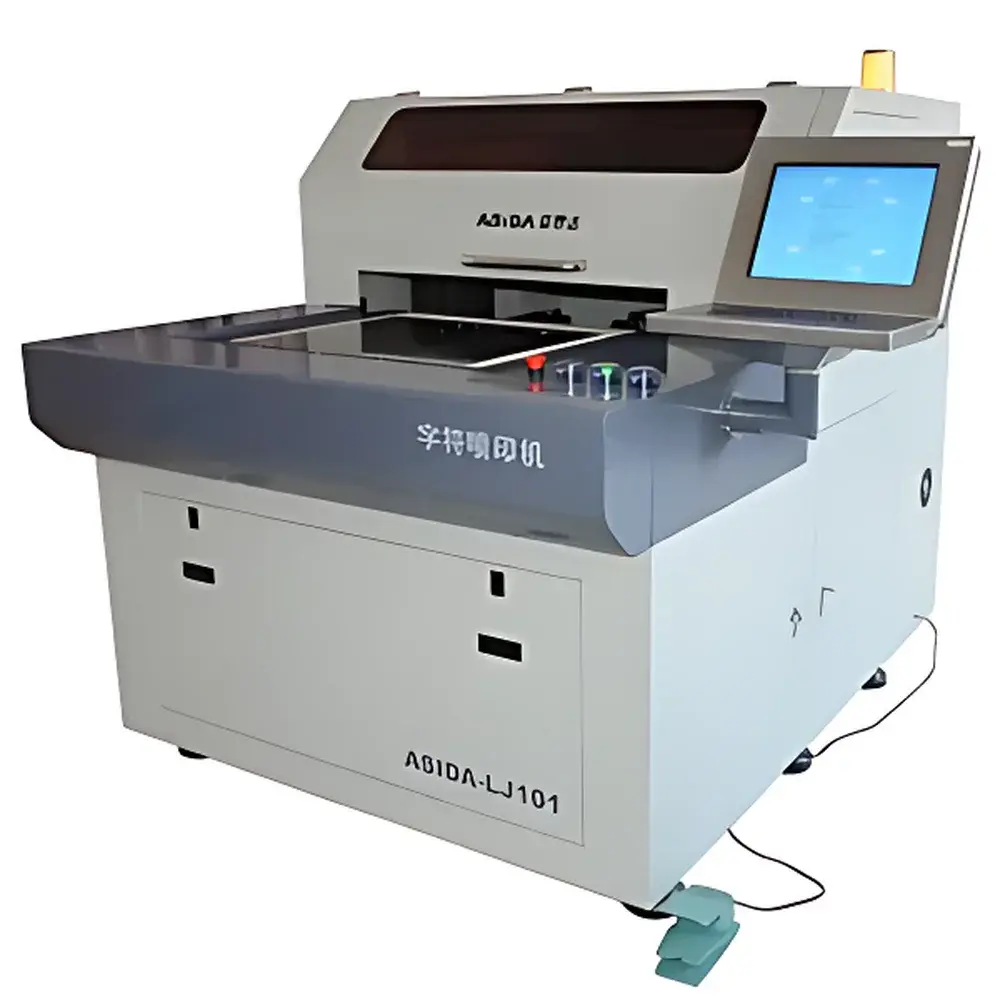
Asida LJ101A PCB-Specific Inkjet Character Printer
| Brand | Asida |
|---|---|
| Model | LJ101A |
| Application | Permanent inkjet marking of legends, serial numbers, barcodes, and identifiers on rigid and flexible printed circuit boards (PCBs) |
| Print Resolution | 720 × 720 dpi / 720 × 1440 dpi |
| Max. PCB Size | 660 × 610 mm |
| Min. PCB Size | 170 × 220 mm |
| PCB Thickness Range | 0.1–6 mm |
| Minimum Line Width | 70 µm |
| Minimum Character Height | 0.5 mm |
| Printhead | KM1024 (14 pL drop volume) |
| Positioning Accuracy | ≤35 µm (CCD-based three-point auto-alignment) |
| UV Curing System | Integrated air-cooled UV lamp with instant curing |
| Cycle Time | ≤70 s per side (for 24″ × 18″ panel) |
| Power Supply | AC 380 V, 10 A, 50 Hz |
| Pneumatic Supply | Dry compressed air, 0.5–0.8 MPa |
| Dimensions (W×D×H) | 1350 × 1790 × 1500 mm |
| Weight | 1500 kg |
Overview
The Asida LJ101A PCB-Specific Inkjet Character Printer is an industrial-grade, non-contact digital marking system engineered for high-precision, permanent legend printing on rigid and flexible printed circuit boards. Unlike traditional screen-printing methods—whose stencil fabrication, alignment, and solvent-based ink handling introduce process variability, waste, and environmental compliance burdens—the LJ101A employs piezoelectric drop-on-demand (DOD) inkjet technology coupled with real-time CCD vision alignment and UV-curable ink chemistry. This architecture enables direct-to-board digital printing of alphanumeric identifiers, custom serial numbers, DataMatrix codes, polarity indicators, and revision marks without physical tooling or chemical development steps. Designed specifically for PCB manufacturing environments—including SMT lines, final test stations, and backend assembly facilities—the system operates within Class 10,000 cleanroom-compatible enclosures and integrates seamlessly into automated material handling workflows via standard I/O and SECS/GEM protocol support.
Key Features
- CCD-based three-point automatic registration: Captures fiducial marks across the PCB surface to compensate for board warpage, thermal drift, and conveyor positioning error—achieving ≤35 µm repeatable placement accuracy.
- High-stability motion platform: Dual linear servo stages with granite base and precision ground rails ensure sub-micron positional repeatability over extended duty cycles.
- Optimized printhead management: KM1024 industrial printhead with 14 pL droplet control, integrated automatic nozzle cleaning cycle, and sealed ink recirculation loop minimizing ink waste and clogging risk.
- UV-LED curing subsystem: Air-cooled, narrow-spectrum UV source (365 nm peak) delivers full ink polymerization in <1 s post-deposition—enabling immediate downstream handling without smearing or offset transfer.
- Adaptive substrate compatibility: Supports FR-4, polyimide (PI), metal-core (MCPCB), and flex-rigid laminates across thicknesses from 0.1 mm (ultra-thin FPC) to 6 mm (heavy copper power boards).
- Intuitive HMI interface: 15″ touchscreen operator station with drag-and-drop job setup, real-time print preview, and built-in calibration wizards compliant with IPC-A-600 and IPC-6012 visual acceptance criteria.
Sample Compatibility & Compliance
The LJ101A accommodates standard PCB panel formats—from small prototype panels (170 × 220 mm) to large production arrays (660 × 610 mm)—with programmable Z-axis lift compensation for warped substrates. It accepts both bare and assembled boards, including those with solder mask, silkscreen, conformal coating, or component-height tolerances up to 12 mm. All consumables—including UV-curable acrylate-based inks—are RoHS 3-compliant and halogen-free. The system meets CE machinery directive (2006/42/EC), EMC directive (2014/30/EU), and conforms to IPC-J-STD-020 moisture sensitivity level (MSL) handling guidelines during operation. Optional audit trail logging supports GLP/GMP documentation requirements per ISO 9001:2015 and FDA 21 CFR Part 11 when paired with Asida’s TraceLink software module.
Software & Data Management
Controlled via Asida’s proprietary MarkVision™ v4.2 software suite, the LJ101A supports native import of Gerber RS-274X, ODB++, and IPC-2581 data formats—automatically extracting legend layers, reference designators, and barcode fields without manual re-drawing. Dynamic variable data injection is enabled through CSV/Excel batch files, SQL database queries, or RESTful API integration with MES/ERP systems (e.g., Siemens Opcenter, Rockwell FactoryTalk). All print jobs are timestamped, user-authenticated, and stored with full image metadata—including camera capture logs, ink usage metrics, and alignment deviation reports—for traceability and root-cause analysis. Software updates are delivered via secure HTTPS with SHA-256 signature verification.
Applications
- Permanent part numbering and revision tracking on high-reliability aerospace and automotive PCBs.
- Machine-readable DataMatrix codes for traceability in medical device PCBs compliant with UDI (FDA 21 CFR Part 830) and IEC 62304.
- Component-side polarity and orientation marks for automated optical inspection (AOI) and pick-and-place machine guidance.
- Low-volume, high-mix production where frequent job changeovers render screen printing economically unviable.
- Environmental compliance: Eliminates VOC-emitting solvents and reduces ink consumption by >65% versus screen printing—supporting ISO 14001-certified green manufacturing initiatives.
FAQ
Does the LJ101A support IPC-2581 or Gerber file import for automated legend extraction?
Yes. MarkVision™ natively parses layer attributes, net names, and reference designators from IPC-2581, Gerber X2, and ODB++ files—generating optimized print paths without manual vector recreation.
What UV ink formulations are certified for lead-free soldering processes (reflow up to 260°C)?
Asida supplies two qualified UV inks: AS-UVF1 (flexible polyurethane-acrylate, Tg = 115°C) and AS-UVR2 (rigid epoxy-acrylate, withstands 10x reflow cycles at 260°C per J-STD-020). Material safety data sheets (MSDS) and HALT test reports available upon NDA.
Can the system be integrated into a fully automated SMT line with SMEMA handshaking?
Yes. Standard configuration includes dual SMEMA 2.0 interfaces (input/output), photoeye triggers, and discrete I/O for conveyor synchronization. Custom SECS/GEM implementation is available for semiconductor fab-level integration.
Is remote diagnostics and firmware update capability supported?
All units ship with embedded industrial Ethernet (TCP/IP), enabling secure remote access via TLS-encrypted VNC and over-the-air firmware updates signed with Asida’s private key infrastructure.