
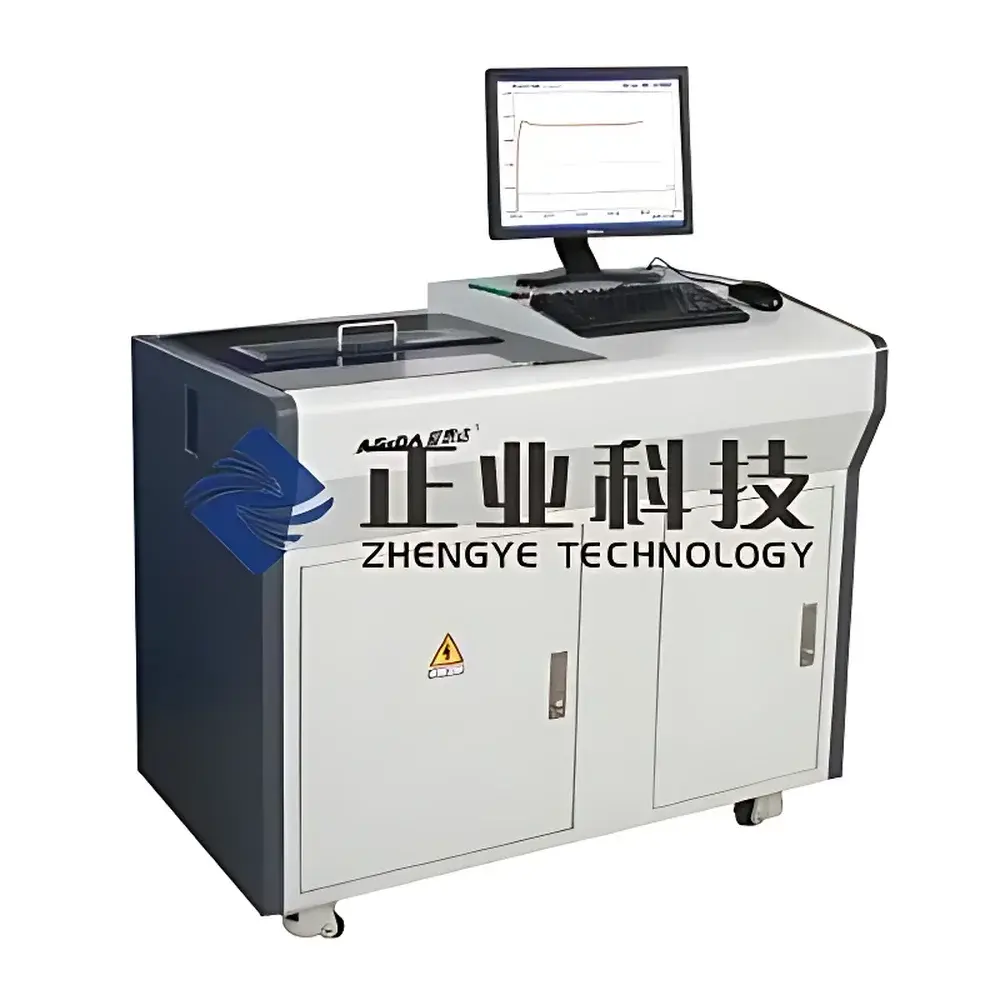
Asida LV12 Ionic Contamination Tester for PCB Cleanliness Verification
| [Brand | Asida |
|---|---|
| Origin | Guangdong, China |
| Model | LV12 |
| Test Method | Static Extraction |
| Measurement Accuracy | ±5% |
| Conductivity Resolution | 0.001 µS/cm |
| Sample Plate Size Range | 10 cm × 10 cm to 60 cm × 35 cm |
| Extractant Density | 0.85–0.855 g/cm³ |
| Extractant Volume | ~17 L |
| Water Tank Dimensions | 352 mm × 70 mm × 600 mm (L×W×H) |
| Overall Dimensions | 1050 mm × 600 mm × 920 mm (L×W×H) |
| Power Consumption | 1300 W |
| Input Voltage/Frequency | 220 V / 50 Hz |
| Net Weight | ~115 kg |
| Operating Ambient Temperature | 22 ± 3 °C |
| Extractant Temperature Control | 40 ± 2 °C |
| Compliance | GB/T 4677.22a, GB/T 18268, SJ/T 11364, IPC-6012B Clause 3.9, IPC-TM-650 2.3.25B] |
Overview
The Asida LV12 Ionic Contamination Tester is a precision laboratory instrument engineered for quantitative assessment of ionic residue on printed circuit boards (PCBs), electronic components, and assembled assemblies. It operates on the principle of static solvent extraction followed by high-resolution conductivity measurement—aligned with industry-standard methodologies defined in IPC-TM-650 2.3.25B and GB/T 4677.22a. The system immerses or floods the test surface with a precisely formulated low-conductivity extractant (typically isopropanol/water mixture at controlled density 0.85–0.855 g/cm³), enabling dissolution and mobilization of soluble ionic contaminants—including chlorides, bromides, sulfates, sodium, potassium, and ammonium ions. The resulting extract solution is continuously recirculated through a temperature-stabilized flow cell, where real-time conductivity is measured at 0.001 µS/cm resolution. Conductivity values are converted to sodium chloride equivalent (NaCl eq.) in µg/cm² using calibration curves traceable to NIST-certified standards. This enables objective pass/fail evaluation against IPC cleanliness thresholds (e.g., ≤1.56 µg/cm² NaCl eq. for Class 3 assemblies).
Key Features
- Automated thermal control system maintains extractant temperature at 40 ± 2 °C throughout testing—critical for reproducible solubility and ion mobility.
- Dual-mode communication interface: configurable USB or RS-232 connectivity ensures compatibility with legacy and modern laboratory PCs.
- Embedded Windows-based control software runs without installation; executable directly from USB drive or local storage.
- Tri-lingual UI support (English, Simplified Chinese, Traditional Chinese) facilitates global deployment across multinational manufacturing sites.
- Real-time graphical display of conductivity drift and ion accumulation curve—enabling immediate visual verification of extraction kinetics and endpoint stability.
- Multi-tier user authentication with role-based password protection (operator, technician, administrator) supports GLP/GMP audit readiness.
- Integrated mixed-bed ion exchange resin column regenerates extractant conductivity baseline between tests—reducing consumable cost and minimizing inter-test carryover.
- Robust mechanical architecture accommodates large-format PCBs up to 60 cm × 35 cm, with adjustable immersion depth and uniform fluid distribution manifold.
Sample Compatibility & Compliance
The LV12 is validated for use with bare PCBs (pre- and post-solder mask), populated boards (with conformal coating removed per IPC-J-STD-001), discrete passive/active components, and flex-rigid hybrids. Its static extraction protocol satisfies requirements for Class 2 and Class 3 electronics per IPC-A-610 and IPC-6012B Section 3.9. Regulatory alignment includes electromagnetic compatibility per GB/T 18268 (equivalent to IEC 61326-1), hazardous substance labeling per SJ/T 11364 (China RoHS), and test method validity per GB/T 4677.22a. While not an FDA-regulated device, its data integrity framework—including timestamped raw conductivity logs, operator ID tagging, and non-editable test reports—supports 21 CFR Part 11 compliance when deployed within validated QA/QC workflows.
Software & Data Management
The embedded application generates ASTM-compliant test reports containing sample ID, operator name, date/time stamp, ambient and extractant temperatures, final conductivity value, calculated NaCl-equivalent contamination level, pass/fail status per selected standard, and full conductivity vs. time trace. All data are stored in encrypted SQLite databases with automatic daily backup to external media. Export options include CSV (for statistical process control integration), PDF (for archival and customer submission), and XML (for LIMS interoperability). Audit trail functionality records all parameter modifications, user logins, and report generation events—retained for ≥36 months unless purged under documented retention policy.
Applications
- Final cleanliness verification of PCBs after solder paste cleaning, aqueous or semi-aqueous defluxing, and plasma-assisted surface activation.
- In-process monitoring of component-level cleaning efficacy during high-reliability aerospace or medical device assembly.
- Root cause analysis of electrochemical migration (ECM), dendritic growth, or field failures linked to ionic residue-induced leakage currents.
- Qualification of new cleaning chemistries, equipment settings, or process changes against established baseline contamination limits.
- Supplier qualification audits—providing objective, repeatable metrics for incoming material acceptance testing (IAT).
FAQ
What extraction solvent is recommended for routine operation?
Isopropyl alcohol (IPA)/deionized water mixture (75/25 v/v) calibrated to density 0.85–0.855 g/cm³ is specified in IPC-TM-650 2.3.25B and validated for the LV12.
Can the instrument measure specific anions (e.g., Cl⁻) independently?
No—the LV12 performs total ionic contamination quantification via conductivity. For speciated ion analysis, coupling with IC (ion chromatography) is required.
Is temperature calibration traceable to national standards?
Yes—extractant temperature sensors are factory-calibrated against NIST-traceable dry-block calibrators; annual recalibration is recommended.
How often must the mixed-bed resin cartridge be replaced?
Typical service life is 150–200 test cycles under normal usage; the system alerts users when conductivity baseline recovery falls below specification.
Does the LV12 support automated report generation for ISO 9001 internal audits?
Yes—reports include all mandatory elements per ISO 17025 clause 7.8.2: test conditions, equipment IDs, environmental parameters, raw data, uncertainty estimation (±5% stated accuracy), and authorized sign-off fields.



