
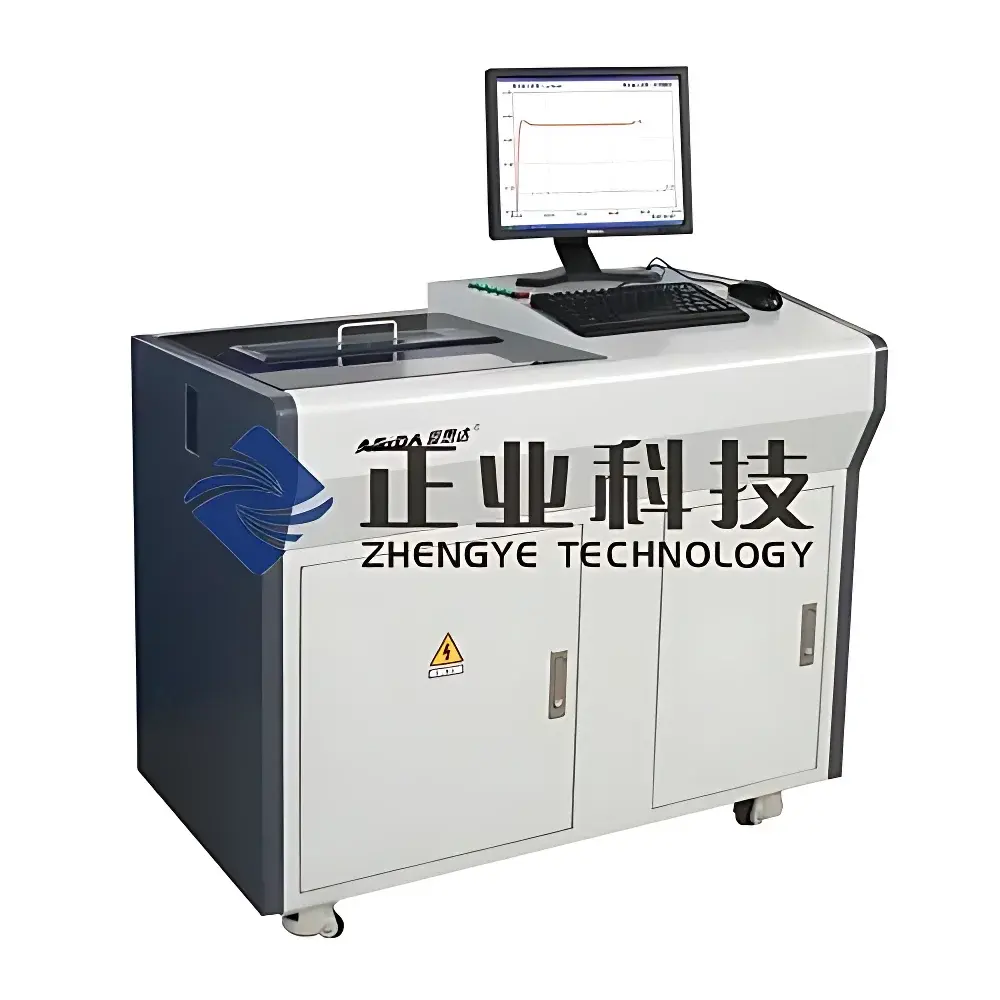
ASIDA LZ12 PCB Ionic Contamination Tester
| Brand | ASIDA |
|---|---|
| Model | LZ12 |
| Type | Static Ionic Contamination Tester for Printed Circuit Boards |
| Measurement Principle | Conductivity-based extraction analysis per IPC-TM-650 2.3.25 and J-STD-001 |
| Standard Extractant Volume | 17 L (customizable up to 30 L) |
| Extractant Temperature Control | 40 ± 2 °C |
| Test Area Range | 1200–8712 cm² |
| Conductivity Resolution | 0.0001 µS/cm² |
| Accuracy | ±5% |
| Electrode Sensitivity Range | 0.0001–9999.9999 µS/cm² |
| Power Supply | AC 220 V, 50 Hz |
| Rated Power | 1300 W |
| Dimensions (Std) | 1050 × 600 × 920 mm |
| Weight (Std) | ~115 kg |
| Operating Ambient | 22 ± 3 °C |
| Data Output | Excel (.xlsx), USB/RS232 interface |
| Language Support | English & Simplified Chinese |
| Security | Multi-level password protection |
| Thermal Stability | ±0.3 °C at 40 °C setpoint |
| Resin Filtration System | Mixed-bed anion/cation exchange resin |
| Compliance | IPC, JEDEC, ISO 9001-aligned workflow support |
| Software | Embedded PC-controlled acquisition with real-time conductivity curve plotting and auto-report generation |
Overview
The ASIDA LZ12 PCB Ionic Contamination Tester is a dedicated, benchtop analytical instrument engineered for quantitative assessment of ionic residue on printed circuit board (PCB) surfaces—critical for ensuring long-term reliability, solderability, and electrochemical migration resistance in electronics manufacturing. It operates on the principle of solvent extraction followed by high-resolution conductivity measurement, fully compliant with IPC-TM-650 Method 2.3.25 (Ionic Contamination by Conductivity) and aligned with J-STD-001 requirements for cleanliness verification. Unlike plasma surface treatment systems—which modify surface energy—the LZ12 is strictly a metrology device: it quantifies residual NaCl-equivalent contamination (µg Eq. NaCl/cm²) via standardized aqueous extraction (typically 75% IPA / 25% deionized water or pure DI water), enabling pass/fail evaluation against industry thresholds (e.g., ≤1.56 µg Eq. NaCl/cm² for Class 3 assemblies). Its thermal-regulated bath maintains extractant at 40 ± 2 °C throughout static immersion, minimizing temperature-induced conductivity drift and ensuring repeatability across shifts and laboratories.
Key Features
- Thermally stabilized extraction chamber with PID-controlled heating system (±0.3 °C precision at 40 °C setpoint), eliminating manual bath calibration and reducing inter-operator variability.
- High-sensitivity dual-electrode conductivity sensor with 0.0001 µS/cm² resolution and full-scale range up to 9999.9999 µS/cm²—capable of detecting sub-ppb-level ionic species under controlled flow conditions.
- Integrated mixed-bed ion exchange resin filtration module, regenerable in situ, ensuring baseline stability and eliminating carryover between sequential samples.
- Embedded Windows-based control software with intuitive GUI, supporting both static immersion (6 min standard) and user-defined test duration (1–60 min); manual interruption and result preservation permitted at any stage.
- Dual communication interface (USB 2.0 and RS-232) for seamless integration into existing lab networks or standalone operation; no external drivers required.
- Multi-tier access control: administrator, technician, and viewer roles enforced via encrypted password authentication—supports audit-ready workflows per GLP/GMP documentation standards.
- Automated report generation in native Microsoft Excel (.xlsx) format, including timestamped conductivity curves, raw data tables, calculated µg Eq. NaCl/cm² values, and operator ID metadata.
Sample Compatibility & Compliance
The LZ12 accommodates rigid and flexible PCBs up to 8712 cm² (e.g., 660 mm × 660 mm panels), with adjustable fixture supports for uneven or warped substrates. It accepts bare boards, solder-masked assemblies, and conformal-coated samples (post-cure). Extraction vessels are constructed from high-purity PP and PTFE-lined stainless steel to prevent leachable ions. The system meets material compatibility requirements per IPC-CC-830B for cleanliness validation and supports traceability per ISO/IEC 17025:2017 clause 7.7 (result reporting). While not FDA 21 CFR Part 11 certified out-of-box, its logging architecture—including immutable timestamps, user attribution, and uneditable Excel outputs—facilitates internal validation for regulated environments (e.g., aerospace or medical electronics).
Software & Data Management
The proprietary ASIDA CleanTrack™ software provides real-time visualization of conductivity vs. time, with overlay capability for comparative batch analysis. All measurements are stored locally with SHA-256 hashed integrity checks. Export options include CSV for LIMS ingestion and PDF summaries with embedded QC charts. Audit logs record every parameter change, test initiation, and report export event—retained for ≥36 months unless manually purged. No cloud dependency or telemetry; all processing occurs on-device. Firmware updates are delivered via signed USB stick to preserve cybersecurity posture in air-gapped facilities.
Applications
- Final wash validation after aqueous or semi-aqueous cleaning processes in SMT lines.
- Pre-conformal coating qualification to prevent delamination or dendritic growth.
- Process troubleshooting of no-clean flux residues in high-reliability avionics assemblies.
- Supplier incoming inspection for bare PCBs per IPC-A-600 acceptance criteria.
- Root cause analysis of field failures linked to electrochemical corrosion or leakage current.
- Supporting ISO 14001 environmental compliance through documented reduction of ionic waste load in effluent streams.
FAQ
What extraction fluids are compatible with the LZ12?
Deionized water (≥15 MΩ·cm resistivity) and 75/25 isopropyl alcohol/water mixtures are validated per IPC-TM-650 2.3.25. Other solvents require method verification.
Can the LZ12 perform dynamic (flow-through) testing?
No—the LZ12 is configured exclusively for static immersion. For dynamic testing, refer to the ASIDA LZ21 model.
Is calibration traceable to NIST standards?
Conductivity sensor calibration uses certified KCl standards (1413 µS/cm and 12.88 mS/cm), with certificates of calibration available upon request.
How often must the ion exchange resin be replaced?
Under typical usage (≤20 tests/day), resin service life exceeds 6 months; system alerts trigger at 90% capacity utilization.
Does the system support automated data upload to enterprise MES or QMS platforms?
Yes—via configurable REST API endpoints or scheduled file export to network shares, compatible with Siemens Opcenter, ETQ Reliance, and Plex Manufacturing Cloud.



